Question
What does a superconductor exhibit?

Answer

  1. Diamagnetism.
Explanation:
A superconductor exhibits diamagnetism.

Need a full question paper?

Generate a complete, print-ready paper with questions like this in minutes — across 16+ boards, with answer keys.
Start Generating Free

Similar questions

In $_{88}Ra^{226}$ nucleus, there are
The magnetic compass is not useful for navigation near the magnetic poles because(a) The magnetic field near the poles is zero(b) The magnetic field near the poles is almost vertical(c) At low temperature, the compass needle looses its magnetic properties(d) Neither of the above


A point charge is kept at the centre of a metallic insulated spherical shell. Then (a) Electric field out side the sphere is zero(b) Electric field inside the sphere is zero(c) Net induced charge on the sphere is zero(d) Electric potential inside the sphere is zero
   
   
The time period of a thin bar magnet in earth's magnetic field is $T.$ If the magnet is cut into two equal parts perpendicular to its length, the time period of each part in the same field will be
The temperature of an object is observed to rise in a period. In this period:
  1. Heat is certainly supplied to it.
  2. Heat is certainly not supplied to it.
  3. Heat may have been supplied to it.
  4. Work may have been done on it.
Spherical aberration in a lens(a) Is minimum when most of the deviation is at the first surface(b) Is minimum when most of the deviation is at the second surface(c) Is minimum when the total deviation is equally distributed over the two surface (d) Does not depend on the above consideration


In a movie hall, the distance between the projector and the screen is increased by 1% illumination on the screen is(a) Increased by 1%(b) Decreased by 1%(c) Increased by 2%(d) Decreased by 2%
       
$20 \mu \mathrm{A}$ current flows for $30$ seconds in a wire, transfer of charge will be
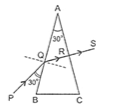
In the diagram, a prism of angle $30^{\circ}$ is used. A ray $PQ$ is incident as shown. An emergent ray $RS$ emerges perpendicular to the second face. The angle of deviation is:
Image
Whenever a hydrogen atom emits a photon in the Balmer series(a) It need not emit any more photon(b) It may emit another photon in the Paschen series(c) It must emit another photon in the Lyman series(d) It may emit another photon in the Balmer series