Question
What does it mean for an object to be positively and negatively charged?

Answer

Compared to the normal state, the lack of electrons in an object shows that it is positively charged and the excess of electrons shows that it is negatively charged.

Need a full question paper?

Generate a complete, print-ready paper with questions like this in minutes — across 16+ boards, with answer keys.

Start Generating Free

Similar questions

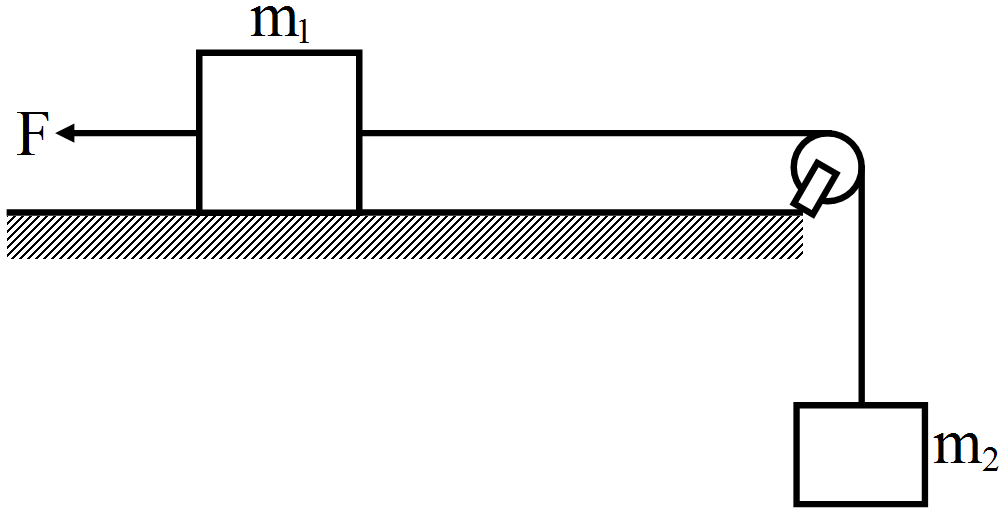
Consider the situation shown in The force F is equal to the $\frac{\text{m}_2\text{g}}{2}$ If the area of cross-section of the string is A and its Young's modulus Y, find the strain developed in it. The string is light and there is no friction anywhere.
Ultraviolet radiations of different frequencies and are incident on two photosensitive materials having work functions $W_1$ and $W_2$ $\left(W_1>W_2\right)$ respectively. The kinetic energy of the emitt3ed electrons is same in both the cases. Which one of the two radiations will be of higher frequency?
A Gaussian surface has change $-q+3 q$ and $-2 q$. Calcualte the resultant electric flux through the surface.
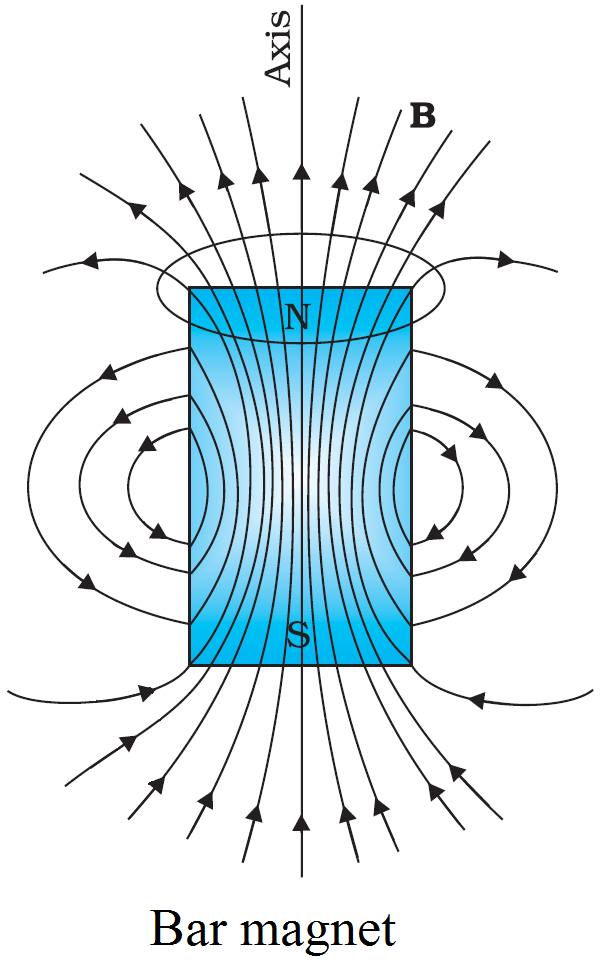
A bar magnet has magnetic moment M. It is divided into n- equal parts. Will each part be a magnetic dipole? What will be the magnetic moment of each part?
An experimenter measures the length of a rod. Initially the experimenter and the rod are at rest with respect to the lab. Consider the following statements:
  1. If the rod starts moving parallel to its length but the observer stays at rest, the measured length will be reduced.
  2. If the rod stays at rest but the observer starts moving parallel to the measured length of the rod, the length will be reduced.
A box is pushed through 4.0m across a floor offering 100N resistance. How much work is done by the resisting force?
How the direction of induced electromotive force is determined?
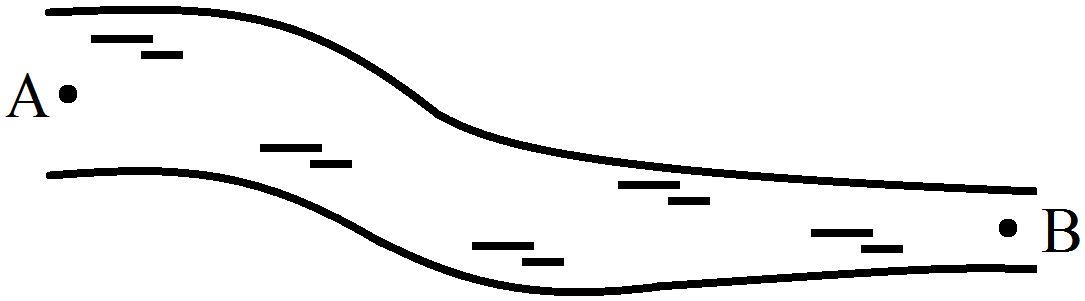
Water flows through a tube shown in The areas of cross-section at A and B are $1cm^2$ and $0.5cm^2$ respectively. The height difference between A and B is 5cm. If the speed of water at A is 10cm/s find.
  1. The speed at B.
  2. The difference in pressures at A and B.
When a semiconducting material is doped with an impurity, new acceptor levels are created. In a particular thermal collision, a valence electron receives an energy equal to 2kT and just reaches one of the acceptor levels. Assuming that the energy of the electron was at the top edge of the valence band and that the temperature T is equal to 300K, find the energy of the acceptor levels above the valence band.
‘Device X’ shown here, converts the input voltage waveform into the output voltage waveform as shown in fig. Name the device X.