Question
What does it mean for an object to be positively and negatively charged?

Answer

Compared to the normal state, the lack of electrons in an object shows that it is positively charged and the excess of electrons shows that it is negatively charged.

Need a full question paper?

Generate a complete, print-ready paper with questions like this in minutes — across 16+ boards, with answer keys.
Start Generating Free

Similar questions

An object having a velocity $4.0\ m/s$ is accelerated at the rate of $1.2\ m/s^2$ for $5.0s.$ Find the distance travelled during the period of acceleration.
An electron, passing through a region is not deflected. Are you sure that there is no magnetic field in that region?
A long solenoid is fabricated by closely winding a wire of radius $0.5\ mm$ over a cylindrical nonmagnetic frame so that the successive turns nearly touch each other. What would be the magnetic field $B$ at the centre of the solenoid if it carries a current of $5A$?
Does a gas have just two specific heat capacities or more than two? Is the number of specific heat capacities of a gas countable?
Write the expression, in a vector form, for the Lorentz magnetic force$\overrightarrow{\text{F}}$ due to a charge moving with velocity $\overrightarrow{\text{V}}$in a magnetic field $\overrightarrow{\text{B}}.$  What is the direction of the magnetic force?
How does the mobility of electrons in a conductor change, if the potential difference applied across the conductor is doubled, keeping the length and temperature of the conductor constant?
Light from a point source falls on a small area placed perpendicular to the incident light. If the area is rotated about the incident light by an angle of 60°, by what fraction will the illuminance change?
Can the peak voltage across the inductor be greater than the peak voltage of the source in an LCR circuit?
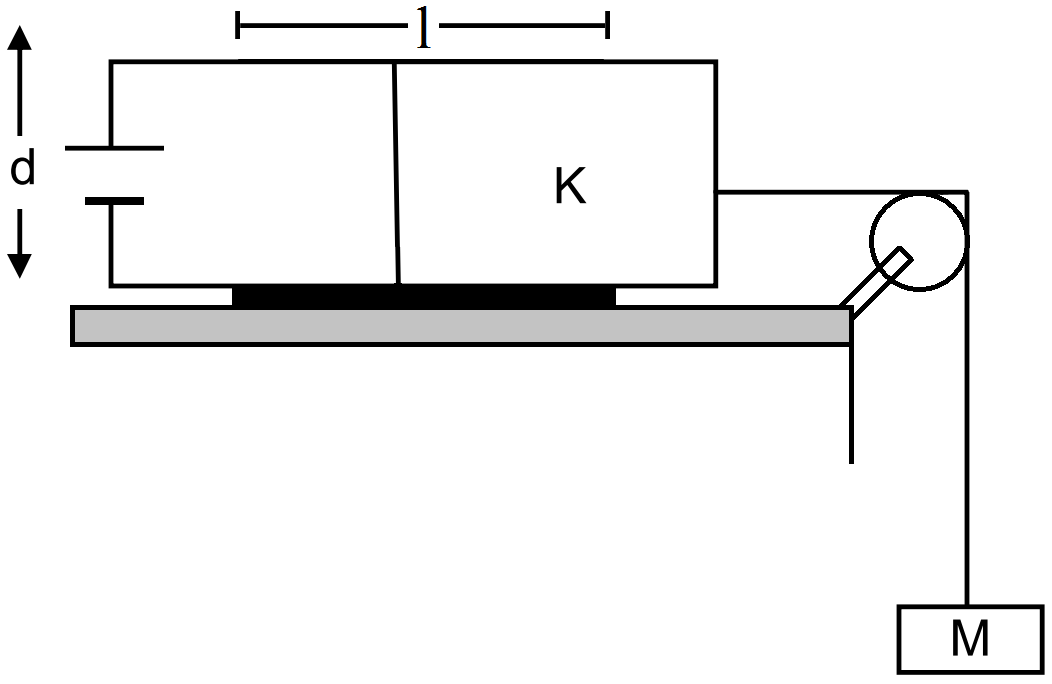
Consider the situation shown in figure. The width of each plate is b. The capacitor plates are rigidly clamped in the laboratory and connected to a battery of emf $\epsilon.$ All surfaces are frictionless. Calculate the value of M for which the dielectric slab will stay in equilibrium.
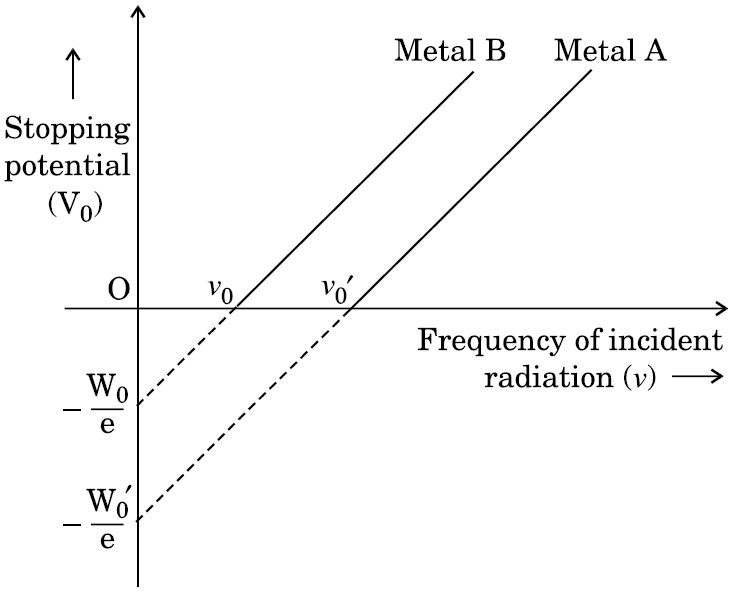
The graph shows the variation of stopping potential with frequency of incident radiation for two photosensitive metals A and B. Which one of the two has higher value of work-function? Justify your answer..