MCQ
What force should be applied on the wedge so that block over it does not move? (All surfaces are smooth)
  • A
    $F=(M+m) g \cot \theta$
  • $F=(M+m) g \tan \theta$
  • C
    $F=(M+m) g \sin \theta$
  • D
    $F=(M+m) g \cos \theta$

Answer

Correct option: B.
$F=(M+m) g \tan \theta$
b
(b)

$a =\left(\frac{ F }{ m + M }\right) \ldots \ldots(1)$

$m a \cos \theta=m g \sin \theta$

$a=g \tan \theta$

Put in $(1)$

$F=(M+m) g \tan \theta$

Need a full question paper?

Generate a complete, print-ready paper with questions like this in minutes — across 16+ boards, with answer keys.
Start Generating Free

Similar questions

The modulus of elasticity is dimensionally equivalent to
A bullet of mass $0.01\, kg$ and travelling at a speed of $500 \,m/s$. strikes a block of  mass $2 \,kg$. which is suspended by a string of length $5\,m$. The centre of gravity of the  block is found to raise a vertical distance of $0.1\,m$. What is the speed of the bullet  after it emerges from the block- ................ $\mathrm{m}/ \mathrm{s}$
A body of mass $m$ hangs at one end of a string of length $l$, the other end of which is fixed. It is given a horizontal velocity so that the string would just reach where it makes an angle of $60^o$ with the vertical. The tension in the string at mean position is
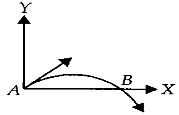
The velocity of projectile at the intial point $A$ is $\left( {2\hat i + 3\hat j} \right)$ $m/s $ . It's velocity (in $m/s$) at point $B$ is
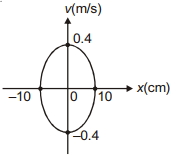
The plot of velocity $(v)$ versus displacement $(x)$ of a particle executing simple harmonic motion is shown in figure. The time period of oscillation of particle is .........
A Carnot engine with sink's temperature at $17\,^oC$ has $50\%$ efficiency. By how much should its source temperature be changed to increases its efficiency to $60\%$ ?...... $K$
Two tuning forks have frequencies $450\, Hz$ and $454\, Hz$ respectively. On sounding these forks together, the time interval between successive maximum intensities will be .... $sec$
In which of the following cases forces may not be required to keep the
In a thermodynamic process pressure of a fixed mass of a gas is changed in such a manner that the gas releases $20 \,J$ of heat when $8 \,J$ of work was done on the gas. If the initial internal energy of the gas was $30 \,J$, then the final internal energy will be ........ $J$
$50\, gm$ of copper is heated to increase its temperature by $10^oC$. If the same quantity of heat is given to $10\; gm$ of water, the rise in its temperature is ........ $^oC$ (Specific heat of copper $= 420 \;Joule-kg^{-1} {°C^{-1}}$)