Question
What functions do the female reproductive system perform?

Answer

The female reproductive system perform the following functions:
  1. It forms the female gamete, i.e., the egg.
  2. It receives the male gamete, i.e., sperm, for fertilisation.
  3. It provides the site for fertilisation.
  4. It provides suitable conditions for the development of foetus.
  5. It produces hormones that control the stages of ovulation and maintain pregnancy.

Need a full question paper?

Generate a complete, print-ready paper with questions like this in minutes — across 16+ boards, with answer keys.
Start Generating Free

Similar questions

  1. What is an age pyramid?
  2. Explain with the help of figures, the three different types of age pyramids represented by human population.
Explain the ovarian and uterine events that occur during a menstrual cycle in a human female, under the influence of Pituitary and Ovarian hormones respectively.
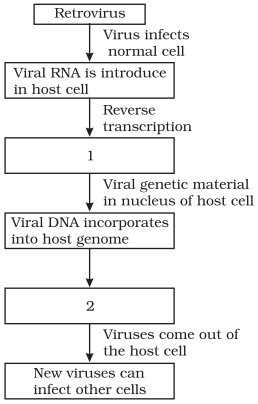
In the given flow diagram, the replication of retrovirus in a host is shown. Observe and answer the following questions,

  1. Fill in (1) and (2).
  2. Why is the virus called retrovirus?
  3. Can the infected cell survive while viruses are being replicated and released?

Write the causes, symptoms and prevention measures of diphtheria.
Describe diagrammatically the male reproductive organs.
  1. In humans, males are heterogametic and females are homogametic. Explain. Are there any examples where males are homogametic and females heterogametic?
  2. Also describe as to, who determines the sex of an unborn child? Mention whether temperature has a role in sex determination.
“Microbes play a dual role when used for sewage treatment as they not only help to retrieve usable water but also generate fuel”. Explain.
Answer the following questions.
Explain the events taking place at the time of fertilisation of an ovum in a human female.
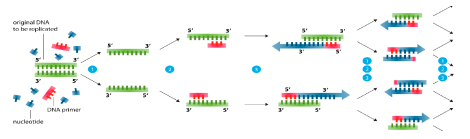
Polymerase chain reaction (PCR) is a laboratory technique used to amplify DNA sequences. The method involves using short DNA sequences called primers to select the portion of the genome to be amplified. The temperature of the sample is repeatedly raised and lowered to help a DNA replication enzyme copy the target DNA sequence. The technique can produce a billion copies of the target sequence in just a few hours.
Image
i. List the three steps involved in Polymerase Chain Reaction (PCR).
ii. Name the source organism of Taq polymerase.
iii. Explain the specific role of this enzyme in PCR.
Explain the difference between prokaryotic and eukaryotic DNA.