MCQ
What happens when a glass rod is rubbed with silk?
- AGains protons from silk.
- BGains electrons from silk.
- CGives electrons to silk.
- DGives protons to silk.
Explanation:
Excess electrons are transferred from glass to silk when a glass rod is rubbed with silk. Hence, the glass rod becomes positive, and silk becomes negative.
Generate a complete, print-ready paper with questions like this in minutes — across 16+ boards, with answer keys.
An image of the sun is formed by a lens of focal length of 30 cm on the metal surface of a photoelectric cell and a photoelectric current I is produced. The lens forming the image is then replaced by another of the same diameter but of focal length 15 cm. The photoelectric current in this case is
|
(a) |
(b) I |
(c) 2I |
(d) 4I |
A nichrome wire 50 cm long and one square millimetre cross-section carries a current of 4A when connected to a 2V battery. The resistivity of nichrome wire in ohm metre is
|
(a) 1 |
(b) 4 |
(c) 3 |
(d) 2 |
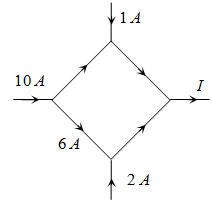
The figure shows a network of currents. The magnitude of currents is shown here. The current I will be
|
(a) 3 A |
(b) 9 A |
(c) 13 A |
(d) 19 A |
An ammeter whose resistance is 180 Ω gives full scale deflection when current is 2 mA. The shunt required to convert it into an ammeter reading 20 mA (in ohms) is
|
(a) 18 |
(b) 20 |
(c) 0.1 |
(d) 10 |
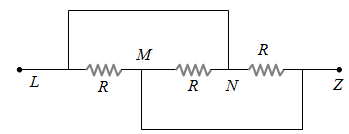
Three equal resistances each of value R are joined as shown in the figure. The equivalent resistance between M and N is
|
(a) R |
(b) 2R |
(c) |
(d) |
A parallel plate capacitor is charged and the charging battery is then disconnected. If the plates of the capacitor are moved further apart by means of insulating handles, then
|
(a) The charge on the capacitor increases |
|
(b) The voltage across the plates decreases |
|
(c) The capacitance increases |
|
(d) The electrostatic energy stored in the capacitor increases |
A heater coil is cut into two equal parts and only one part is now used in the heater. The heat generated will now be
|
(a) One fourth |
(b) Halved |
(c) Doubled |
(d) Four times |


