MCQ
What happens when a glass rod is rubbed with silk?
  • Gains protons from silk.
  • B
    Gains electrons from silk.
  • C
    Gives electrons to silk.
  • D
    Gives protons to silk.

Answer

Correct option: A.
Gains protons from silk.

Excess electrons are transferred from glass to silk when a glass rod is rubbed with silk. Hence, the glass rod becomes positive, and silk becomes negative.

Need a full question paper?

Generate a complete, print-ready paper with questions like this in minutes — across 16+ boards, with answer keys.
Start Generating Free

Similar questions

A sample of radioactive element containing $4 \times 10^{16}$ active nuclei. Half life of element is $10$ days, then number of decayed nuclei after $30$ days is  ........ $\times 10^{16}$ 
If there are $n$ capacitors in parallel connected to $V$ volt source, then the energy stored is equal to
Two resistors $400\, \Omega$ and $800\, \Omega$ are connected in series across a $6 V$ battery. The potential difference measured by a voltmeter of $10\, k \Omega$ across $400\, \Omega$ resistor is close to$....V$
The plates of a capacitor are charged to a potential difference of $320 \, volts$ and are then connected across a resistor. The potential difference across the capacitor decays exponentially with time. After $1 $ second the potential difference between the plates of the capacitor is $240 \, volts$, then after $2$ and $3$ seconds the potential difference between the plates will be
In Young’s double slit experiment, the wavelength of the light used is doubled and distance between two slits is half of initial distance, the resultant fringe width becomes........$  times$
For the propagation of light wave, medium is required. This is according to:
At absolute zero, $Si$ acts as:
A bandwidth of $6\, {MHz}$ is available for $A.M.$ transmission. If the maximum audio signal frequency used for modulating the carrier wave is not to exceed $6 \,{kHz}$. The number of stations that can be broadcasted within this band simultaneously without interfering with each other will be ..... .
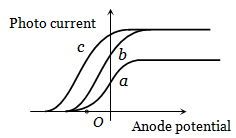
The figure shows the variation of photocurrent with anode potential for a photo-sensitive surface for three different radiations. Let $\mathrm{I}_{\mathrm{a}}, \mathrm{I}_b$ and $\mathrm{I}_{\mathrm{c}}$ be the intensities and $\mathrm{f}_{\mathrm{a}}, \mathrm{f}_{\mathrm{b}}$ and $\mathrm{f}_{\mathrm{c}}$ be the frequencies for the curves a, b and c respectively
 
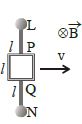
A square frame of metallic wire is moving in a uniform magnetic field $(\vec{B})$ acting perpendicular to the paper inward as shown. $LP$  and  $QN$  are also metallic wires then find the potential difference between $L$ and $N$