Question
What happens when $CO _2$ gas is passed through lime water?

Answer

When carbon dioxide is passed through lime water for a short time, it turns lime water milky due to formation of a white precipitate of calcium carbonate. The reaction is-$\text{Ca(OH)}_2+\text{CO}_2\rightarrow\text{CaCO}_3\downarrow+\text{H}_2\text{O}\\\ \ \ \ \ \ \ \ \ \ \ \ \ \ \ \ \ \ \ \ \ \ \ \ \ \ \ \ \ \ \ \ \ \ \ (\text{white precipate})$
When carbon dioxide gas is passed through lime water for a considerable time ,then the white precipitate of calcium carbonate which is fomed initially as shown in the above reaction ,dissolves due to formation of a soluble salt calcium hydrogen carbonate and the solution becomes clear again. The reaction is-$\text{CaCO}_3\downarrow+\text{H}_2\text{O}+\text{CO}_2\rightarrow\text{Ca(HCO}_3)_2\\\ \ \ \ \ \ \ \ \ \ \ \ \ \ \ \ \ \ \ \ \ \ \ \ \ \ \ \ \ \ \ \ \ \ \ \ \ \ \ \ \ \ \ \ \ \ {(\text{soluble in water)}}$

Need a full question paper?

Generate a complete, print-ready paper with questions like this in minutes — across 16+ boards, with answer keys.
Start Generating Free

Similar questions

Name the compound whose one formula unit is associated with 10 water molecules. How is it prepared? Give equations of related reactions. Give two uses of the compound.
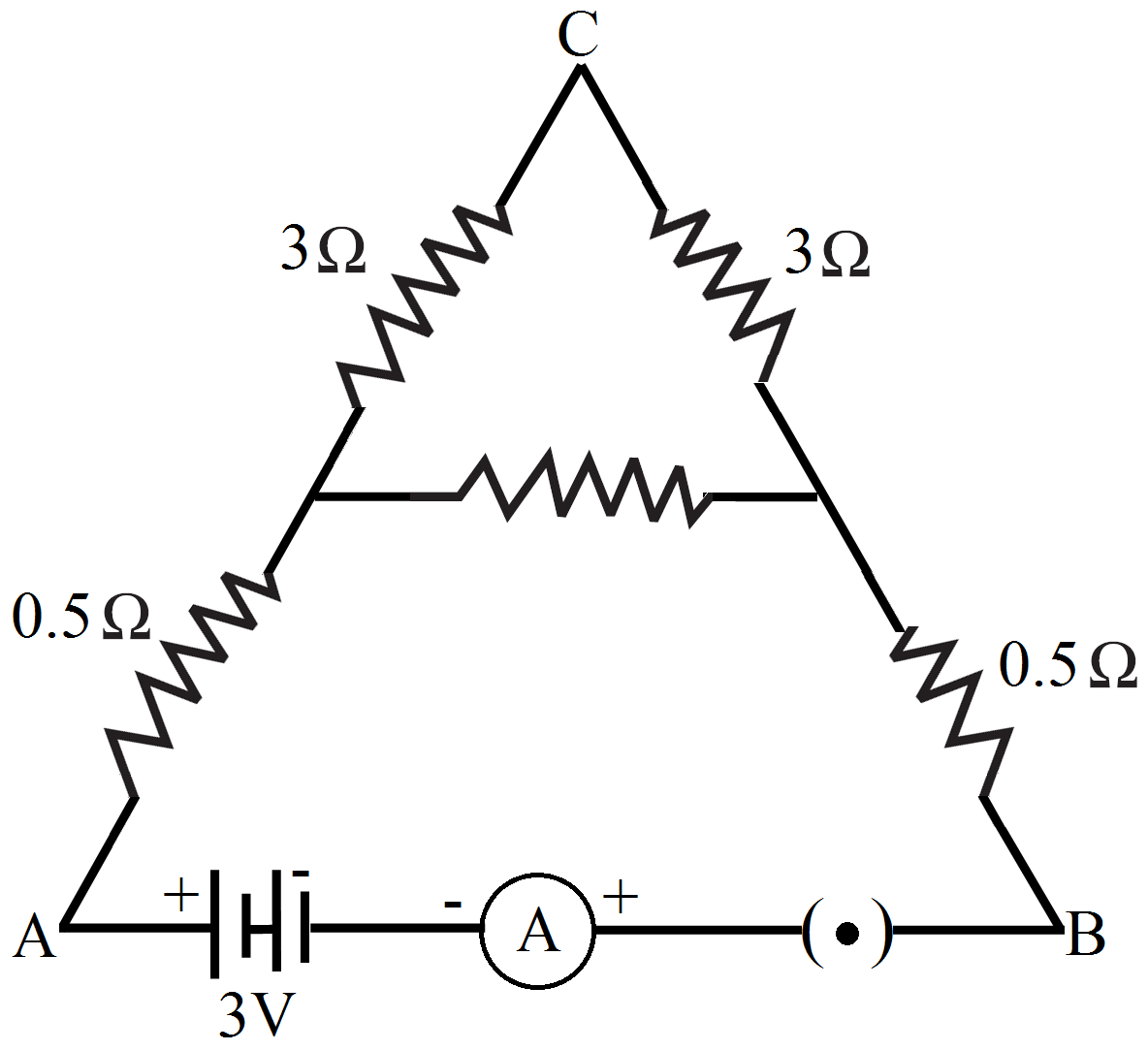
Five resistors are connected in a circuit as shown. Find the ammeter reading when circuit is closed.
A zinc plate was kept in a glass container having $CuSO_4$ solution. On examining it was found that the blue colour of the solution is getting lighter and lighter. After a few days, when the zinc plate was taken out of the solution, a number of small holes were noticed in it. State the reason and give chemical equation of the reaction involved.
What is the difference between a direct current and an alternating current? How many times does AC used in India change direction in one second?
State the difference between Fleming’s Left - Hand Rule and Fleming’s Right-Hand Rule. Name the electrical devices where these rules find an important application.
Define the following in terms of gain or loss of hydrogen with one example:
  1. Oxidation.
  2. Reduction.
  1. Differentiate, between alkanes and alkenes. Name and draw the structure of one member of each.
  2. Alkanes generally give clean flame. Why?
“It is a matter of chance whether a couple will have a male or a female child." Justify this statement by drawing a flow chart.
Here are some results of solutions tested with universal indicator paper:
  1. Sulphuric acid: Red
  2. Metal polish: Dark blue
  3. Washing-up liquid:
  4. Yellow Milk of magnesia:
  5. Light blue Oven cleaner:
  6. Purple Car battery acid: Pink
Arrange the solutions in order of their increasing pH values (starting with the one with the lowest pH).
Define breathing. State the differences between breathing and respiration.