MCQ
What happens when some charge is placed on a soap bubble?
- AIts radius decreases
- BIts radius increases
- CThe bubble collapses
- DNone of these
Explanation:
The radius of soap bublle increases because of outward force acting on the bubble due to charging.
Generate a complete, print-ready paper with questions like this in minutes — across 16+ boards, with answer keys.
In Young's double slit experiment, if the slit widths are in the ratio 1 : 9, then the ratio of the intensity at minima to that at maxima will be
|
(a) 1 |
(b) 1/9 |
(c) 1/4 |
(d) 1/3 |
A double convex lens ( having focal length equal to the focal length of a concave mirror. The radius of curvature of the concave mirror is
|
(a) 10 cm |
(b) 20 cm |
(c) 40 cm |
(d) 15 cm |
Which of the following (referred to a spherical mirror) do (does) not depend on whether the rays are paraxial or not?
Image formed on the retina is
|
(a) Real and inverted |
(b) Virtual and erect |
|
(c) Real and erect |
(d) Virtual and inverted |
A man is suffering from colour blindness for green colour. To remove this defect, he should use goggles of
|
(a) Green colour glasses |
(b) Red colour glasses |
|
(c) Smoky colour glasses |
(d) None of the above |
Kirchoff’s I law and II law of current, proves the
|
(a) Conservation of charge and energy |
|
(b) Conservation of current and energy |
|
(c) Conservation of mass and charge |
|
(d) None of these |
An elastic circular wire of length l carries a current I. It is placed in a uniform magnetic field  (Out of paper) such that its plane is perpendicular to the direction of . The wire will experience
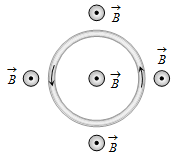
|
(a) No force |
(b) A stretching force |
|
(c) A compressive force |
(d) A torque |
A vertical straight conductor carries a current vertically upwards. A point P lies to the east of it at a small distance and another point Q lies to the west at the same distance. The magnetic field at P is
| (a) Greater than at Q |
| (b) Same as at Q |
| (c) Less than at Q |
| (d) Greater or less than at Q depending upon the strength of the current |
The work function of a substance is 4.0 eV. The longest wavelength of light that can cause photoelectron emission from this substance is approximately
|
(a) 540 nm |
(b) 400 nm |
(c) 310 nm |
(d) 220 nm |