MCQ
What happens when white light passes through a glass prism:
  • A
    Light dispersion and formation of a 7 colors spectrum.
  • B
    Light dispersion and formation of a  6 colors spectrum.
  • C
    Light reflection and a formation of a 6 colors spectrum.
  • D
    Light reflection and a formation of a 7 colors spectrum.
Answer

  1. Light dispersion and formation of a 7 colors spectrum.

Explanation:

Upon passage through the prism, the white light is separated into its component colors - red, orange, yellow, green, blue, indigo and violet.

Need a full question paper?

Generate a complete, print-ready paper with questions like this in minutes — across 16+ boards, with answer keys.

Start Generating Free

Similar questions

If the distance of the far point for a myopia patient is doubled, the focal length of the lens required to cure it will become:
A newly planted sapling usually grows and matures into a tree in more than:
  1. 50 years.
  2. 25 years.
  3. 45 years.
  4. 15 years.
A student very cautiously traces the path of a ray through a glass slab for different values of the angle of incidence refraction$(\angle\text{i}).$ He then measures the corresponding values of the angle of refraction $(\angle\text{r}) $ and the angle of emergence $(\angle\text{e})$ for every value of the angle of incidence. On analysing these measurements of angles, his conclusion would be.
The real image formed by a concave mirror is smaller than the object if the object is:
If the resistance of a certain copper wire is $1 Ω,$ then the resistance of a similar nichrome wire will be about:
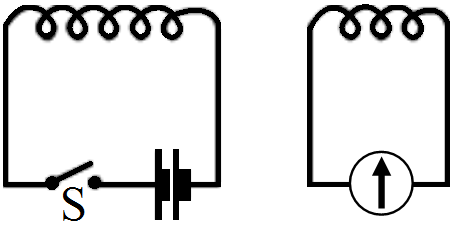
When the switch S is closed in the figure given below, the pointer of the galvanometer moves to the right.

If S is kept closed, will the pointer:
  1. Return to zero?
  2. Stay over on the right?
  3. Move to the left and stay there.
  4. Move to and fro until S is opened.
In your laboratory you trace the path of light rays through a glass slab for different values of angle of incidence ($\angle\text{i}$) and in each case measure the values of the corresponding angle of refraction (​​​​​​$\angle\text{r}$) and angle of emergence ($\angle\text{e}$). On the basis of your observations your correct conclusion is:
In order to obtain a magnification of, -0.75 with a convex lens of focal length 8cm, the object should be placed:
  1. At less than 8cm.
  2. Between 8cm and 16cm.
  3. Beyond 16cm.
  4. At 16cm.
Which of the following statements is incorrect regarding magnetic field lines?
  1. The direction of magnetic field at a point is taken to be the direction in which the north pole a magnetic compass needle points.
  2. Magnetic field lines are closed curves.
  3. If magnetic field lines are parallel and equidistant, they represent zero field strength.
  4. Relative strength of magnetic field is shown by the degree of closeness of the field lines.
In our houses all electrical devices operate on 220V. It implies that: