Question
What happens with $CO _2$ and $O _2$ in plants during daytime?

Answer

Plants utilise Oxygen both during day as well as night for respiration. During the day the plants photosynthesise. In photosynthesis process plants use Carbon dioxide from the atmosphere. Oxygen is a byproduct of photosynthesis. Plants don't need so much oxygen for respiration.
They use some of it and release the remaining which animals use for their respiration. So you can say that plants take in carbon dioxide and give out oxygen during the day. At night plants cannot do photosynthesis because there is no light. But they continue to respire for which they take in oxygen and give out carbon dioxide however Oxygen produced during photosynthesis is much more than that utilised during respiration so over all plants give more Oxygen than they consume.

Need a full question paper?

Generate a complete, print-ready paper with questions like this in minutes — across 16+ boards, with answer keys.
Start Generating Free

Similar questions

What are the by-products of fertiliser industries? How do they affect the environment?
a. Non-metal A which is the largest constituent of air combines with hydrogen on heating in the presence of Fe (as catalyst) and forms a gas.
b. When this gas B is treated with $H _2 SO _4$, compound C is formed which is broadly used as chemical fertiliser.
i. Identify A, B and C.
ii. Locate the position of $A$ in the modern periodic table.
iii. Which elements are present before and after the element $A$ ?
iv. Write the electronic configuration of element A .
The metal M reacts vigorously with water to form a solution S and a gas G. The solution S turns red litmus to blue whereas gas G, which is lighter than air, burns with a pop sound. Metal M has a low melting point and it is used as a coolant in nuclear reactors.
  1. What is metal M?
  2. What is solution S? Is it acidic or alkaline?
  3. What is gas G?
  4. Write a balanced chemical equation for the reaction which takes place when metal M reacts with water.
  5. Is this reaction exothermic or endothermic?
P is a cell (or group of cells) in the human body which is sensitive to a particular type of stimulus and conveys the messages to CNS through nerves Q. On the other hand, R is a part of the human body which can respond to a stimulus according to the instructions sent from the CNS through nerves S.
  1. What is P? Name five organs which contain cells (or group of cells) like P.
  2. Name the nerves Q.
  3. What is R? Give two examples of R.
  4. Name nerves S.
  5. How do messages travel through the nerves Q and S?
How do carbohydrates, fats and proteins get digested in human beings?
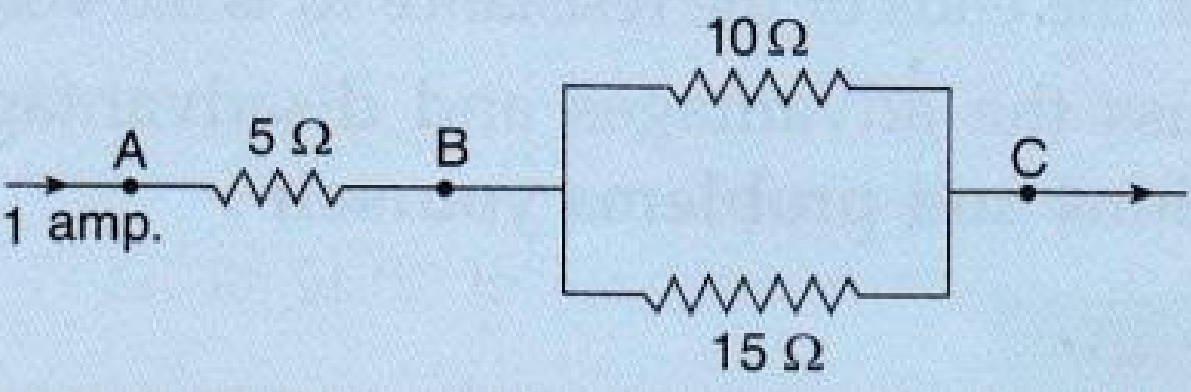
Three resistors are connected as shown in the diagram.

Through the resistor 5 ohm, a current of 1 ampere is flowing,
  1. What is the current through the other two resistors?
  2. What is the p.d. across AB and across AC?
  3. What is the total resistance?

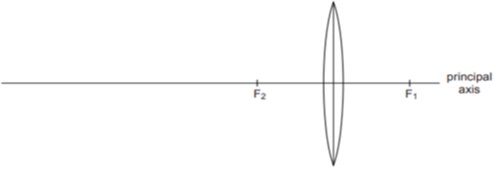
Image
The above image shows a thin lens of focal length $5 m$.
(i) What is the kind of lens shown in the above figure?
(ii) If a real inverted image is to be formed by this lens at a distance of $7 m$ from the pole, then show with calculation where should the object be placed?
(iii) Draw a neatly labelled diagram of the image formation mentioned in (ii)

Give reasons why a woman should avoid frequent pregnancies. Explain the following methods of contraception giving one example of each.
  1. Barrier method.
  2. Chemical method.
When a moist slice of bread was kept aside for a few days then some organism grew on it to form a white cottony mass which later turned black. When this slice of bread was observed through a magnifying glass, then fine thread-like projections and thin stems having bulb-like structures at the top were seen.
  1. What is the common name and scientific name of the organism which grew on the moist slice of bread?
  2. How did this organism grow on the moist slice of bread automatically?
  3. What are the fine, thread-like projections on the surface of slice of bread known as?
  4. What name is given to the knob-like structures and what do they contain?
  5. What is the name of this method of reproduction?
  6. Name one unicellular organism which reproduces by this method.
  7. Name tow non-flowering plants which reproduce by this method.
Gas A, which is the major cause of global warming, combines with hydrogen oxide B in nature in the presence of an environmental factor C and a green material D to form a six carbon organic compounds E and a gas F. The gas F is necessary for breathing.
  1. What is gas A?
  2. What is the common name of B?
  3. What do you think could be C?
  4. What is material D? Where is it found?
  5. Name the organic compound E.
  6. What is gas F? Name the natural process during which it is released.