Maharashtra BoardEnglish MediumSTD 12 ScienceChemistryElectrochemistry4 Marks
Question
What is a cell constant ? What are its units? How is it determined experimentally?
✓
Answer
(A) Cell constant of a conductivity cell is defined as the ratio of the distance between the electrodes divided by the area of cross section of the electrodes.
(B)
$\therefore \text { Cell constant }=b=\frac{l}{a} \quad cm ^{-1}$
In SI units it is expected as $m^{-1}$.
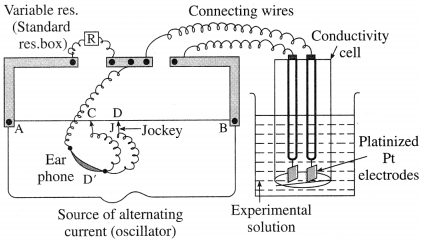
The resistance of an electrolytic solution is measured by using a conductivity cell and Wheatstone
The measurement of molar conductivity of a solution involves two steps as follows:
Step I : Determination of cell constant of the conductivity cell :
KCl solution $\left(0.01 M\right.$ ) whose conductivity is accurately known ( $K =0.00141 \Omega^{-1} cm^{-1}$ ) is taken in a beaker and the conductivity cell is dipped. The two electrodes of the cell are connected to one arm while the variable known resistance $(R)$ is placed in another arm of Wheatstone bridge.
A current detector $D^{\prime}$ which is a head phone or a magic eye is used. J is the sliding jockey (contact) that slides on the arm $A B$ which is a wire of uniform cross section. A source of A.C. power (alternating power) is used to avoid electrolysis of the solution.
By sliding the jockey on wire $A B$, a balance point (null point) is obtained at $C$. Let $A C$ and $B C$ be the lengths of wire.
If $R _{\text {solution }}$ is the resistance of KCl solution and $R _{ x }$ is the known resistance then by Wheatstone's bridge principle,
$\frac{R_{\text {soluthan }}}{B C}=\frac{R_z}{A C} \\
\therefore R_{\text {solution }}=B C \times \frac{R_x}{A C}$
Then the cell constant ' $b$ ' of the conductivity cell is obtained $b y, b=K_{ cl } \times R_{\text {solution }}$.
Step II : Determination of conductivity of the given solution:
KCl solution is replaced by the given electrolytic solution and its resistance $\left(R_s\right)$ is measured by Wheatstone bridge method by similar manner by obtaining a null point at $D$.
The conductivity ( K ) of the given solution is,
$K=\frac{\text { cell constant }}{R_s}=\frac{b}{R_s}$
Step III: Calculation of molar conductivity:
The molar conductivity $\left(\Lambda_m\right)$ is given by,
$\wedge_m=\frac{\kappa}{C}\left(\text { or } \wedge_m=\frac{1000 \times \kappa}{C}\right)$
Since the concentration of the solution is known, $\wedge_m$ can be calculated.
Need a full question paper?
Generate a complete, print-ready paper with questions like this in minutes — across 16+ boards, with answer keys.