Question
What is a moving coil galvanometer? Write its working by drawing its diagram and its principle. Prove that current in it is proportional to the produced deflection.###What is a galvanometer? Explain construction, working and principle of a moving coil galvanometer.
Answer

SELF

Need a full question paper?

Generate a complete, print-ready paper with questions like this in minutes — across 16+ boards, with answer keys.

Start Generating Free

Similar questions

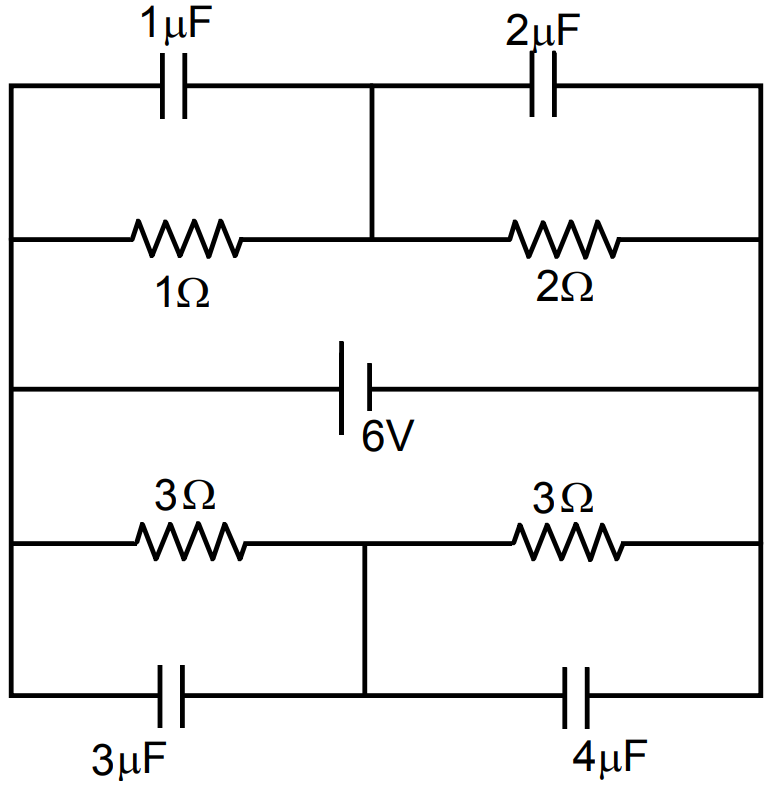
Find the charges on the four capacitors of capacitances $1\mu\text{F},2\mu\text{F},3\mu\text{F}$ and $4\mu\text{F}$ shown in the figure.
A heavy ball is suspended from the ceiling of a motor car through a light string. A transverse pulse travels at a speed of 60cm/s on the string when the car is at rest and 62cm/s when the car accelerates on a horizontal road. Find the acceleration of the car. Take $g = 10m/s^2.$
A capacitor of capacitance $12.0\mu\text{F}$ is connected to a battery of emf 6.00V and internal resistance $1.00\Omega$ through resistanceless leads. $12.0\mu\text{s}$ after the connections are made, what will be (a) the current in the circuit (b) the power delivered by the battery (c) the power dissipated in heat and (d) the rate at which the energy stored in the capacitor is increasing.
  1. With the help of a diagram, explain the principle and working of a moving coil galvanometer.
  2. What is the importance of a radial magnetic field and how is it produced?
  3. Why is it that while using a moving coil galvanometer as a voltmeter a high resistance in series is required whereas in an ammeter a shunt is used?
  1. With the help of a labelled diagram, explain the working of a step-up transformer. Give reasons to explain the following:
  1. The core of the transformer is laminated.
  2. Thick copper wire is used in windings.
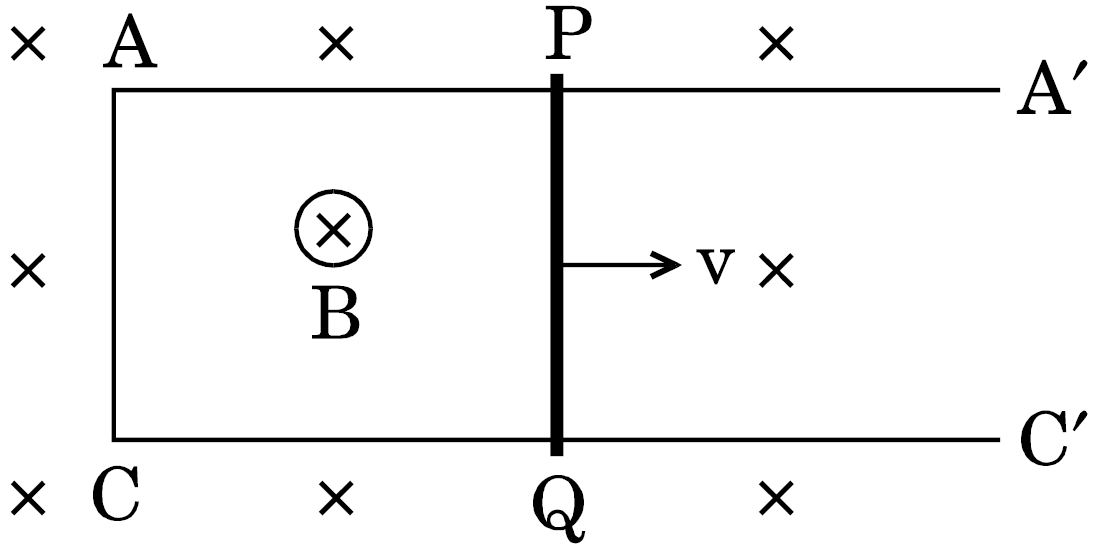
  1. A conducting rod PQ of length 20cm and resistance $0.1\Omega$ rests on two smooth parallel rails of negligible resistance AA' and CC'. It can slide on the rails and the arrangement is positioned between the poles of a permanent magnet producing uniform magnetic field B = 0.4T. The rails, the rod and the magnetic field are in three mutually perpendicular directions as shown in the figure. If the ends A and C of the rails are short circuited,
Find:
  1. External force required to move the rod with uniform velocity v = 10cm/ s,
  2. Power required to do so.
  1. Draw a schematic sketch of a cyclotron. Explain clearly the role of crossed electric and magnetic field in accelerating the charge. Hence derive the expression for the kinetic energy acquired by the particles.
  2. An α–particle and a proton are released from the centre of the cyclotron and made to accelerate.
    1. Can both be accelerated at the same cyclotron frequency? Give reason to justify your answer.
    2. When they are accelerated in turn, which of the two will have higher velocity at the exit slit of the dees?
Repeat the previous problem if the particle C is displaced through a distance x along the line AB.
  1. Draw a circuit diagram to study the input and output characteristics of an n-p-n transistor in its common emitter configuration. Draw the typical input and output characteristics.
  2. Explain, with the help of a circuit diagram, the working of n-p-n transistor as a common emitter amplifier.
A uniform magnetic field B exist in a region. An electron projected perpendicular to the field goes in a circle. Assuming Bohr's quantization rule for angular momentum, calculate (a) the smallest possible radius of the electron (b) the radius of the nth orbit and (c) the minimum possible speed of the electron.
An electron gun with its collector at a potential of 100 V fires out electrons in a spherical bulb containing hydrogen gas at low pressure $(\sim 10^{–2}$ mm of Hg$)$. A magnetic field of $2.83 \times 10^{–4}$ T curves the path of the electrons in a circular orbit of radius 12.0 cm. (The path can be viewed because the gas ions in the path focus the beam by attracting electrons, and emitting light by electron capture; this method is known as the ‘fine beam tube’ method.) Determine e/m from the data.