Question
What is a moving coil galvanometer? Write its working by drawing its diagram and its principle. Prove that current in it is proportional to the produced deflection.###What is a galvanometer? Explain construction, working and principle of a moving coil galvanometer.
Answer

SELF

Need a full question paper?

Generate a complete, print-ready paper with questions like this in minutes — across 16+ boards, with answer keys.

Start Generating Free

Similar questions

Verify the Gauss’s law for magnetic field of a point dipole of dipole moment m at the origin for the surface which is a sphere of radius R.
A point object is placed at a distance of 15cm from a convex lens. The image is formed on the other side at a distance of 30cm from the lens. When a concave lens is placed in contact with the convex lens, the image shifts away further by 30cm. Calculate the focal lengths of the two lenses.
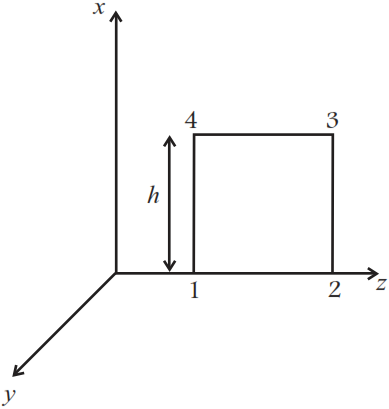
A plane EM wave travelling in vacuum along z direction is given by $\text{E}=\text{E}_0\sin(\text{kz}-\omega\text{t})\hat{\text{i}}\text{ and }\text{B}=\text{B}_0\sin(\text{kz}-\omega\text{t})\hat{\text{j}}$.
  1. Evaluate $\oint\text{E.dl}$ over the rectangular loop 1234 shown in Fig.
  2. Evaluate $\int\text{B.ds}$ over the surface bounded by loop 1234.
  3. Use equation $\oint\text{E.dl}=\frac{-\text{d}\phi_\text{B}}{\text{dt}}$ to prove $\frac{\text{E}_0}{\text{B}_0}=\text{c}$.
  4. By using similar process and the equation $\oint\text{B.dl}=\mu_0\text{I}+\in_0\frac{\text{d}\phi_\text{E}}{\text{dt}}$, prove that $\text{c}=\frac{1}{\sqrt{\mu_0\in_0}}$.
​​​​​​​
One end of a 10cm long silk thread is fixed to a large vertical surface of a charged nonconducting plate and the other end is fastened to a small ball having a mass of 10g and a charge of 4.0 × 10⁻⁵C. In equilibrium, the thread makes an angle of 60° with the vertical. Find the surface charge density on the plate.
Two identical balls, each having a charge of 2.00 × 10-7C and a mass of 100g, are suspended from a common point by two insulating strings each 50cm long. The balls are held at a separation 5.0cm apart and then released. Find,
  1. The electric force on one of the charged balls.
  2. The components of the resultant force on it along and perpendicular to the string.
  3. The tension in the string.
  4. The acceleration of one of the balls. Answers are to be obtained only for the instant just after the release.
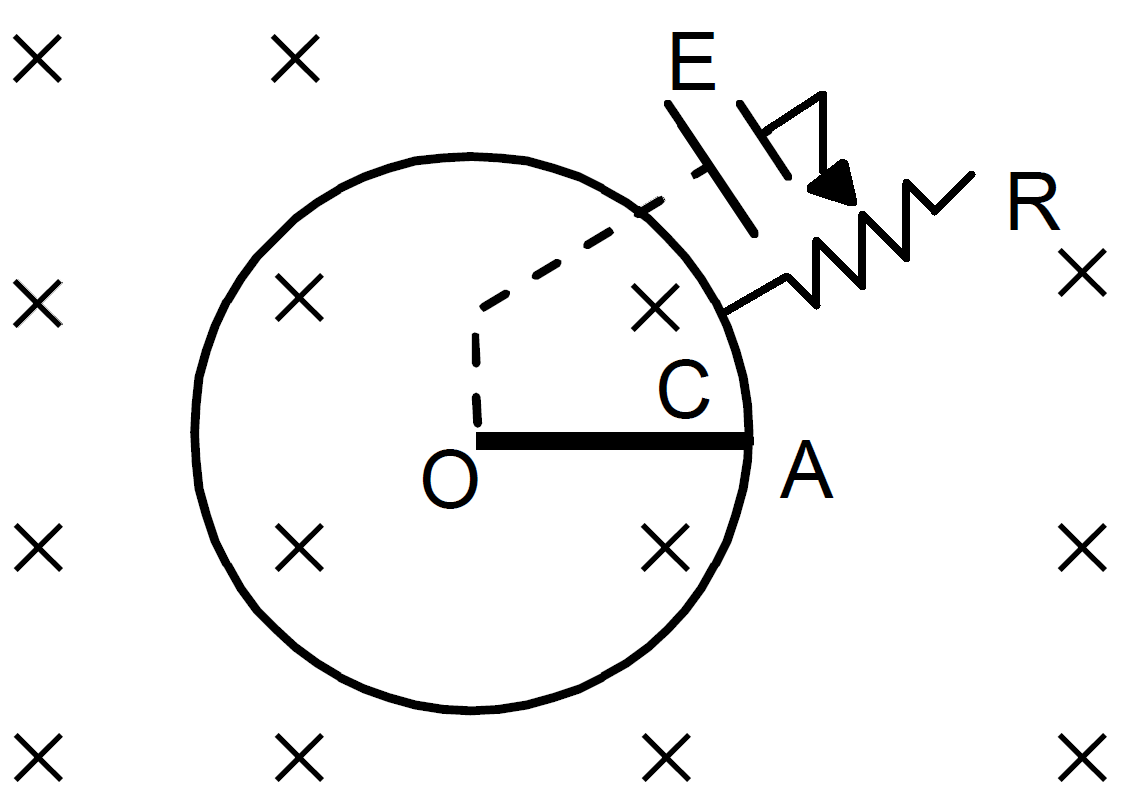
Figure shows a situation similar to the previous problem. All parameters are the same except that a battery of emf $\in$ and a variable resistance R are connected between O and C. The connecting wires have zero resistance. No external force is applied on the rod (except gravity, forces by the magnetic field and by the pivot). In what way should the resistance R be changed so that the rod may rotate with uniform angular velocity in the clockwise direction? Express your answer in terms of the given quantities and the angle $\theta$ made by the rod OA with the horizontal.

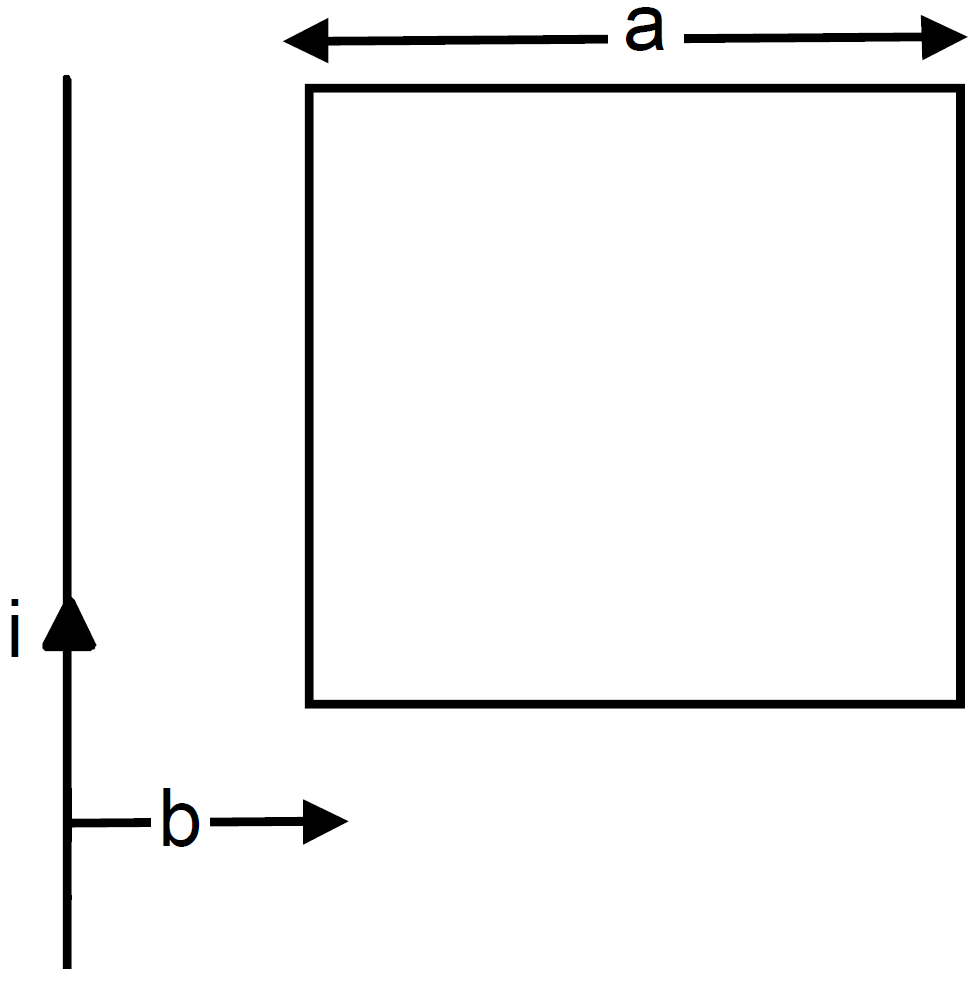
Find the mutual inductance between the straight wire and the square loop of figure.

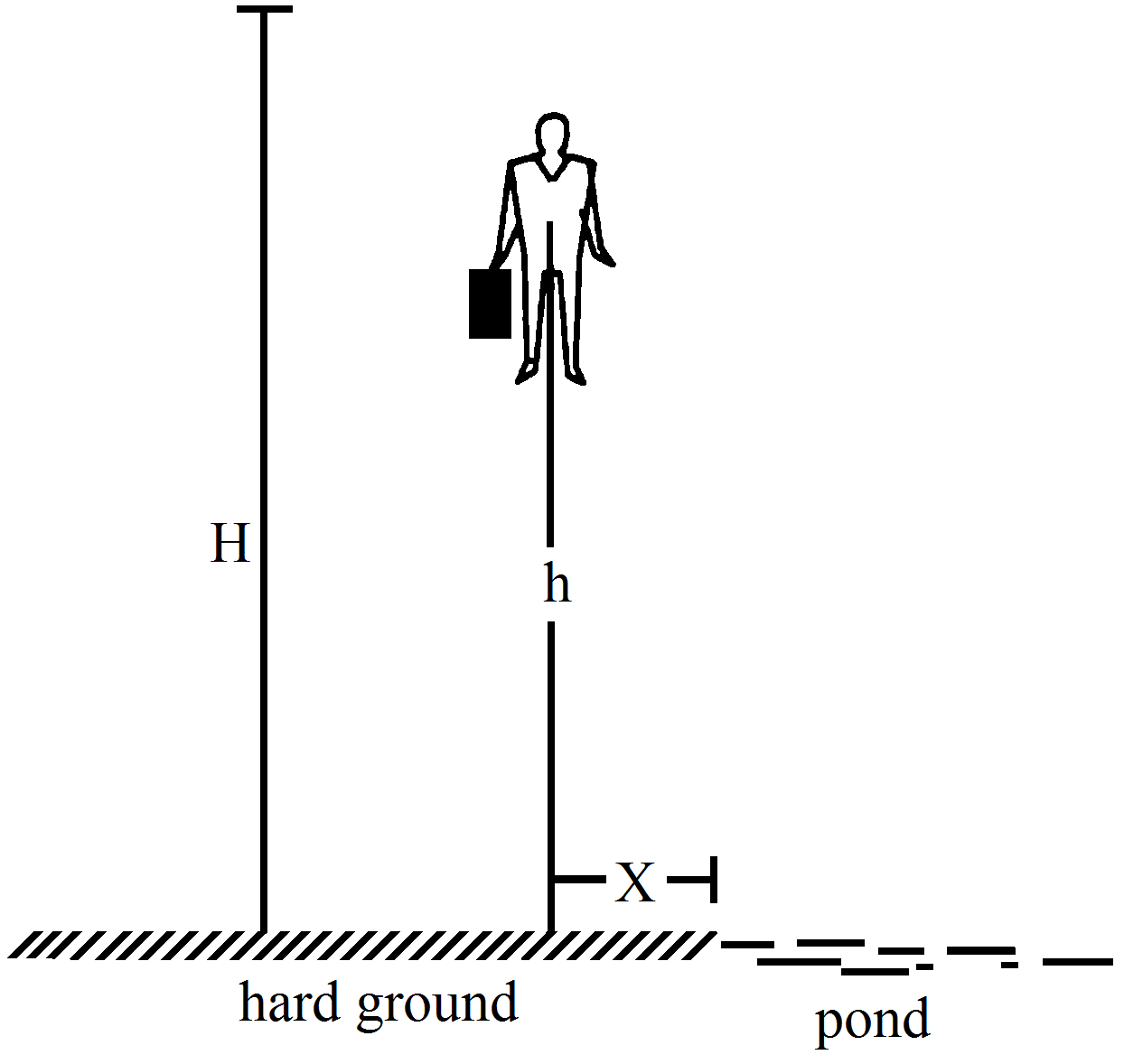
A man of mass M having a bag of mass m slips from the roof of a tall building of height H and starts falling vertically. When at a height h from the ground, he notices that the ground below him is pretty hard, but there is a pond at a horizontal distance x from the line of fall. In order to save himself he throws the bag horizontally (with respect to himself) in the direction opposite to the pond. Calculate the minimum horizontal velocity imparted to the bag so that the man lands in the water. If the man just succeeds to avoid the hard ground, where will the bag land?

An electron of kinetic energy 100eV circulates in a path of radius 10cm in a magnetic field. Find the magnetic field and the number of revolutions per second made by the electron.
Check that the ratio ke2/G memp is dimensionless. Look up a Table of Physical Constants and determine the value of this ratio. What does the ratio signify?