Question
What is a salt bridge ?

Answer

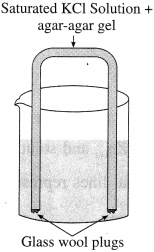
A salt bridge is a U -shaped glass tube containing a saturated solution of a strong electrolyte, like $KCl , NH _4 NO _3$, $Na _2 SO _4$ in a solidified agar-agar gel.
A hot saturated solution of these electrolytes in $5 \%$ agar solution is filled in the U-shaped tube and allowed it to cool and solidify forming a gel.

Image

It is used to connect two half cells or electrodes forming a galvanic or voltaic cell.

Need a full question paper?

Generate a complete, print-ready paper with questions like this in minutes — across 16+ boards, with answer keys.
Start Generating Free

Similar questions

Anhydrous sodium sulphate dissolves in water with the evolution of heat. What is the effect of temperature on its solubility ?
Consider the reaction $2 A + B \rightarrow 2 C$. Suppose that at a particular moment during the reaction, rate of disappearance of $A$ is $0.076 M / s$,
(a) What is the rate of formation of $C$ ?
(b) What is the rate of consumption of B?
(c) What is the rate of the reaction?
Why naphthalene dissolves in benzene but not in water ?
What is the enthalpy of atomization? Give an example.
What is effective atomic number $(EAN)?$
Calculate EAN of cobalt $( Z =27)$ in $\left[ CO \left( NH _3\right)_6\right]^{+3}$ and of zinc $( Z =30)$ in $\left[ Zn \left( NH _3\right)_4\right] SO _4$.
Why phenol is more acidic than ethyl alcohol ?
Explain hydroboration-oxidation of alkene.
Distinguish between ethylamine, diethylamine and triethylamine by using Hinsberg’s reagent?
Write the name and formulae of the monomers used for the preparation of dacron.
Calculate the standard enthalpy of the reaction, $2 C _{\text {(graphite) }}+3 H _{2( g )} \longrightarrow C _2 H _{6( g )} \quad ; \Delta H^0=$ ? from the following $\Delta H^0$ values:
(a) $C _2 H _{6( g )}+\frac{7}{2} O _{2( g )} \longrightarrow 2 CO _{2( g )}+3 H _2 O _{(l)} \quad ; \Delta H^0=-1560 kJ$
(b) $H _{2( g )}+\frac{1}{2} O _{2( g )} \longrightarrow H _2 O _{( l )}$$\text { ; } \Delta H^0=-285.8 kJ$
(c) $C _{\text {(graphite) }}+ O _{2( g )} \longrightarrow CO _{2( g )} \quad ; \Delta H^0=-393.5 kJ$