Question
What is a thermometer? What things should be kept in mind while designing a thermometer? Explain to them.
Answer

SELF

Need a full question paper?

Generate a complete, print-ready paper with questions like this in minutes — across 16+ boards, with answer keys.

Start Generating Free

Similar questions

A cylindrical vessel filled with water upto a height of 2m stands on a horizontal plane. The side wall of the vessel has a plugged circular hole touching the bottom. Find the minimum diameter of the hole so that the vessel begin to move on the floor, if the plug is removed. The coefficient of friction between the bottom of the vessel and the plane is 0.4 and total mass of water plus vessel is 100kg.
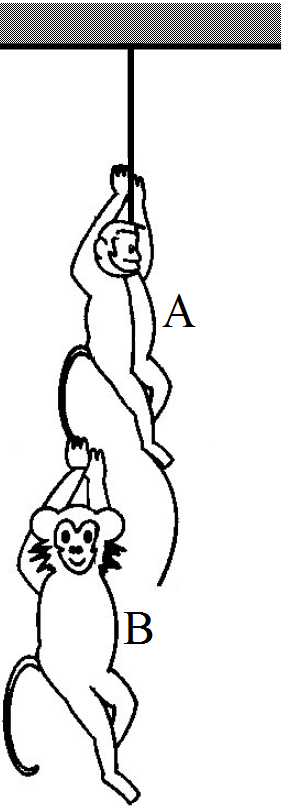
The monkey B shown in figure is holding on to the tail of the monkey A which is climbing up a rope. The masses of the monkeys A and B are 5kg and 2kg respectively. If A can tolerate a tension of 30N in its tail, what force should it apply on the rope in order to carry the monkey B with it? Take $g = 10m/s^2$​​​​​​​
What do you mean by the term "equilibrium"? What are equilibrium of rest and equilibrium of motion? State the conditions for complete equilibrium of a body.
A sphere of a radius 10cm weighs 1kg, calculate the moment of inertia.
  1. About the diameter.
  2. About the tangent.
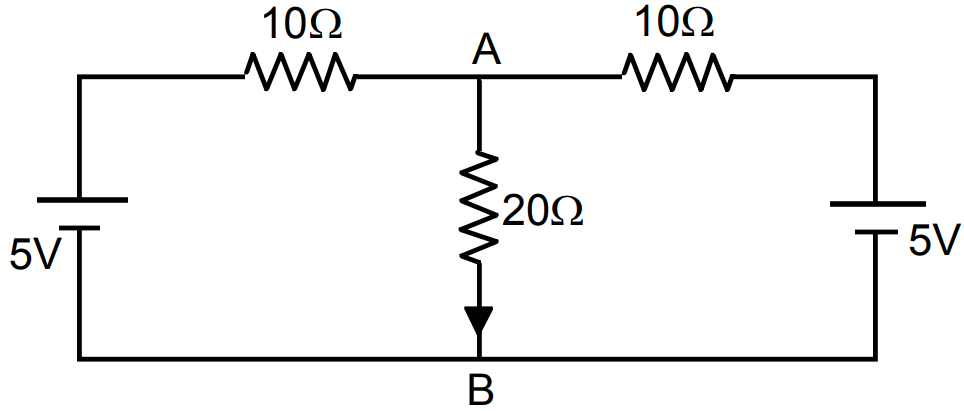
(a) Find the current in the $20\Omega$ resistor shown in the figure. (b) If a capacitor of capacitance $4\mu\text{F}$ is joined between the points A and B, what would be the electrostatic energy stored in it in steady state?
An empty plastic box of mass m is found to accelerate up at the rate of $\frac{\text{g}}{6}$ when placed deep inside water. How much sand should be put inside the box so that it may accelerate down at the rate of $\frac{\text{g}}{6}?$
From a certain apparatus, the diffusion rate of hydrogen has an average value of $28.7 \mathrm{~cm}^3 \mathrm{~s}^{-1}$. The diffusion of another gas under the same conditions is measured to have an average rate of $7.2 \mathrm{~cm}^3 \mathrm{~s}^{-1}$. Identify the gas. [Hint: Use Graham's law of diffusion $\frac{\mathrm{R}_1}{\mathrm{R}_2}=\left(\frac{\mathrm{M}_2}{\mathrm{M}_1}\right)^{\frac{1}{2}}$, where $\mathrm{R}_1, \mathrm{R}_2$ are diffusion rates of gases 1 and 2 , and $\mathrm{M}_1$ and $\mathrm{M}_2$ their respective molecular masses. The law is a simple consequence of kinetic theory]
Estimate the mean free path and collision frequency of a nitrogen molecule in a cylinder containing nitrogen at 2.0 atm and temperature 17°C. Take the radius of a nitrogen molecule to be roughly $1.0\mathring{\text{A}}$ Compare the collision time with the time the molecule moves freely between two successive collisions (Molecular mass of $N^2 = 28.0u$).
In a series RC circuit with an AC source, $\text{R}=300\Omega,\text{C}=25\mu\text{F},\in_0=50\text{V}$ and $\nu=\frac{50}{\pi}\text{Hz}.$ Find the peak current and the average power dissipated in the circuit.
Briefly explain how you will estimate the molecular diameter of oleic acid.