Gujarat BoardEnglish MediumSTD 11 ScienceBIOLOGYMorphology of Flowering Plants5 Marks
Question
What is a tissue? Describe different types of simple tissues in plants.
✓
Answer
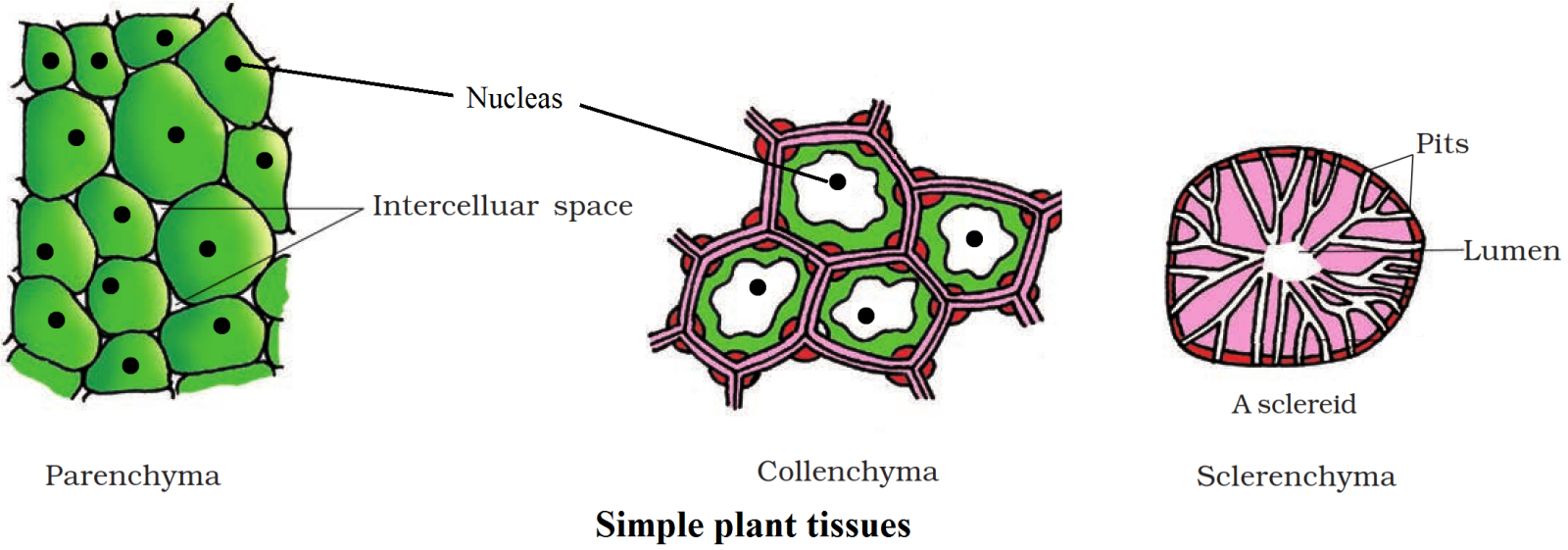
A tissue is a group of cells having a common origin and usually performing a common function. Simple Tissues: A simple tissue is made of only one type of cells. Simple tissues are of following types:
Parenchyma: Parenchyma forms the major component within organs. The cells of the parenchyma are generally isodiametric. They may be spherical, oval, round, polygonal or elongated in shape. Their walls are thin and made up of cellulose. They may either be closely packed or have small intercellular spaces.
Function: The parenchyma performs various functions like photosynthesis, storage, secretion.
Collenchyma: The collenchyma occurs in layers below the epidermis in dicotyledonous plants. It is found either as a homogeneous layer or in patches. It consists of cells which are much thickened at the corners due to a deposition of cellulose, hemicellulose and pectin. Collenchymatous cells may be oval, spherical or polygonal and often contain chloroplasts. These cells assimilate food when they contain chloroplasts. Intercellular spaces are absent.
Function: They provide mechanical support to the growing parts of the plant such as young stem and petiole of a leaf.
Sclerenchyma: Sclerenchyma consists of long, narrow cells with thick and lignified cell walls having a few or numerous pits. They are usually dead and without protoplasts. On the basis of variation in form, structure, origin and development, sclerenchyma may be either fibres or sclereids. The fibres are thick-walled, elongated and pointed cells, generally occuring in groups, in various parts of the plant. The sclereids are spherical, oval or cylindrical, highly thickened dead cells with very narrow cavities (lumen). These are commonly found in the fruit walls of nuts; pulp of fruits like guava, pear and sapota; seed coats of legumes and leaves of tea.
Function: Sclerenchyma provides mechanical support to organs.
Need a full question paper?
Generate a complete, print-ready paper with questions like this in minutes — across 16+ boards, with answer keys.