Question
What is abnormal molar mass? Explain.

Answer

self

Need a full question paper?

Generate a complete, print-ready paper with questions like this in minutes — across 16+ boards, with answer keys.
Start Generating Free

Similar questions

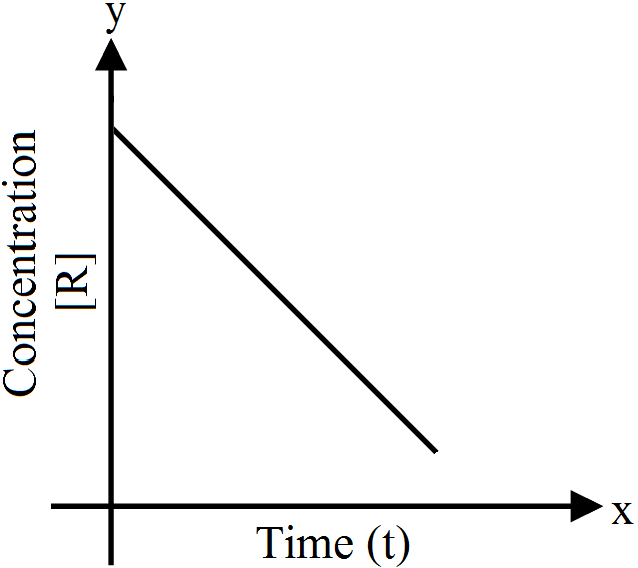
Consider the reaction $\text{R}\xrightarrow{\ \ \text{k}\ \ } \text{P}.$ The change in concentration of $R$ with time is shown in the following plot:
  1. Predict the order of the reaction.
  2. Derive the expression for the time required for the completion of the reaction.
  3. What does the slope of the above line indicate?
Explain the properties of vitamins and also classify them.
Answer the following questions: Describe the preparation of potassium permanganate from pyrolusite ore. Write balanced chemical equation for one reaction to show the oxidizing nature of potassium permanganate.
A first order reaction takes 30 min for 50% completion, what would be time for its 90% completion.
On the basis of crystal theory, octahedral in the presence of strong field ligand and weak field ligand. Explain the difference in crystal field splitting.
The following results have been obtained during the kinetic studies of the reaction :
$2 A+ B \rightarrow C + D$
Experiment$[ A ] / mol L ^{-1}$$[ B ] / mol L ^{-1}$Initial rate of formation of D $/ mol L ^{-1} min^{-1}$
I0.10.1$6.0 \times 10^{-3}$
II0.30.2$7.2 \times 10^{-2}$
III0.30.4$2.88 \times 10^{-1}$
IV0.40.1$2.40 \times 10^{-2}$
Determine the rate law and the rate constant for the reaction.
  1. Account for the following:
    1. Mn shows the highest oxidation state of $+7$ with oxygen but with fluorine it shows the highest oxidation state of $+4.$
    2. $Cr^{2+}$ is a strong reducing agent.
    3. $Cu^{2+}$ salts are coloured while $Zn^{2+}$ salts are white.
  2. Complete the following equations:
    1. $2\text{MnO}_{2} + 4\text{KOH} + \text{O}_{2} \xrightarrow{\Delta}$
    2. $\text{Cr}_{2}\text{O}^{2-}_{7}+ 14\text{H}^{+} + 6\text{I}^{-}\rightarrow.$
(a) What type of protein is present in keratin?
(b) Write the reactions showing the presence of following in the open structure of glucose:
   i. an aldehyde group
  ii. a primary alcohol
(c) What products would be formed when a nucleotide from DNA containing thymine is hydrolysed?
(d) Amino acids show amphoteric behaviour. Why?
(e) What are a Amino Acids? Give examples.
(f) a. How can you explain the absence of an aldehyde group in the pentaacetate of D-glucose?
    b. Name the bases present in RNA. Which one of these is not present in DNA?
(g) Which monosaccharide units are present in starch, cellulose and glycogen and which linkages link these units?
What happens when :
(a) Ethene is passed into concentrated $H _2 SO _4$ and the product boiled with water.
(b) Ethyl ethanoate is boiled with KOH aq.
(c) Methyl magnesium iodide is heated with methanol.
(d) Acetaldehyde is heated with Tollen's reagent.
(e) Alkaline solution of phenol is heated with $CO _2$ under high pressure and then the product is acid hydrolysed.
Explain on the basis of valence bond theory that $\left[ Ni ( CN )_4\right]^{2-}$ ion with square planar structure is diamagnetic and the $\left[ NiCl _4\right]^{2-}$ ion with tetrahedral geometry is paramagnetic.