Question
What is activation energy? Explain with the help of graph by suitable example

Answer

$\rightarrow$ Activation energy can be understood clearly using the formation reaction of hydrogen iodide.
$\ce{\rightarrow H2(g) + I2(g) \rightarrow 2HI(g)}$
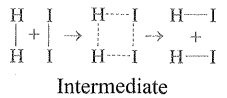
$\rightarrow$ According to Arrhenius, this reaction can take place only when a molecule hydrogen and molecule of iodine collide to form an unstable intermediate. It exists for a very short time and then breaks up to form two molecules of hydrogen iodide.
Image
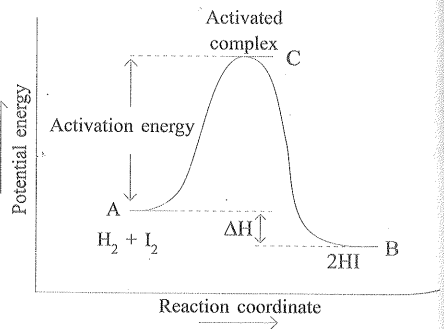
$\rightarrow$ The energy required to form this intermediate, called activated complex $(C),$ is known as activation energy $(E_a).$
$\rightarrow$ Below figure is obtained by plotting potential energy $VS$ reaction coordinate.
Reaction coordinate represents the profile of energy change when reactant change into products.
Image
$\rightarrow$ Some energy is released when the complex decomposes to form products.
So, the final enthalpy of the reaction depends upon the nature of reactants and products.

Need a full question paper?

Generate a complete, print-ready paper with questions like this in minutes — across 16+ boards, with answer keys.
Start Generating Free

Similar questions

Give the structures and IUPAC names of the products expected from the following reactions:
a. Catalytic reduction of butanol.
b. Hydration of propene in the presence of dilute sulphuric acid.
c. Reaction of propanone with methyl magnesium bromide followed by hydrolysis.
How would you account for the following:
  1. Among lanthanoids, $\ce{Ln} \ (III)$ compounds are predominant. However, occasionally in solutions or in solid compounds,$\ +2 $ and $ \ +4$ ions are also obtained.
  2. The $\ce{E^o_{M^{2+}/M}}$ for copper is positive $(0.34V)$. Copper is the only metal in the first series of transition elements showing this behaviour.
  3. The metallic radii of the third $(5d)$ series of transition metals are nearly the same as those of the corresponding members of the second series.
[Fe(CN)6]4- and [Fe(H2O)6]2+ are of different colours in dilute solutions. Why?
Give reasons:
  1. $E^\circ$ value for $\ce{Mn^{3+}/ Mn^{2+}}$ couple is much more positive than that for $ \ce{Fe^{3+}/ Fe^{2+}}.$
  2. Iron has higher enthalpy of atomization than that of copper.
  3. $\ce{Sc^{3+}}$ is colourless in aqueous solution whereas $\ce{Ti^{3+}}$ is coloured.
Note on: Cyclic structure of glucose.
A solution Ni(NO3)2 is electrolysed between platinum electrodes a current of 5 amperes for 20 minutes. What mass of Ni is deposited at the cathode?
Give the mechanism for the formation of ethanol from ethene.
$E_{\text {cell }}^0$ for the given redox reaction is 2.71 V
$Mg _{( s )}+ Cu _{(0.01 M )}^{2+} \longrightarrow \stackrel{2++ Cu _{( s )}}{ Mg _{(0.001 M )}^{2+}}$
Calculate $E_{\text {cell }}$ for the reaction. Write the direction of flow of current when an external opposite potential applied is
(i) less than 2.71 V and (ii) greater than 2.71 V .
The emf of a cell corresponding to the reaction.
$\text{Zn(s)}+2\text{H}^+(\text{aq})\xrightarrow{ \ \ \ \ \ }\text{Zn}^{2+}(0.1\text{M})+\text{H}_2(\text{g 1 atm} )$ is 0.28 volt at 25°C.
Write the half-cell reactions and calculate the pH of the solution at the hydrogen electrode.
$\text{E}^{\circ}_{\text{Zn}^{2+}/\text{Zn}}=-0.76\text{V},\text{E}^{\circ}_{\text{H}^+/\text{H}_2}=0\text{V}$
Write chemical reaction to affect the following transformation.
(ii) Acetone to propane