Question
What is activation energy? Explain with the help of graph by suitable example

Answer

→ Activation energy can be understood clearly using the formation reaction of hydrogen iodide.
→ H2(g) + I2(g) → 2HI(g)
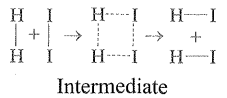
→ According to Arrhenius, this reaction can take place only when a molecule hydrogen and molecule of iodine collide to form an unstable intermediate. It exists for a very short time and then breaks up to form two molecules of hydrogen iodide.
Image
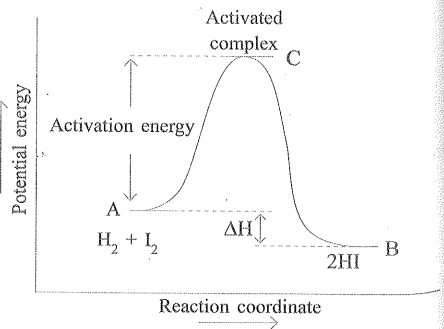
→ The energy required to form this intermediate, called activated complex (C), is known as activation energy (Ea).
→ Below figure is obtained by plotting potential energy VS reaction coordinate. Reaction coordinate represents the profile of energy change when reactant change into products.
Image
→ Some energy is released when the complex decomposes to form products. So, the final enthalpy of the reaction depends upon the nature of reactants and products.
Need a full question paper?

Generate a complete, print-ready paper with questions like this in minutes — across 16+ boards, with answer keys.

Start Generating Free

Similar questions

Explain chemical properties of $KMnO _4$
  1. Deficiency of which vitamin causes night-blindness?
  2. Name the base that is found in nucleotide of RNA only.
  3. Glucose on reaction with HI gives n-hexane. What does it suggest about the structure of glucose?
Give equations required for the following changes:
(i) Ethanal to methanamine
(ii) Ethanocyl chloride to methanamine
(iii) Ethanoic acid to propan-1-amine.
Write structures of compounds A, B and C in each of the following reactions:
  1. $ \text{C}_6\text{H}_5\text{Br}\xrightarrow{\text{Mg/dry ether}}\text{A}\xrightarrow[(b )\text{ }\text{H}_3\text{O}^+]{(a)\text{ }\text{Co}_{2\text{(g)}}}\text{B}\xrightarrow{\text{PC}l_5}\text{C}$
  2. $ \text{C}\text{H}_3\text{CN}\xrightarrow[(b )\text{ }\text{H}_3\text{O}^+]{(a)\text{ }\text{SnC}l_{2}/\text{HC}l}\text{A}\xrightarrow{\text{dil.NaOH}}\text{B}\xrightarrow{\text{ }\text{ }\text{ }\text{ }\text{ }\triangle\text{ }\text{ }\text{ }\text{ }\text{ }\text{ }\text{ }\text{ }}\text{C}$
Thermodynamic feasibility of the reaction alone cannot decide the rate of the reaction. Explain with the help of one example.
  1. Draw the structures of all isomeric alcohols of molecular formula C5H12O and give their IUPAC names.
  2. Classify the isomers of alcohols in question 11.3 (i) as primary, secondary and tertiary alcohols.
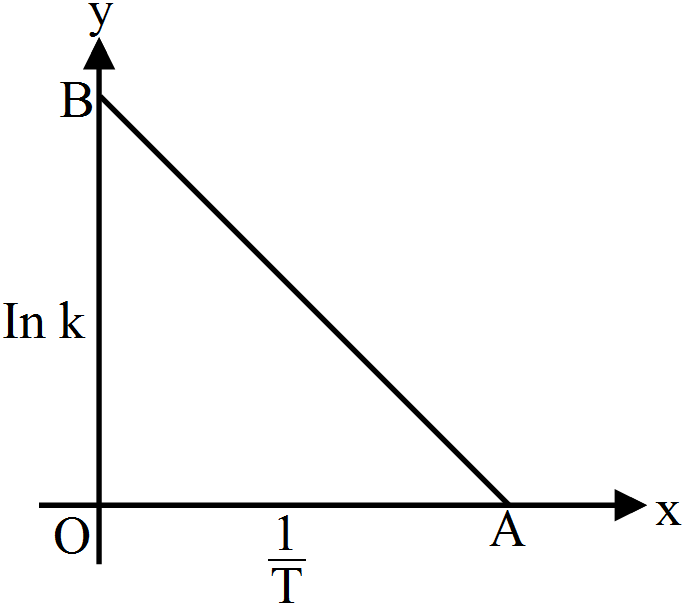
A graph between ln k and $\frac{1}{\text{t}}$ for a reaction is given. Here k is rate constant and T is temperature in Kelvin.

If OA = a and OB = b, answer the following:

  1. What is the activation energy (Ea) of the reaction?
  2. What is the frequency factor (A) for the reaction?

Discuss the formation of amine compounds by reduction of nitrile and amide compounds.
Calculate the standard free energy change for the following reaction at 25°C.
$\text{Au(s) + Ca}^{2+}(1\text{M})\xrightarrow{ \ \ \ \ \ \ \ }\text{Au}^{3+}(1\text{m) + Ca(s)}$
$\text{E}^{\circ}_{\text{Au}^{3+}/\text{Au}}=+1.50\text{V},=\text{E}^{\circ}_{\text{Ca}^{2+}/\text{Ca}}-2.87\text{V}$
Predict whether the reaction will be spontaneous or not at 25°C. Which of the above two half cells will act as an oxidising agent and which one will be a reducing agent?
How is the molar conductivity of a weak electrolyte at infinite dilution determined?