MCQ
What is activation energy?
  • A
    It is the minimum amount of energy it takes to start a chemical reaction.
  • B
    It is the intermediate compound in a chemical reaction.
  • C
    It is the energy needed for an exothermic reaction.
  • D
    It is the energy needed for an endothermic reaction.
Answer

  1. It is the minimum amount of energy it takes to start a chemical reaction.

Explanation:

Activation Energy:- The minimum energy which must be available to a chemical system with potential reactants to result in a chemical reaction

Activation energy may also be defined as the minimum energy required to start a chemical reaction.

The activation energy of a reaction is usually denoted by Ea and given in units of kilojoules per mole (kJ/ mol) or kilocalories per mole (kcal/ mol).

Need a full question paper?

Generate a complete, print-ready paper with questions like this in minutes — across 16+ boards, with answer keys.

Start Generating Free

Similar questions

Consider the following reaction :

Phenol  $\xrightarrow{{Zn\,\,dust}}X\,\xrightarrow[{Anhyd.\,AlC{l_3}}]{{C{H_3}Cl}}\,Y\xrightarrow{{Alkaline\,\,KMn{O_4}}}\,Z$

the product $Z$ is

For the cell at $298\ K$

$Ag\left( s \right)\left| {AgBr\left( s \right)\,\left| {B{r^ - }\left( {0.01\,M} \right)} \right|\,\left| {{I^ - }\left( {0.02\,M} \right)} \right|\,AgI\left( s \right)} \right|Ag\left( s \right)$

the correct information is

[Given : $K_{sp}\,\left( {AgBr} \right) = 4 \times {10^{ - 13}}$ , 

$K_{sp}\,\left( {AgI} \right)$ $ = 8 \times {10^{ - 17}},\frac{{2.303\,RT}}{F} = 0.06\,V,\,\log \,2 = 0.3]$

The compound which forms a dative bond with ammonia
If one strand of $DNA$ has the sequence $ATCGTATG$, the sequence in the complementary strand would be
Iron exhibits $+2$ and $+3$ oxidation states. Which of the following statements about iron is incorrect ?
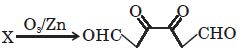
Find out the $X$ of the given reaction :-
Indicate the complex entity which shows optical isomerism.
$\begin{array}{*{20}{c}}
  {\begin{array}{*{20}{c}}
  {\begin{array}{*{20}{c}}
  {C{H_2} - OH\,\,} \\ 
  {\,\,|\,\,\,\,\,\,\,\,\,\,\,\,\,\,\,\,\,\,\,\,\,\,\,\,\,\,\,\,\,\,} 
\end{array}} \\ 
  {C = O\,\,\,\,\,\,\,\,\,\,\,\,\,\,\,} \\ 
  {|\,\,\,\,\,\,\,\,\,\,\,\,\,\,\,\,\,\,\,\,\,\,\,\,\,\,} 
\end{array}} \\ 
  {\,\,CH - OH\,\,\,\,\,\,\,} \\ 
  {|\,\,\,\,\,\,\,\,\,\,\,\,\,\,\,\,\,\,\,\,\,\,\,\,\,\,\,\,} \\ 
  {C{H_2} - OH\,\,\,\,}
\end{array}\xrightarrow{{HI{O_4}}}$  Product obtained is
In the Rosenmund's reduction, $BaS{O_4}$ taken with catalyst $Pd$ acts as
$(A)$ $C_3H_6O$ $\mathop {\xrightarrow{{NaCN}}}\limits_{{H_2}S{O_4}} $ cyanohydrin of $(A).$ If the cyanohydrin is optically active, then the possible structure of $(A)$ is