Question
What is alcoholism? What are its effects?

Answer

  • Alcoholism is the addiction to have alcohol in the form of different types of liquor. Liquor is produced from alcohol. Alcohol is in turn obtained by fermentation of different substances.
  • Consuming liquor becomes an addiction for a long-term. Due to alcohol, the efficiency of nervous system and especially the brain is affected.
  • Other vital organs such as kidneys and liver are adversely affected.
  • Lifespan of an alcoholic decreases due to constant drinking and malnourishment.
  • Especially in adolescent age if alcohol is consumed the brain functioning does not take place properly. The mental ability of memorization and learning becomes slow. There is lack of concentration in studies.
  • The alcoholic person lacks the rational thinking and hence faces with social, mental and familial problems along with physical illness.

Need a full question paper?

Generate a complete, print-ready paper with questions like this in minutes — across 16+ boards, with answer keys.

Start Generating Free

Similar questions

A rainbow is the combined effect (an exhibition) of the refraction, dispersion, and total internal reflection of light (taken together). (Practice Activity Sheet – 1)
(OR)
With a neat labelled diagram, explain how the formation of rainbow occurs.
Using the law of conservation of energy, obtain the expression for the escape velocity
With the help of a diagram, derive the formula for the resultant resistance of three resistors connected in series.
Water and dissolved minerals get into the root hair of a plant by a process called A and enter the conducting tissue B. The process C helps the water and dissolved minerals to move up through the tissue B in roots and stem, and reach the leaves of a plant. In the leaves food is made by a process D. This food is then transported to all the parts of a plant through tissue E. The process of distributing food made in the leaves to all the parts of the plants is called F.
  1. What are (i) A, (ii) B, (iii) C, (iv) D, (v) E, and (vi) F?
  2. Which tissue is made up of living cells: B or E?
  3. Which tissue, B or E, contains sieve tubes?
  4. Which tissue, B or E, contains tracheids?
Write a short note on Electrical energy generation and environment.
Consider the following chemical reactions which take place in different organisms/ tissues under various conditions:
  1. Glucose → Respiration → Respiration Ethanol + Carbon-dioxide + Energy.
  2. Glucose → Respiration → Respiration Carbon-dioxide + Water + Energy.
  3. Glucose → Respiration → Respiration Lactic acid + Energy.
  1. Name one organism which respires according to equation (i) above.
  2. Name one organism which respires according to equation (ii) above.
  3. When and where does respiration represented by equation (iii) above take place?
  4. Which equation/ equations represent aerobic respiration?
  5. Which equation/ equations represent anaerobic respiration?
  6. Which of the above reactions produces the maximum amount of energy?
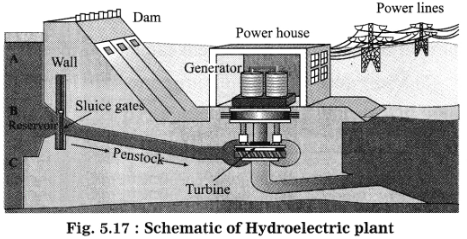
The schematic of hydroelectric plant is shown in Figure. Water from about middle of the total height of the dam is taken to the turbine, as shown by point B in the diagram.
Image
(i) With reference to point B, potential energy of how much water reservoir in the dam will be converted into kinetic energy?
(ii) What will be the effect on electricity generation, if the channel taking water to turbine starts at point A?
(iii) What will be the effect on electricity generation, if the channel taking water to turbine starts at point C?
What is a plant hormone? Name four plant hormones. State one function of each.
Explain the need and importance of space missions.
State Newton’s universal law of gravitation. Express it in mathematical form.