Question
What is an alternating current (AC)?
Answer

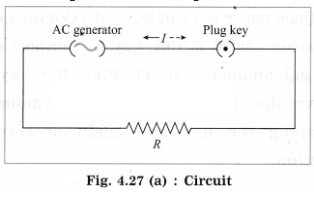
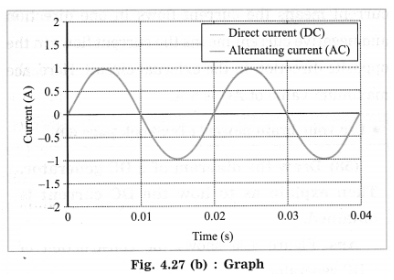
A current that changes in magnitude and direction after equal intervals of time is called an alternating current (AC) (Fig. 4.27).
Image
Image

Electric current changes sinusoidally with time. Electric current and potential difference are shown by the symbol ~.
[Note: An alternating current is obtained with an AC generator.]

Need a full question paper?

Generate a complete, print-ready paper with questions like this in minutes — across 16+ boards, with answer keys.

Start Generating Free

Similar questions

Acidified potassium permanganate $\left( KMnO _4\right)$ is a chemical oxidant and explain, how acidified potassium permanganate oxidise ferrous sulphate $\left( FeSO _4\right)$. Accordingly write a new definition of oxidation and reduction.
Define Snell’s law of refraction. A ray of light is incident on a glass slab at an angle of incidence of 60°. If the angle of refraction be 32.7°, calculate the refractive index of glass.
$(\text{Given:}\ \sin60^\circ=0.866,\text{ and }\sin32.7^\circ=540)$
What does the electricity meter measure?
Why could no fixed position be given to hydrogen in Mendeleev’s periodic table?
Draw a neat and labelled diagram to show the path of a ray of light in air and glass when the ray is incident obliquely on a glass slab. Show the (i) incident ray (ii) refracted ray (iii) emergent ray (iv) angle of incidence (v) angle of refraction (vi) angle of emergence in the diagram.
(OR)
Draw a neat and labelled diagram to show refraction of light through a glass slab.
A piece of wire of resistance $20 Ω$ is drawn out so that its length is increased to twice its original length. Calculate the resistance of the wire in the new situation.
Label correctly the structures seen in Windmill.
When a copper coin is dipped in silver nitrate solution, a glitter appears on the coin after some time. Why does this happen? Write the chemical equation.
Define absolute refractive index.
Calculate the resistance of a copper wire 1.0km long and 0.50mm diameter if the resistivity of copper is $1.7\times10\Omega\ \text{m}.$