Question
What is an ammeter? How can we convert any galvanometer into an ammeter of given range? Explain.###Describe briefly that how and when any galvanometer is converted into an ammeter?

Answer

SELF

Need a full question paper?

Generate a complete, print-ready paper with questions like this in minutes — across 16+ boards, with answer keys.
Start Generating Free

Similar questions

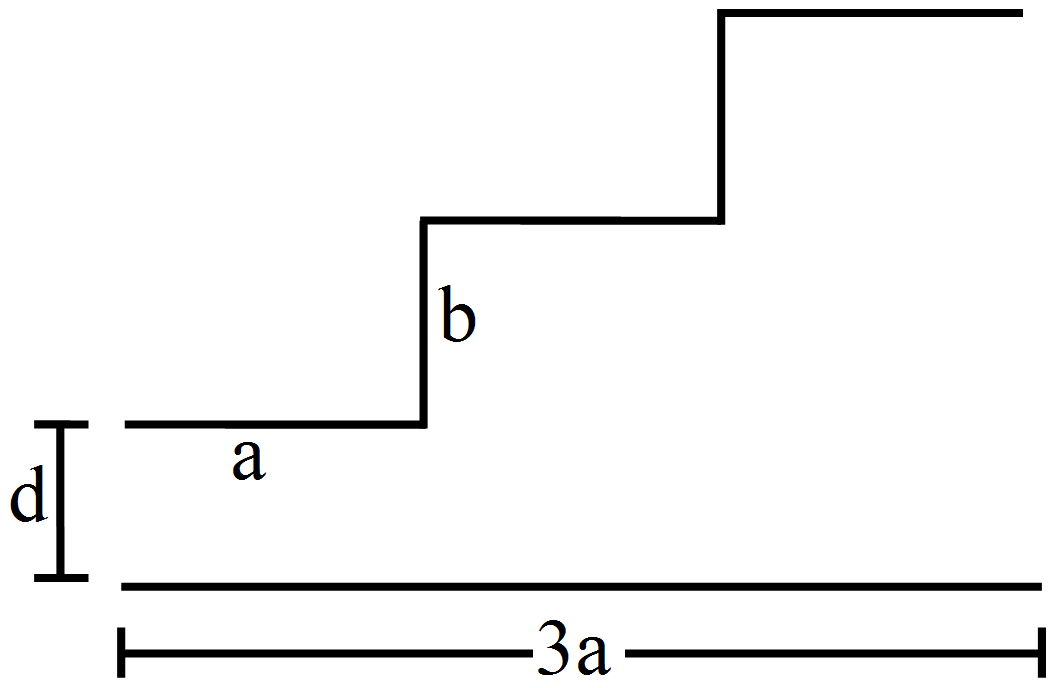
A capacitor is made of a flat plate of area A and a second plate having a stair-like structure as shown in figure. The width of each stair is a and the height is b. Find the capacitance of the assembly.
Consider the situation of the previous problem. Suppose each of the blocks is pulled by a constant force F instead of any impulse. Find the maximum elongation that the spring will suffer and the distances moved by the two blocks in the process.
When a parallel beam of a monochromatic source of light of wavelength $\lambda$ is incident on a single slit of width a, show how the diffraction pattern is formed at the screen by the interference of the wavelets from the slit. Show that, besides the central maxima $\theta=0$, secondary maxima are observed at $\theta=\left(n+\frac{1}{2}\right) \frac{\lambda}{a}$ and the minima at $\theta=\frac{n \lambda}{a}$. Why do secondary maxima get weaker in intensity with increasing n?
Define the following and establish relation between them : (i) intensity of magnetisation (ii) magnetisation field (H) (iii) magnetic susceptibility $\chi$, (iv) magnetic permeability.###Explain permeability, susceptibility, intensity of magnetisation and magnetisation field $( H )_{ X }$ and state their units. Establish relation between them in M.K.S. system.
A travelling wave is produced on a long horizontal string by vibrating an end up and down sinusoidally. The amplitude of vibration is 1.0cm and the displacement becomes zero 200 times per second. The linear mass density of the string is 0.10kg/m and it is kept under a tension of 90N.
  1. Find the speed and the wavelength of the wave.
  2. Assume that the wave moves in the positive x-direction and at t = 0, the end x = 0 is at its positive extreme position. Write the wave equation.
  3. Find the velocity and acceleration of the particle at x - 50cm at time t = 10ms.
If neutrons exert only attractive force, why don't we have a nucleus containing neutrons alone?
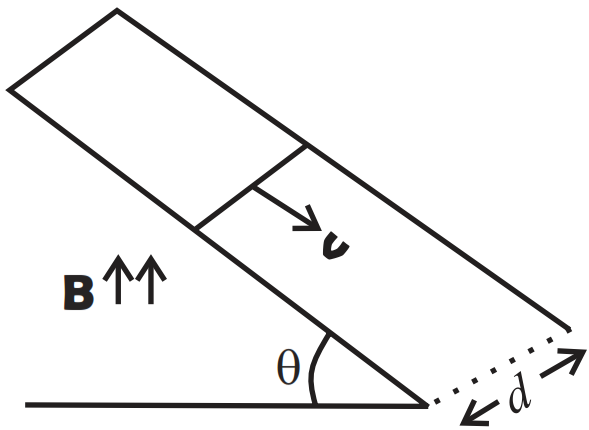
A rod of mass m and resistance R slides smoothly over two parallel perfectly conducting wires kept sloping at an angle θ with respect to the horizontal (Fig). The circuit is closed through a perfect conductor at the top. There is a constant magnetic field B along the vertical direction. If the rod is initially at rest, find the velocity of the rod as a function of time.
We have stimulated emission and spontaneous emission. Do we also have stimulated absorption and spontaneous absorption?
Lenses are constructed by a material of refractive index 1.50. The magnitude of the radii of curvature are 20cm and 30cm. Find the focal lengths of the possible lenses with the above specifications.
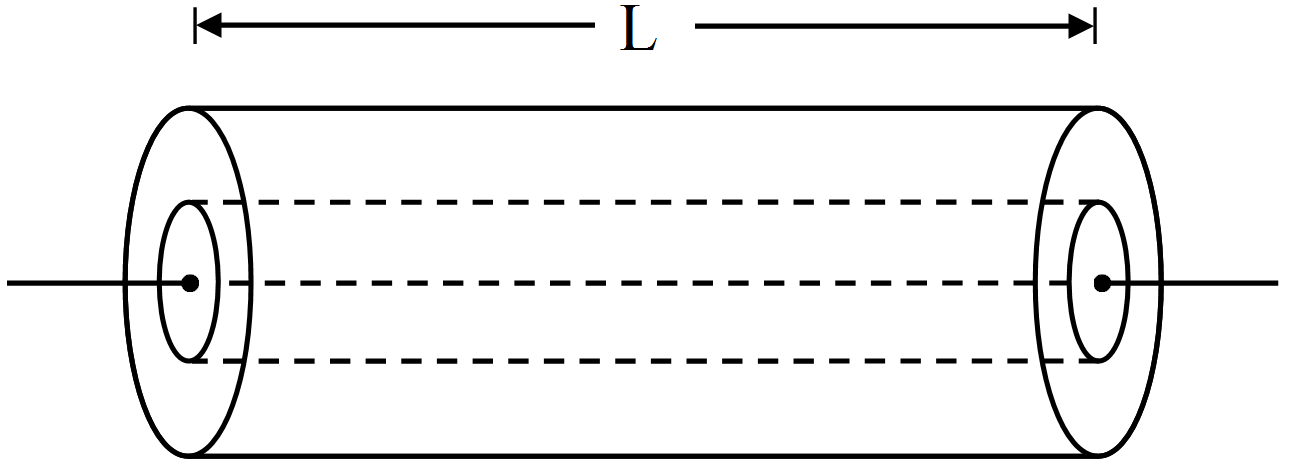
Figure shows two long coaxial solenoids, each of length ‘L’. The outer solenoid has an area of cross-section $A_1$ and number of turns/ length $n_1$ The corresponding values for the inner solenoid are $A_2$ and $n_2$ Write the expression for self-inductance $L_1, L_2$ of the two coils and their mutual inductance M. Hence show that $\text{M} < \sqrt{\text{L}_2\text{L}_2}.$