Question
What is an ammeter? How can we convert any galvanometer into an ammeter of given range? Explain.###Describe briefly that how and when any galvanometer is converted into an ammeter?

Answer

SELF

Need a full question paper?

Generate a complete, print-ready paper with questions like this in minutes — across 16+ boards, with answer keys.
Start Generating Free

Similar questions

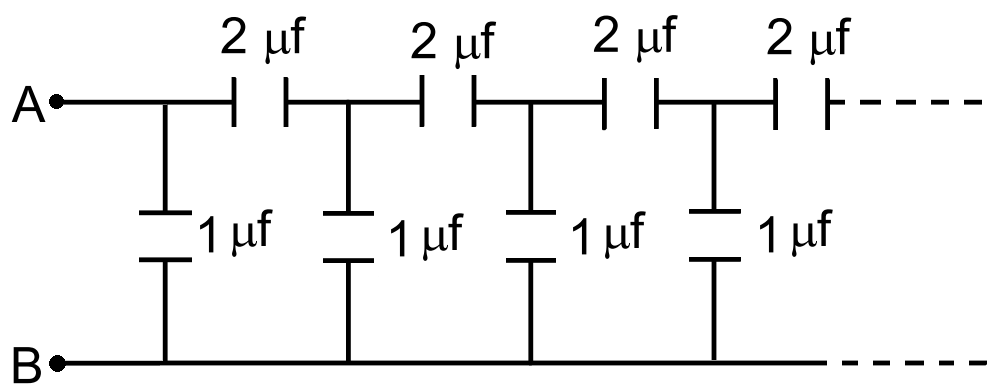
Find the equivalent capacitance of the infinite ladder shown in figure between the points A and B.
A current of $1.0A$ exists in a copper wire of cross$-$section $1.0mm^2$. Assuming one free electron per atom, calculate the drift speed of the free electrons in the wire. The density of copper is $9000\ kg/m^{-3}.$
Derive the lens formula $\frac{1}{\text{f}}=\frac{1}{\text{v}}-\frac{1}{\text{u}}$ for a thin concave lens, using the necessary ray diagram.
In an intrinsic semiconductor the energy gap $E_{g}$ is $1.2eV$. Its hole mobility is much smaller than electron mobility and independent of temperature. What is the ratio between conductivity at $600K$ and that at $300K$? Assume that the temperature dependence of intrinsic carrier concentration $n_i$ is given by,
$\text{n}_{\text{i}}=\text{n}_{\text{0}}\ {\text{exp}}\Big(-\frac{\text{E}_\text{g}}{2{\text{K}_{\text{B}}}{\text{T}}}\Big)$
where $n_0$ is a constant.
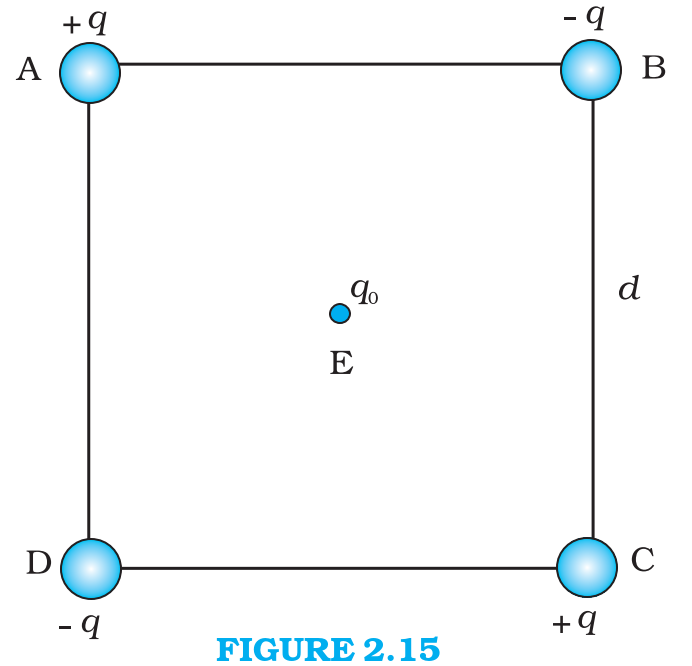
Four charges are arranged at the corners of a square $\text{ABCD}$ of side $d$, as shown in Fig. $2.15.(a)$ Find the work required to put together this arrangement. $(b)$ A charge $q_0$ is brought to the centre $E$ of the square, the four charges being held fixed at its corners. How much extra work is needed to do this?
Image
The half-life of $^{199}Au$ is $2.7$ days.
  1. Find the activity of a sample containing $1.00\mu\text{g}$ of $^{198}Au.$
  2. What will be the activity after $7$ days? Take the atomic weight of $^{198}Au$ to be $198\ g/mol.$
A wave travels along the positive x-direction with a speed of 20m/s. The amplitude of the wave is 0.20cm and the wavelength 2.0cm.
  1. Write a suitable wave equation which describes this wave.
  2. What is the displacement and velocity of the particle at x = 2.0cm at time t = 0 according to the wave equation written? Can you get different values of this quantity if the wave equation is written in a different fashion?
When the sun is directly overhead, the surface of the earth receives $1.4 \times 10^3 W m^{-2}$ of sunlight. Assume that the light is monochromatic with average wavelength $500nm$ and that no light is absorbed in between the sun and the earth's surface. The distance between the sun and the earth is $1.5 \times 10^{11}m.$
  1. Calculate the number of photons falling per second on each square metre of earth's surface directly below the sun.
  2. How many photons are there in each cubic metre near the earth's surface at any instant?
  3. How many photons does the sun emit per second?
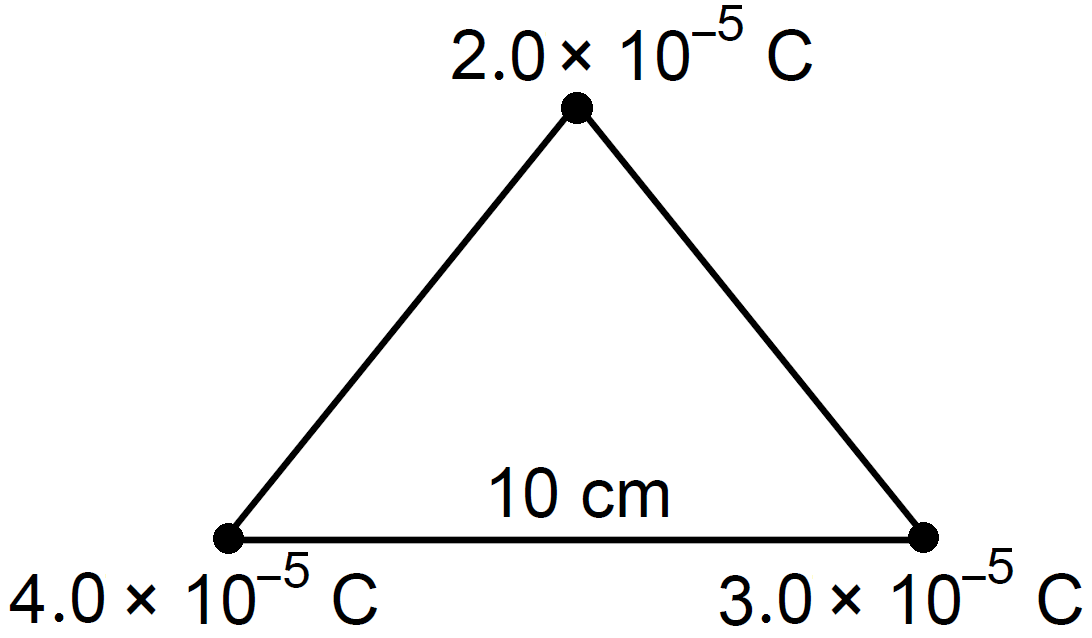
How much work has to be done in assembling three charged particles at the vertices of an equilateral triangle as shown in figure?
An LR circuit with emf $\epsilon$ is connected at t = 0.
  1. Find the charge Q which flows through the battery during 0 to t.
  2. Calculate the work done by the battery during this period.
  3. Find the heat developed during this period.
  4. Find the magnetic field energy stored in the circuit at time t.
  5. Verify that the results in the three parts above are consistent with energy conservation.