Question
What is an elastic collision? What will happen, when
  1. A heavy body collides with a light mass at rest.
  2. A light body collides with a heavy mass at rest.
Answer

Elastic collision is one in which both momentum and energy are conserved. We know, when two bodies m1 and m2 moving with velocities u1 and u2 collide, their velocities become,

$\text{v}_1=\frac{(\text{m}_1-\text{m}_2)\text{u}_1+2\text{m}_2\text{u}_2}{\text{(m}_1+\text{m}_2}$

$\text{v}_2=\frac{\text{m}_2-\text{m}_1)\text{u}_2+2\text{m}_1\text{u}_1}{(\text{m}_1+\text{m}_2)}$

  1. if m1 >> m2 and u2 = 0, we get 

$\text{v}_1=\frac{\text{m}_1\text{u}_1}{\text{m}_1}=\text{u}_1,\text{v}_2=2\text{u}_1$

  1. If m1 >> m2 and u1 = 0, we get 

$\text{v}_1=\frac{2\text{m}_2\text{u}_2}{\text{m}_1}, $ as m2 << m1

$\therefore\text{v}_1\approx0$

$\text{v}_2=-\frac{\text{m}_1\text{u}_2}{\text{m}_1}=-\text{u}_2$

Need a full question paper?

Generate a complete, print-ready paper with questions like this in minutes — across 16+ boards, with answer keys.

Start Generating Free

Similar questions

A molecule in a gas container hits a horizontal wall with speed 200ms-1 and angle 30° with the normal, and rebounds with the same speed. Is momentum conserved in the collision? Is the collision elastic or inelastic?
What would be the effect on a vector if all its components are reversed in direction?
Calculate the radius of new bubble formed when two bubbles of radius $r_1$ and $r_2$ coalesce?
Explain why:
Two bodies at different temperatures T1 and T2 if brought in thermal contact do not necessarily settle to the mean temperature (T1 + T2 )/2.
A family uses 8 kW of power. (a) Direct solar energy is incident on the horizontal surface at an average rate of 200W per square meter. If 20% of this energy can be converted to useful electrical energy, how large an area is needed to supply 8 kW? (b) Compare this area to that of the roof of a typical house.
Explain the Doppler's effect.
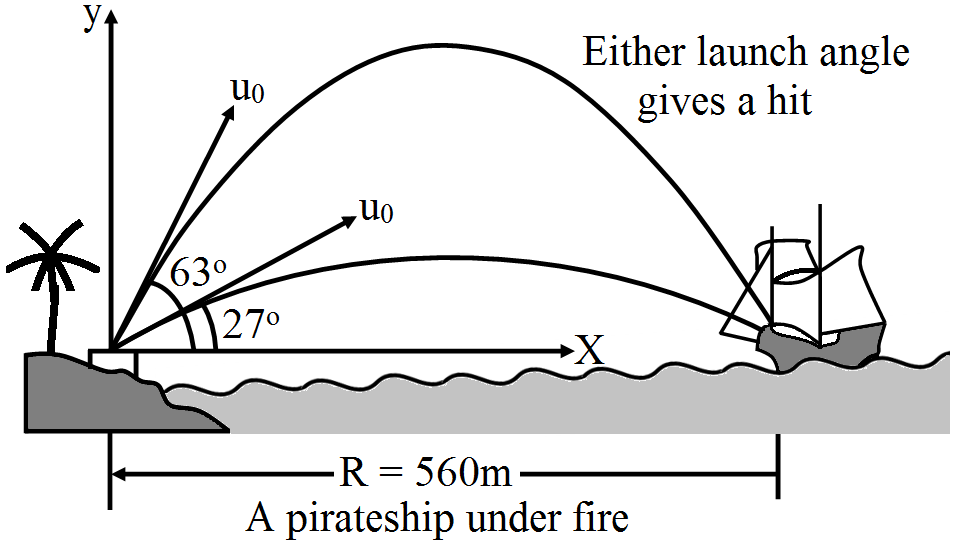
Figure shows a pirateship 560m from a fort defending a harbour entrance. A defence cannon, located at sea level, fires balls at initial speed, u0 = 82m/ s.

  1. At what angle, $\theta_0$ from the horizontal must a ball be fired to hit the ship?
  2. What is the maximum range of the cannon balls?
An electron travelling with a speed of 5 × 10³ms-1 passes through an electric field with an acceleration of 1012ms-2. How long will it take for the electron to double its speed?
A constant force acting on a body of mass 3.0 kg changes its speed from $2.0 ms^{-1}$ to $3.5 ms^{-1}$ in 25 s . The direction of the motion of the body remains unchanged. What is the magnitude and direction of the force?
Consider a sample of oxygen at 300K. Find the average time taken by a molecule to travel a distance equal to the diameter of the earth.