Question
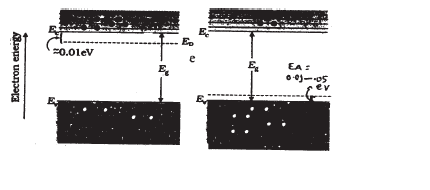
What is an intrinsic semiconductor? How can this material be converted into (1) P-type (2) N-type extrinsic semiconductor? Explain with the help of energy band diagrams.

Answer

Intrinsic semiconductor: Pure semi-conductor having no impurities or negligible impurities.

Conversion into –

  1. P-type – by doping with small amount of trivalent impurities.
  2. N-type- by doping with small amount of pentavalent impurity.


Need a full question paper?

Generate a complete, print-ready paper with questions like this in minutes — across 16+ boards, with answer keys.

Start Generating Free

Similar questions

The following table gives the output of a two input logic gate.
  1. Identify the logic gate and draw its logic symbol.
  2. If the output of this gate is fed as input to a NOT gate, name the new logic gate so formed.
A
B
Y
0
0
1
1
0
1
0
1
1
1
1
0
A 12.3 eV electron beam is used to bombard gaseous hydrogen at room temperature. Upto which energy level the hydrogen atoms would be excited?
Calculate the wavelengths of the second member of Lyman series and second member of Balmer series.
What length of a copper wire of cross-sectional area 0.01mm2 will be needed to prepare a resistance of $1\text{k}\Omega?$ Resistivity of copper $=1.7\times10^{-8}\Omega\text{-m}.$
A block of 2kg is suspended from the ceiling through a massless spring of spring constant k = 100N/m. What is the elongation of the spring? If another 1kg is added to the block, what would be the further elongation?
Find the speed of the electron in the ground state of a hydrogen atom. The description of ground state is given in the previous problem.
Carbon (Z = 6) with mass number 11 decays to boron (Z = 5).
  1. Is it a $\beta^+-\text{decay}$ or a $\beta^--\text{decay}?$
  2. The half-life of the decay scheme is 20.3 minutes. How much time will elapse before a mixture of 90% carbon-11 and 10% boron-11 (by the number of atoms) converts itself into a mixture of 10% carbon-11 and 90% boron-11?
For sound waves, the Doppler formula for frequency shift differs slightly between the two situations: (i) source at rest; observer moving, and (ii) source moving; observer at rest. The exact Doppler formulas for the case of light waves in vacuum are, however, strictly identical for these situations. Explain why this should be so. Would you expect the formulas to be strictly identical for the two situations in case of light travelling in a medium?
A long straight wire of a circular cross-section of radius ‘a’ carries a steady current ‘I’. The current is uniformly distributed across the cross-section. Apply Ampere’s circuital law to calculate the magnetic field at a point ‘r’ in the region for (i) r < a and (ii) r > a.
Radiation from hydrogen discharge tube falls on a cesium plate. Find the maximum possible kinetic energy of the photoelectrons. Work function of cesium is 1.9eV.