Question
What is an isothermal process? Also give essential conditions for an isothermal process to take place.

Answer

A change in pressure and volume of a gas without any change in its temperature is called an isothermal process. Two essential conditions for perfect isothermal process are:
  1. The walls of the container must be perfectly conducting to allow free exchange of heat between the gas and its surrounding.
  2. The process of compression or expansion should be slow so as to provide time for exchange of heat.

Need a full question paper?

Generate a complete, print-ready paper with questions like this in minutes — across 16+ boards, with answer keys.
Start Generating Free

Similar questions

Write down the number of significant figures in the following:
  1. $5238N$
  2. $4200\ kg$
  3. $34.000m$
  4. $0.02340N/ m$
If the temperature of a substance is $-50^{\circ}\text C $ centigrade scale, then find its tempeature on (i) Fahrenheit and (ii) Kelvin scale.
In a car lift compressed air exerts a force $F$ on a small piston having a radius of $5.0 \ cm$. This pressure is transmitted to a second piston of radius $15 \ cm ($Fig $9.7).$ If the mass of the car to be lifted is $1350 \ kg$, calculate $F_1$. What is the pressure necessary to accomplish this task? $\left(g=9.8\ ms ^2\right)$
A person drops a coin. Describe the path of the coin as seen by the person if he is in:
  1. A car moving at constant velocity.
  2. In a freely falling elevator.
A barometer correctly reads the atmospheric pressure as 76cm of mercury. Water droplets are slowly introduced into the barometer tube by a dropper. The height of the mercury column first decreases and then becomes constant. lf the saturation vapour pressure at the atmospheric temperature is 0.80cm of mercury, find the height of the mercury column when it reaches its minimum value.
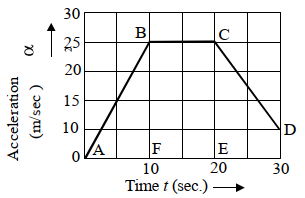
In the given figure the time-acceleration graph of an object moving in a straight line is given. Determined from graph :(i) Average acceleration in the first 20 sec.(ii) From what time tell what time the force acts on the object?Image
Solid spheres of equal mass are made of different materials. What will be the relation between the moment of inertia of the spheres and their density (d)?
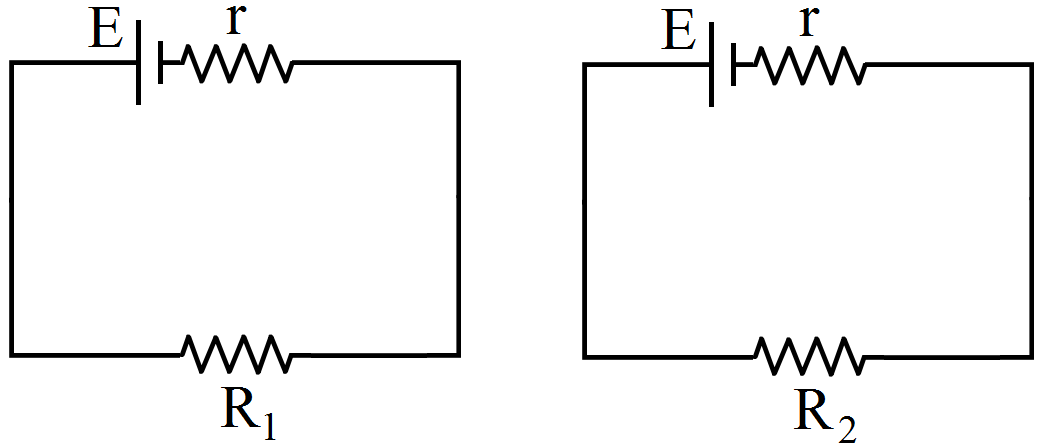
Two unequal resistances $R_1$ and $R_2$ are connected across two identical batteries of emf $\varepsilon$ and internal resistance r. Can the thermal energies developed in $R_1$ and $R_2$ be equal in a given time. If yes, what will be the condition?
As oscillating pendulum stops after some time. Is this a violation of the law of conservation of mechanical energy?
A point charge Q is placed at the origin. Find the electrostatic energy stored outside the sphere of radius R centred at the origin.