Question
What is an ogive? How is it constructed?

Answer

A frequency distribution gives the number of observations that lie in any class interval whereas the cumulative frequency distribution gives the number of frequencies that lie below any mark or above any given mark. When derived from a frequency distribution, the cumulative frequency distribution of one kind gives the number of observations less than the lower boundaries of the successive class and the cumulative frequency distribution of the second kind gives the number of observations that exceed the lower boundaries of the class which are respectively known as the less than and greater than the cumulative frequency distribution. If we draw frequency polygon to the above two distribution we get cumulative frequency polygon (less than & greater than). If we draw a frequency curve to the above two distribution in the same graph, we get cumulative frequency curve or Ogive.Steps Involved:
  1. Find the cumulative frequencies of the given frequencies by "less than method' or 'more than method' as you need.
  2. Less than type cumulative frequencies will give less than type ogive and more type cumulative frequencies will give less than type ogive.
  3. Variable under study is taken on X-axis.
  4. Cumulative Frequencies are taken on Y-axis.
  5. Both the axis should be clearly labeled and scale of measurement should be clearly shown.
  6. Various points are plotted on graph.
  7. By joining these points we get ogive or cumulative frequency curve.

Need a full question paper?

Generate a complete, print-ready paper with questions like this in minutes — across 16+ boards, with answer keys.

Start Generating Free

Similar questions

Direction Read the following case study and answer questions (i) to (v). On the basis of the same. Measures of central tendency are an effective statistical tools, which are widely used for different purposes. Two statistical series are given below, observe them carefully and answer the questions that follow.
Series1
Series2
2
Marks
No. of student
8
5-10
02
6
10-20
03
4
20-45
01
10
45-60
06
15
 
 
  1. What will be the median value of series 1?
  1. 6
  2. 8
  3. 10
  4. None of these
  1. Which of the following formula should be/used to calculate median in series 2?
  1. $\Big(\frac{\text{n}+1}{2}\Big)\text{th}\ \text{term}$
  2. $\Big(\frac{\text{N}+1}{2}\Big)\text{th}\ \text{term}$
  3. $\Big(\frac{\text{N}+1}{2}\Big)\text{th}\ \text{term}$
  4. $\text{None of these}$
  1. Mode value of series 2 will be equal to ...
  1. 12
  2. 16
  3. 28
  4. Can't be determined
  1. Which of the following methods should be used to calculate mode in series 1?
  1. Observation method.
  2. Grouping table method.
  3. Empirical relation between central tendencies.
  4. Can't be determined.
  1. What will be the mode value in series 1?
  1. 6
  2. 8
  3. 10
  4. None of the above
Calculate the correlation coefficient between the heights of fathers in inches (X) and their sons (Y).
X
65
66
57
67
68
69
70
72
Y
67
56
65
68
72
72
69
71
What are fixed costs? Explain the nature and shape of the total fixed and average fixed cost curves.
“You have unlimited wants and limited resources to satisfy them.” Explain this statement by giving two examples.
Following table gives the distribution of companies according to the size of capital. Using step deviation method, find out the mean size of the capital of a company.
Capital (₹ in lakh)
Less than 5
Less than 10
Less than 15
Less than 20
Less than 25
Less than 30
Number of Companies
20
27
29
38
48
53
Hint: In the above problem, cumulative frequenices are given, we first find the simple frequencies and thereafter we will calculate arithmetic mean.
At a given price, there is excess demand for a good. Explain how the equilibrium price will be reached. Use diagram.
Calculate Karl Pearson's coefficient of correlation from following data:
X
24
22
25
27
23
26
Y
18
14
22
20
19
24
Represent the following data by a graph using false base line:
Years
2009
2010
211
2012
2013
2014
2015
2016
2017
2018
Sales in '000 (₹)
25
28
30
26
21
35
30
23
16
38
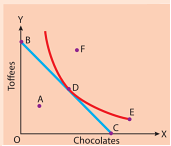
Rohan is choosing how to allocate this spending between chocolates and toffees. The figure alongside shows his budget line and indifference curve. Identify the point as mentioned in the diagram and match it with the appropriate statement given below:
(i) The point at which Rohan maximises his satisfaction.
(ii) The point at which he buys only chocolates and no toffees.
(iii) A consumption bundle which would not exhaust his budget for these goods.
(iv) A point yielding the same satisfaction as at 'D' but which Rohan's budget can't afford.
(v) The point at which he buys only toffees and no chocolates.
(vi) A consumption bundle preferred to point 'D' but which Rohan can't afford.
Image
Find the Standard Deviation from the given data.
S. No. 1 2 3 4 5
X 10 20 30 40 50