Question
What is artificial hybridisation? How is it useful in plant breeding?

Answer

"Artificial hybridisation is a crop improvement technique where only desired pollen grains are used for pollination, and the stigma is protected from contamination by unwanted pollen. It ensures that the plant breeder has complete control over the cross.
Major Steps Involved:
Emasculation:Removal of anthers from a bisexual flower before they dehisce, using forceps. (Note: Not required for unisexual flowers).
Bagging: Covering the emasculated (or unisexual) flower with a bag (usually made of butter paper) to prevent unwanted pollen from landing on the stigma.
Pollination: When the stigma becomes receptive, mature pollen from the desired parent is dusted on it.
Re-bagging: The flower is covered again to allow fruit development.
Utility in Plant Breeding:
Combination of Traits: It allows breeders to combine desirable characteristics (like high yield, disease resistance, and drought tolerance) from two different plants into a single superior variety.
Genetic Improvement: It is the primary method for creating high-yielding Hybrid Seeds used in modern agriculture.
Precision: It eliminates the chance of random, inferior pollination, ensuring that the progeny has the specific traits targeted by the breeder."
Need a full question paper?

Generate a complete, print-ready paper with questions like this in minutes — across 16+ boards, with answer keys.

Start Generating Free

Similar questions

What are the properties of an antibiotic?
What changes are seen in human male and females by onsetting of puberty.
Give an interesting observation of melanic Moth supporting development by natural selection in England.
Why did T.H. Morgan select Drosophila melanogaster to study sex linked genes for his lab experiments?
How can education help in building up a socially responsible and reproductively healthy society? (Enumerate the aspects that should be emphasised).
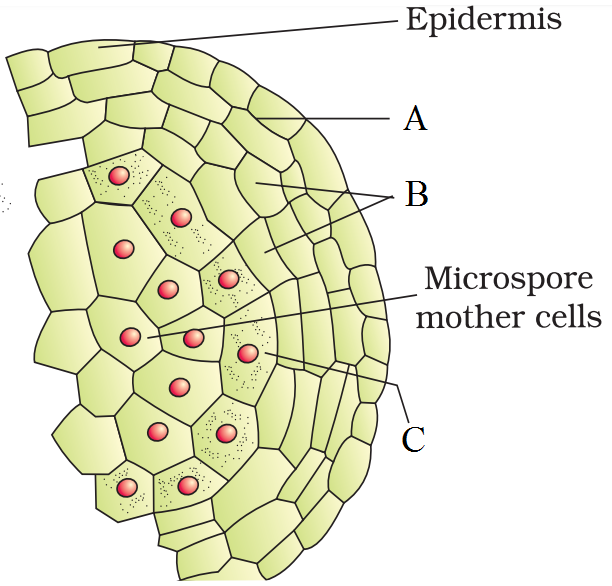
Given below is an enlarged view of onemicro sporangium of a mature anther.

  1. Name 'a', 'b' and 'c' wall layers.
  2. Mention the characteristics and function of the cells forming the wall layer 'c'.
Three microbes are listed below. Name the product produced by each one of them and mention their use:
  1. Aspergillus niger.
  2. Trichoderma polysporum.
  3. Monascus purpureus.
How did Hershey and Chase differentiate between DNA and protein in their experiment while proving that DNA is the genetic material?
Mrs. Peter and Mrs. James had babies at the same hospital. Mrs. Peter took home a girl, Nancy and Mrs. James received a boy, Richard. However, Mrs. James was certain she gave birth to a girl and brought suit against the hospital. Blood tests showed that Mr. James was type O, Mrs. James was type AB and Mr. and Mrs. Peter were both type B. Nancy was type A and Richard was type O. List the possible genotypes of each individual and then indicate the correct parents for each child.
Genotypes :
  1. Mrs. Peter ____________.
  2. Mr. Peter ______________.
  3. Nancy _____________.
  4. Mrs. James _________________.
  5. Mr. James ________________.
  6. Richard _______________.
  7. Whose baby is Nancy?
  8. Whose baby is Richard?
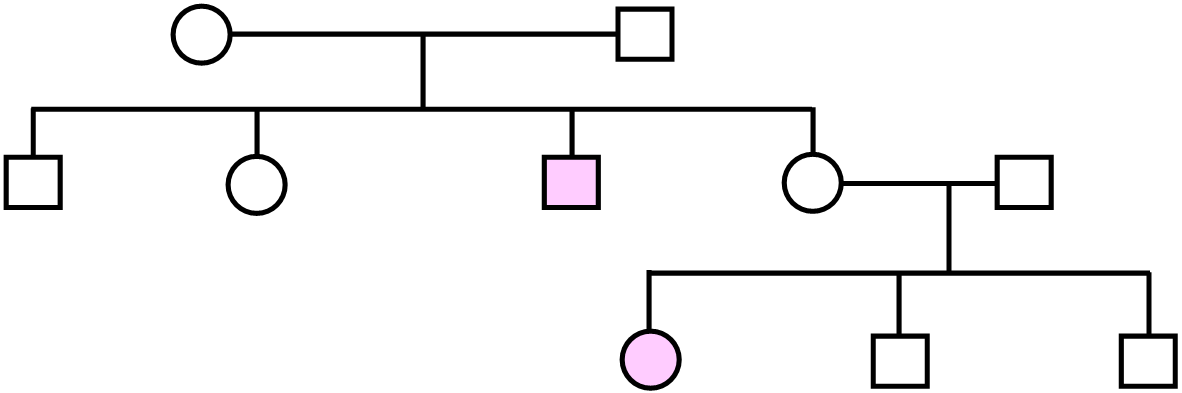
Study the given pedigree chart and answer the questions that follow:

Is the trait recessive or dominant?