Question
What is Bond Enthalpy? Discuss in detail.

Answer

SELF

Need a full question paper?

Generate a complete, print-ready paper with questions like this in minutes — across 16+ boards, with answer keys.

Start Generating Free

Similar questions

Write a comment on the following:
(i) Internal energy (ii) Heat
4 In the alkane $\mathrm{H}_3 \mathrm{C}-\mathrm{CH}_2-\mathrm{C}\left(\mathrm{CH}_3\right)_2-\mathrm{CH}_2-\mathrm{CH}\left(\mathrm{CH}_3\right)_2$, identify $1^{\circ}, 2^{\circ}, 3^{\circ}$ carbon atoms and give the number of H atoms bonded to each one of these.
Give reasons for the following:
$\mathrm{CCl}_4$ is immiscible in water, whereas $\mathrm{SiCl}_4$ is easily hydrolysed.
Write balanced chemical equation for the following reactions:
Permanganate ion $(\text{MnO}^-_4)$ reacts with sulphur dioxide gas in acidic medium to produce $Mn2+$ and hydrogensulphate ion.
(Balance by ion electron method)
Match the following equilibria with the corresponding condition.
Column I
Column II
i.
Liquid ⇌ Vapour
a.
Saturated solution
ii.
Solid ⇌ Liquid
b.
Boiling point
iii.
Solid ⇌ Vapour
c.
Sublimation point
iv.
Solute(s) ⇌ Solute (solution)
d.
Melting point
 
 
e.
Unsaturated solution
On the basis of quantum numbers, justify that the sixth period of the periodictable should have 32 elements.
Some time ago formation of polar stratospheric clouds was reported over Antarctica. Why were these formed? What happens when such clouds break up by warmth of sunlight?
  1. Define standard enthalpy of formation. Explain why the enthalpy changes for the reaction given below are not enthalpies of formation of $CaCO_3$ and HBr:
  1. $\text{CaO(s)}+\text{CO}_2(\text{g})\overrightarrow{\ \ \ \ \ \ \ \ }\ \text{CaCO}_3(\text{s});$ $\Delta_\text{r}\text{H}^\circ=-178.3\text{kJ mol}^{-1}$
  2. $\text{H}_2(\text{g})+\text{Br}_2(\text{g})\overrightarrow{\ \ \ \ \ \ \ }\ 2\text{HBr(g)};$ $\Delta_\text{r}\text{H}^\circ=-72.8\text{kJ mol}^{-1}$
  1. Use the bond enthalpies listed below to determine the enthalpy of reaction:
$\ \ \ \ \ \ \ \ \text{H}\\ \ \ \ \ \ \ \ \ \ |\\\text{H}-\text{C}-\text{H(g)}+2\text{O}=\text{O(g)}\overrightarrow{\ \ \ \ \ }\ \text{O}=\text{C}=\text{O(g)}\\ \ \ \ \ \ \ \ \ \ |\\ \ \ \ \ \ \ \ \ \text{H}\\+2\text{H}-\text{O}-\text{H(g)}$

Bond enthalpy $(\Delta\text{H}^\circ)/\text{kJ mol}^{-1}$ of C=O = 741; C-H = 414; H-O = 464; O=O = 498.
How do you count for the following observations?
Though alkaline potassium permanganate and acidic potassium permanganate both are used as oxidants, yet in the manufacture of benzoic acid from toluene we use alcoholic potassium permanganate as an oxidant. Why? Write a balanced redox equation for the reaction.
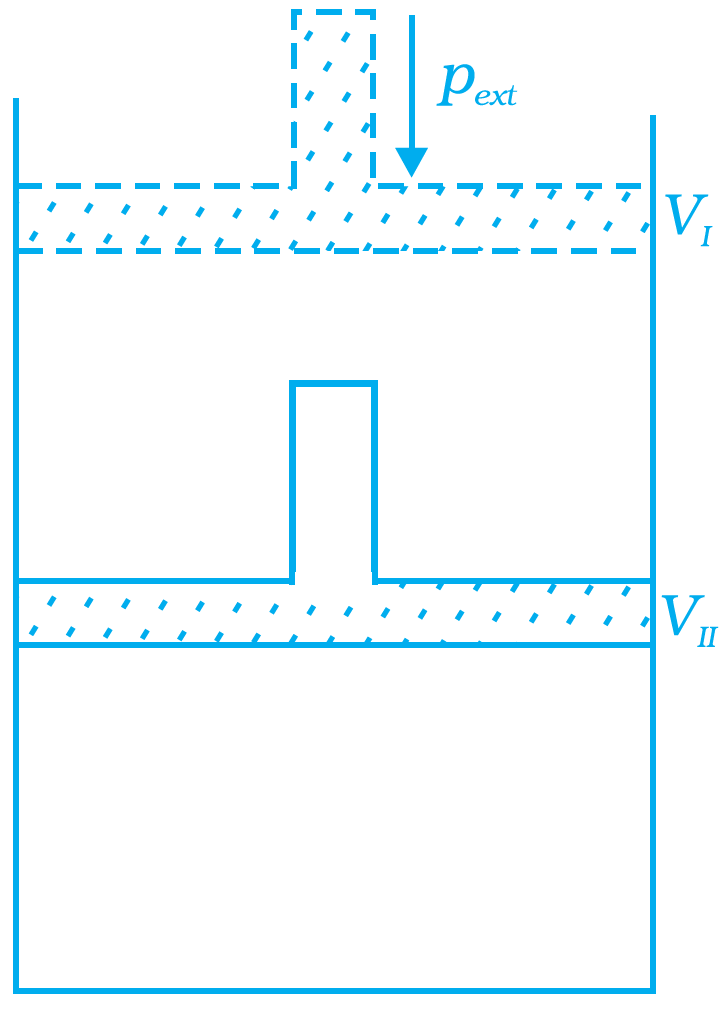
What will be the work done on an ideal gas enclosed in a cylinder, when it is compressed by a constant external pressure, $p_{ext}$​​​​​​​ in a single step as shown in Fig. Explain graphically.