MCQ
What is common in the thermal equilibrium of two systems?
  • A
    Heat
  • Temperature
  • C
    Mass
  • D
    Heat capacity

Answer

Correct option: B.
Temperature
B

Need a full question paper?

Generate a complete, print-ready paper with questions like this in minutes — across 16+ boards, with answer keys.
Start Generating Free

Similar questions

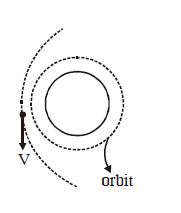
A spaceship approaches the moon (mass $= M$ ) and radius $(R)$ along a parabolic path which almost tangential to its surface. At the moment of maximum approach, the brake rocket is fired to convert the spaceship into a satellite of the moon. Find change in speed
An observer while going on scooter hears sound of two sirens of same frequencies from two opposite directions. If he travels along the direction of one of the siren, then he
A monkey of mass $50\,kg$ climbs on a rope which can withstand the tension $(T)$ of $350\,N$. If monkey initially climbs down with an acceleration of $4\,m / s ^{2}$ and then climbs up with an acceleration of $5\,m / s ^{2}$. Choose the correct option $\left( g =10\,m / s ^{2}\right)$
Two oscillating systems; a simple pendulum and a vertical spring-mass-system have same time period of motion on the surface of the Earth. If both are taken to the moon, then-
A car is moving at a speed of $72\, km/hr.$  the diameter of its wheels is $0.5\, m.$  If the wheels are stopped in $20 $ rotations by applying brakes, then angular retardation produced by the brakes is ............ $ rad/s^2$
Beats are produced by two waves ${y_1} = a\sin 1000\,\pi t,$ ${y_2} = a\sin 998\pi t$The number of beats heard/sec is
The intensity of sound from a radio at a distance of $2$ metres from its speaker is $1 \times {10^{ - 2}}\mu \;W/{m^2}.$ The intensity at a distance of $10$ meters would be
A rope of length $L$ and mass $M$ hangs freely from the ceiling. If the time taken by a transverse wave to travel from the bottom to the top of the rope is $T$, then time to cover first half length is
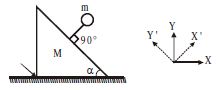
A ball of mass $m$ strikes the inclined face of the wedge normally with speed $v_0$. The wedge is at rest on a rough horizontal surface before collision. The conservation of momentum is applicable for the event of collision for

$(i)$ $m$ as system, along $Y'$
$(ii) $ $M$ as system, along $Y'$
$(iii)$ $(M + m)$ as system, along $X$
$(iv)$  $(M + m)$ as system, along $Y$
Which of the following is correct?
Two identical adiabatic vessels are filled with oxygen at pressure $P_1$ and $P_2 (P_1 > P_2).$ The vessels are interconnected with each other by a nonconducting pipe. If $U_{01}$ and $U_{02}$ denote initial internal energy of oxygen in first and second vessel respectively and $U_{f_1}$ and  $U_{f_2}$ denote final internal energy values, than :