Question
What is convection current? How does it form land and sea breeze?

Answer

As air gets heated up, it becomes lighter and rises up while the heavy upper layer air comes down. This movement is called convection current. Due to this, during day time to fill the space just above the earth's surface, air from sea blows towards earth. During night time, the land gets cooled faster than the water in sea. So, to fill the space just above sea water, air from the land moves. Thus, land and sea breeze are formed.
Need a full question paper?

Generate a complete, print-ready paper with questions like this in minutes — across 16+ boards, with answer keys.

Start Generating Free

Similar questions

In a rotor, a hollow vertical cylinder rotates about its axis and a person rests against the inner wall. At a particular speed of the rotor, the floor below the person is removed and the person hangs resting against the wall without any floor. If the radius of the rotor is $2m$ and the coefficient of static friction between the wall and the person is $0.2.$
  1. Find the minimum speed at which the floor may be removed.
  2. What type of speciality is associated with this question? $[$take, $g = 10m/ s^2]$
Derive an expression for work done against gravity.
Sound waves from a loudspeaker spread nearly uniformly in all directions if the wavelength of the sound is much larger than the diameter of the loudspeaker.
  1. Calculate the frequency for which the wavelength of sound in air is ten times the diameter of the speaker if the diameter is $20\ cm.$
  2. Sound is essentially transmitted in the forward direction if the wavelength is much shorter than the diameter of the speaker. Calculate the frequency at which the wavelength of the sound is one tenth of the diameter of the speaker described above. Take the speed of sound to be $340\ m/s.$
In Exercise, let us take the position of mass when the spring is unstreched as x = 0, and the direction from left to right as the positive direction of x-axis. Give x as a function of time t for the oscillating mass if at the moment we start the stopwatch (t = 0), the mass is:At the maximum stretched position.
In what way do these functions for SHM differ from each other, in frequency, in amplitude or the initial phase?
A mass m is dropped in a tunnel along the diameter of earth from a height $h (< < R)$ above the surface of earth. Find the time period of motion, is the motion simple harmonic?
Explain the reason for change of path of a ball in spinning motion.
Write the three laws of motion.
Why is it necessary to keep the rate of fuel consumption in a rocket constant?
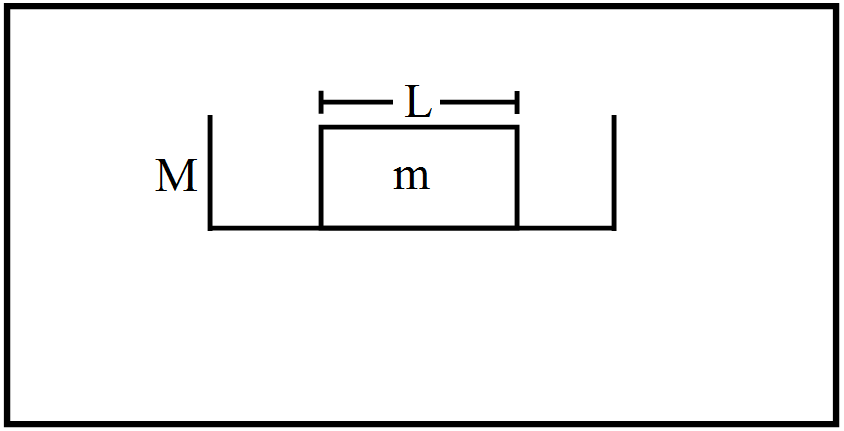
Consider a gravity-free hall in which a tray of mass M, carrying a cubical block of ice of mass m and edge L, is at rest in the middle. If the ice melts, by what distance does the centre of mass of "the tray plus the ice" system descend?
Calculate the temperature whose value is the same on the Celsius and Fahrenheit scale?