Question
What is Depreciation? What is the need for providing Depreciation?

Answer

Describe the two methods of providing Depreciation. Depreciation means fall in the value of tangible fixed asset because of its usage or with efflux of time or due to obsolescence or accident. Depreciation is a permanen, continuing and gradual fall in the value of a fixed asset. Depreciation is provided with the following objectives:
  1. To Determine Correct Profit or Loss: Depreciation is an expense of the business and, therefore, is a charge against revenue. If it is not accounted as an expense, Profit and Loss Account for the accounting period would not give a true and fair view of the profitability of the business (i.e., net profit/ net loss).
  2. To show True and Fair View of the Financial Position: Depreciation, if not charged, would result in assets being stated at a higher value. As a result of this the Position Statement (Balance Sheet) would not present a true and fair view of the financial position.
  3. To determine the Cost of Production: Depreciation is taken into consideration for calculating the cost of production. If it is not taken into account, cost of the production will be lower by the amount of depreciation.
  4. To provide funds for replacement: Depreciation is a non-cash expense and when charged the amount of depreciation is retained in the business and can be used for the replacement of fixed assets after the expiry of their estimated useful life.
  5. To comply with legal provisions: It is necessary to charge depreciation to ith the provisions of the Companies Act and the Income Tax Act.
Depreciation for the year is computed using any of the following two methods:
  1. Fixed Percentage on Original Cost or Fixed Instalment or Straight Line Method; and
  2. Fixed Percentage on Diminishing Balance or Reducing Instalment Method or Written Down Value Method.

Need a full question paper?

Generate a complete, print-ready paper with questions like this in minutes — across 16+ boards, with answer keys.
Start Generating Free

Similar questions

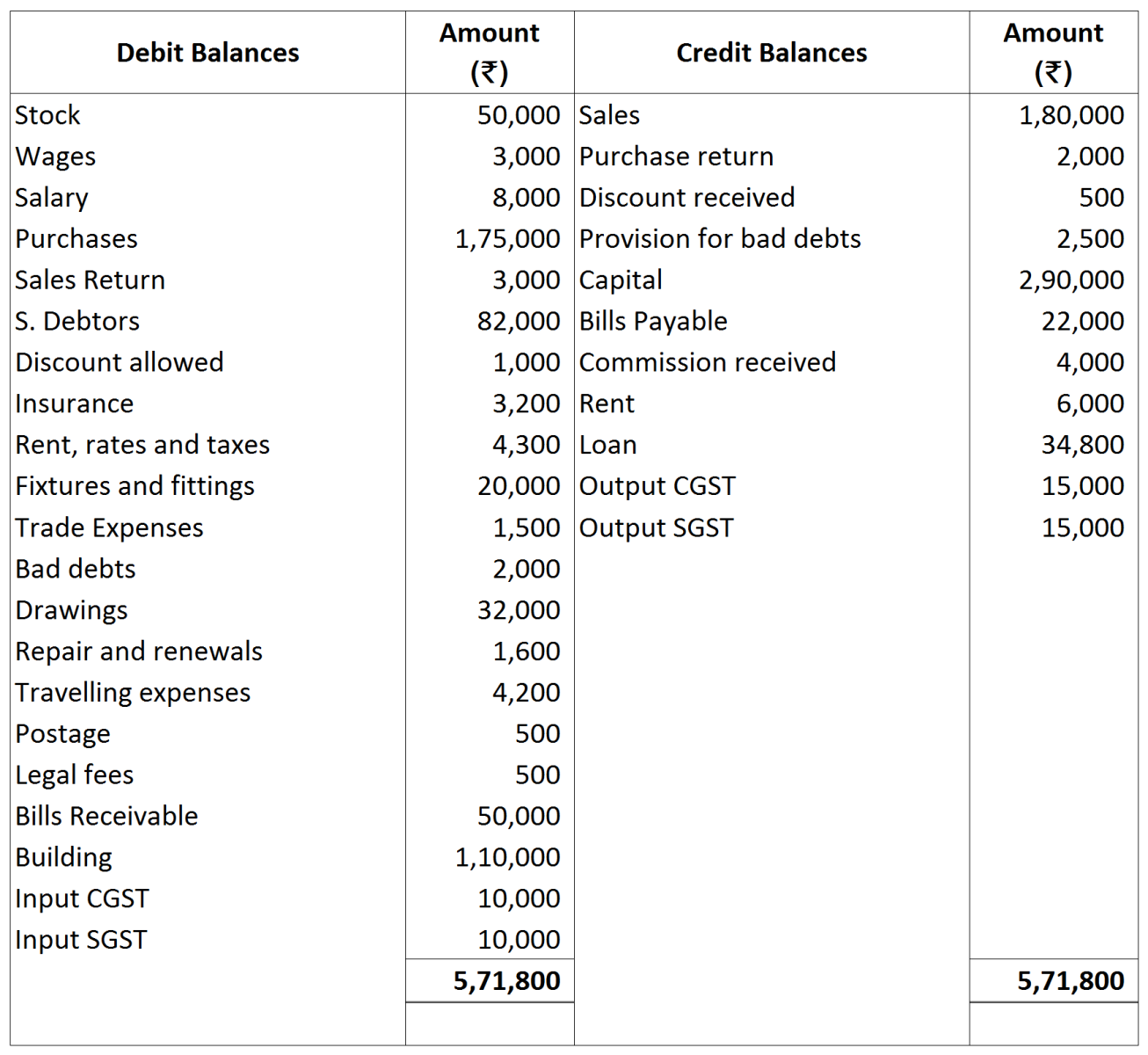
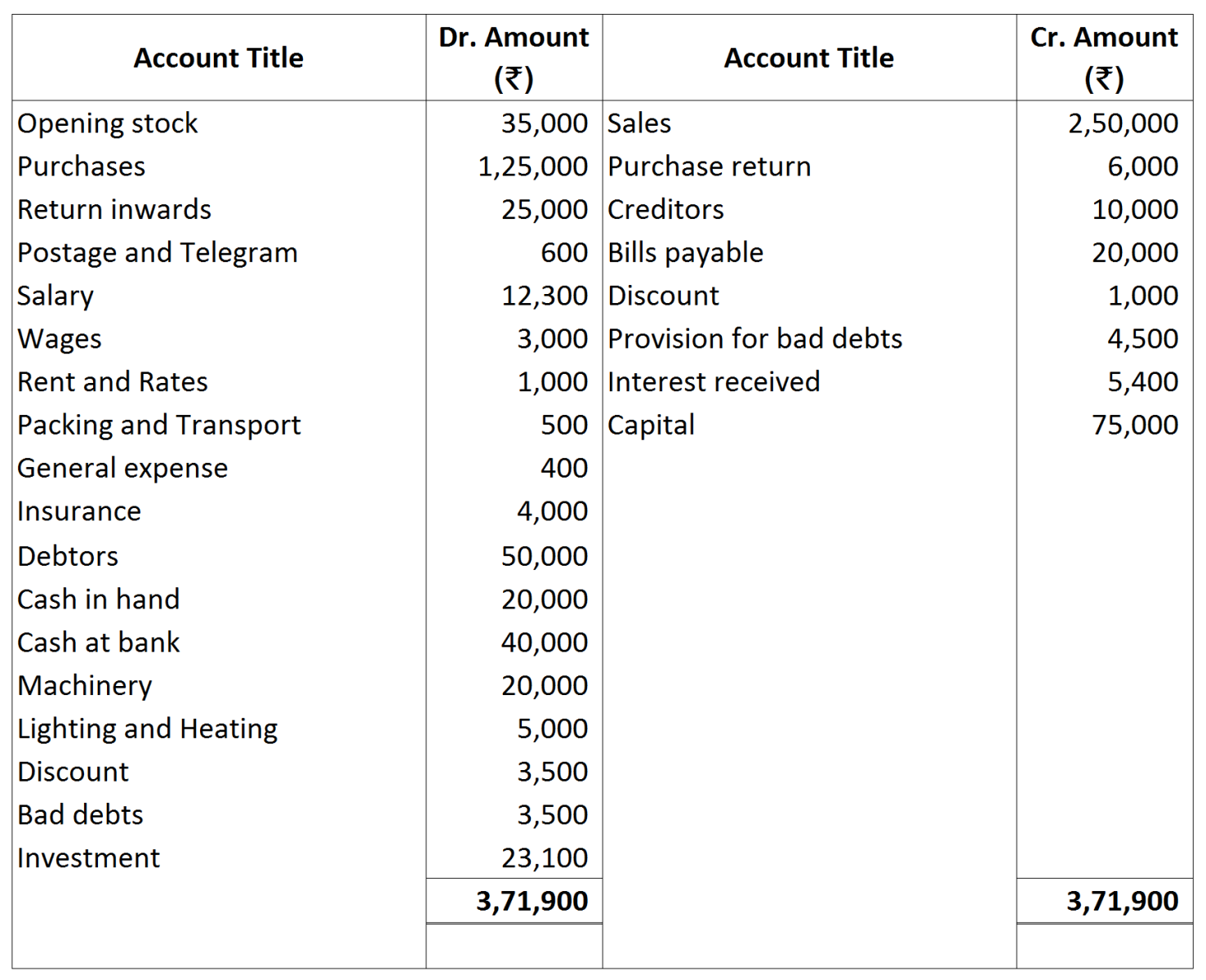
Prepare a trading and profit and loss account of M/s Green Club Ltd. for the year ending March 31, 2017. from the following figures taken from his trial balance :
Adjustments:
  1. Depreciation charged on machinery @ 5% p.a.
  2. Further bad debts 1,500, discount on debtors @ 5% and make a provision on debtors @ 6%.
  3. Wages prepaid 1,000.
  4. Interest on investment @ 5% p.a.
  5. Closing stock 10,000
Give any three points of distinction between Capital Expenditure and Revenue Expenditure.
Give any three limitations of Computer System.
Explain any three of the following:
  1. Retiring of Bills of Exchange.
  2. Holder in due course.
  3. Bills sent to bank for collection.
  4. Noting charges.
On 1st July, 2015, A Co. Ltd. purchases second-hand machinery for ₹ 20,000 and spends ₹ 3,000 on reconditioning and installing it. On 1st January, 2016, the firm purchases new machinery worth ₹ 12,000. On 30th June, 2017, the machinery purchased on 1st January, 2016, was sold for ₹ 8,000 and on 1st July, 2017, a fresh plant was installed.
Payments for this plant was to be made as follows:
1st July, 2017
₹ 5,000
30th June, 2018
₹ 6,000
30th June, 2019
₹ 5,500
Payments in 2018 and 2019 include interest of ₹ 1,000 and ₹ 500 respectively.
The company writes off 10% p.a. on the original cost. The accounts are closed every year on 31st March. Show the Machinery Account for the year ended 31st March, 2018.
X sells goods for ₹ 40,000 to Y on 1st January, 2019 and on the same day draws a bill on Y at three months for the amount. Y accepts it and returns it to X, who discounted it on 4th January, 2019 with his bank at 6% p.a. The acceptance is dishonoured on the due date and the noting charges were paid by bank being ₹ 200.
On 4th April, 2019, Y accepts a new bill at three months for the amount then due to X together with interest at 12% p.a.
Make Journal entries to record these transactions in the books of X.
Prepare a Trading and Profit & Loss account for the year ending March 31, 2018, from the balances extracted of M/s Rahul Sons. Also prepare a balance sheet as at that date.

Adjustments:
  1. Commission received in advance ₹ 1,000.
  2. Rent receivable ₹ 2,000, subject to levy of CGST and SGST @ 9% each.
  3. Salary outstanding ₹ 1,000 and insurance prepaid ₹ 800.
  4. Further Bad-debts ₹ 1,000 and provision for Bad-debts @ 5% on debtors and provision for discount on debtors @ 2%.
  5. Closing Stock ₹ 32,000.
  6. Depreciation on Building @ 6% p.a.
On 1st January, 2019, Ram of Kolkata commenced business with a capital of ₹ 50,000 and entered into following transactions:
Pass the following transactions through proper books to the Ledger. Take out a Trial Balance as on 31st January, 2019. The Cash Book must be balanced.
2019  
Jan. 1 Opened a Bank Account and Deposited ........ 12,500
  Purchased Goods against Cash Payment* ........ 20,000
  Purchased furniture for Shop* ........ 5,000
  Sold goods to R. Raman, Kolkata* ........ 5,000
Jan. 2 Bought goods from Man Mohan, Delhi** ........ 10,000
Jan. 3 Bought stationery and paid by cash ........ 1,000
Jan. 5 Received cash from R. Raman ........ 5,300
  Discount allowed to him ........ 300
Jan. 6 Sold goods to Bimal, Kolkata* ........ 7,500
Jan. 8 Bimal returned part of the goods supplied on the 6th instant ........ 1,500
Jan. 10 Paid cash into bank ........ 1,000
Jan. 12 Paid wages ........ 1,500
Jan. 13 Bought on credit from the Union Furniture Co., Kolkata office desk* ........ 1,500
Jan. 19 Paid wages ........ 1,500
Jan. 21 Paid to Man Mohan by cheque ........ 10,700
  Discount received ........ 500
Jan. 21 Sold goods to Ramesh, Guwahati including IGST** ........ 6,720
Jan. 22 Received cheque from Bimal ........ 6,000
Jan. 23 Bought goods from Man Mohan, Delhi** ........ 7,000
Jan. 24 Drew by cheque for personal use ........ 2,000
Jan. 27 Paid wages ........ 1,500
Jan. 31 Rent due to landlord* ........ 1,000
Transactions marked with (*) are intra-state transactions subject to CGST and SGST @ 6% each.
Transactions marked with (**) are inter-state transactions subject to IGST @ 12%.
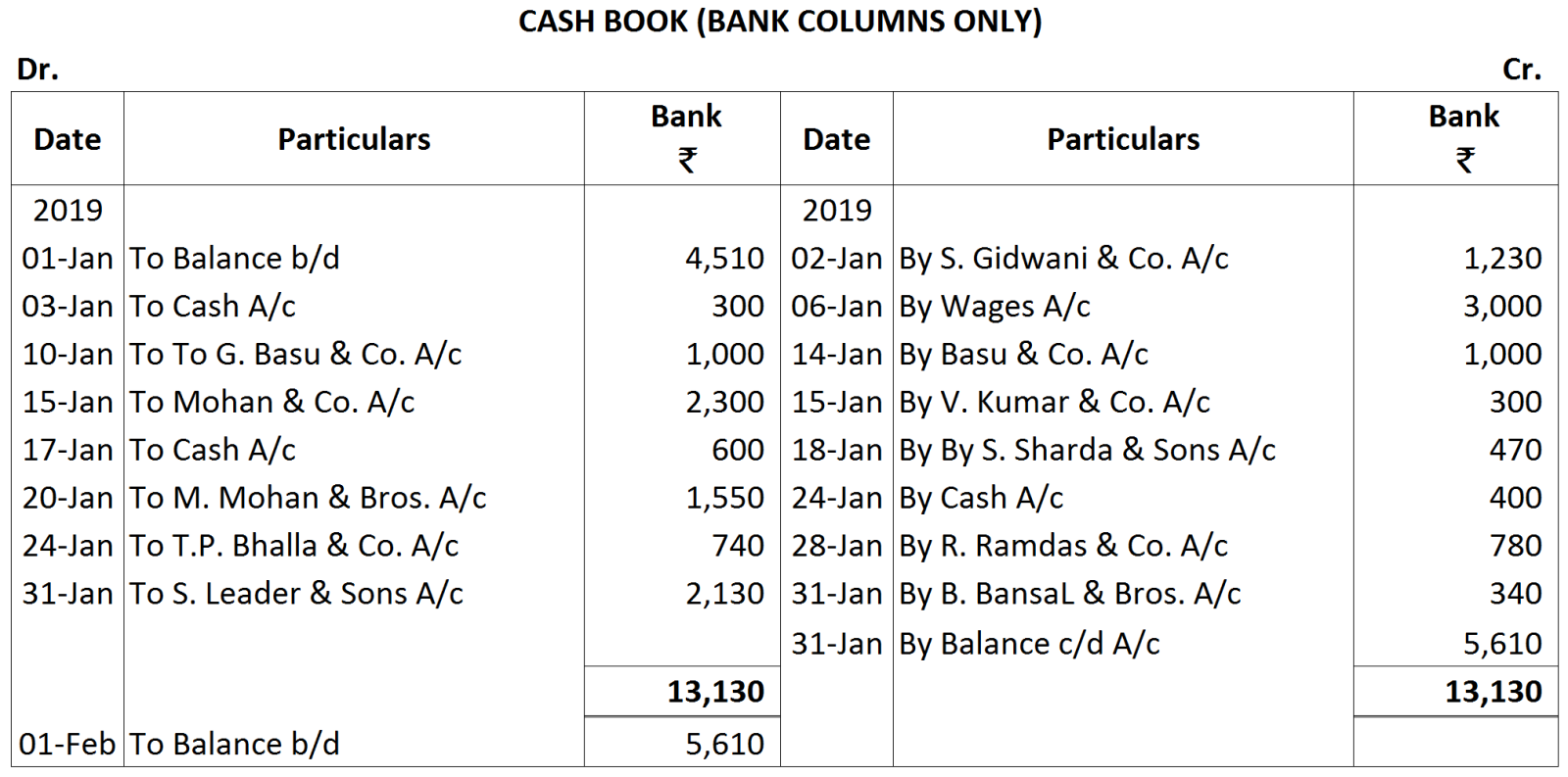
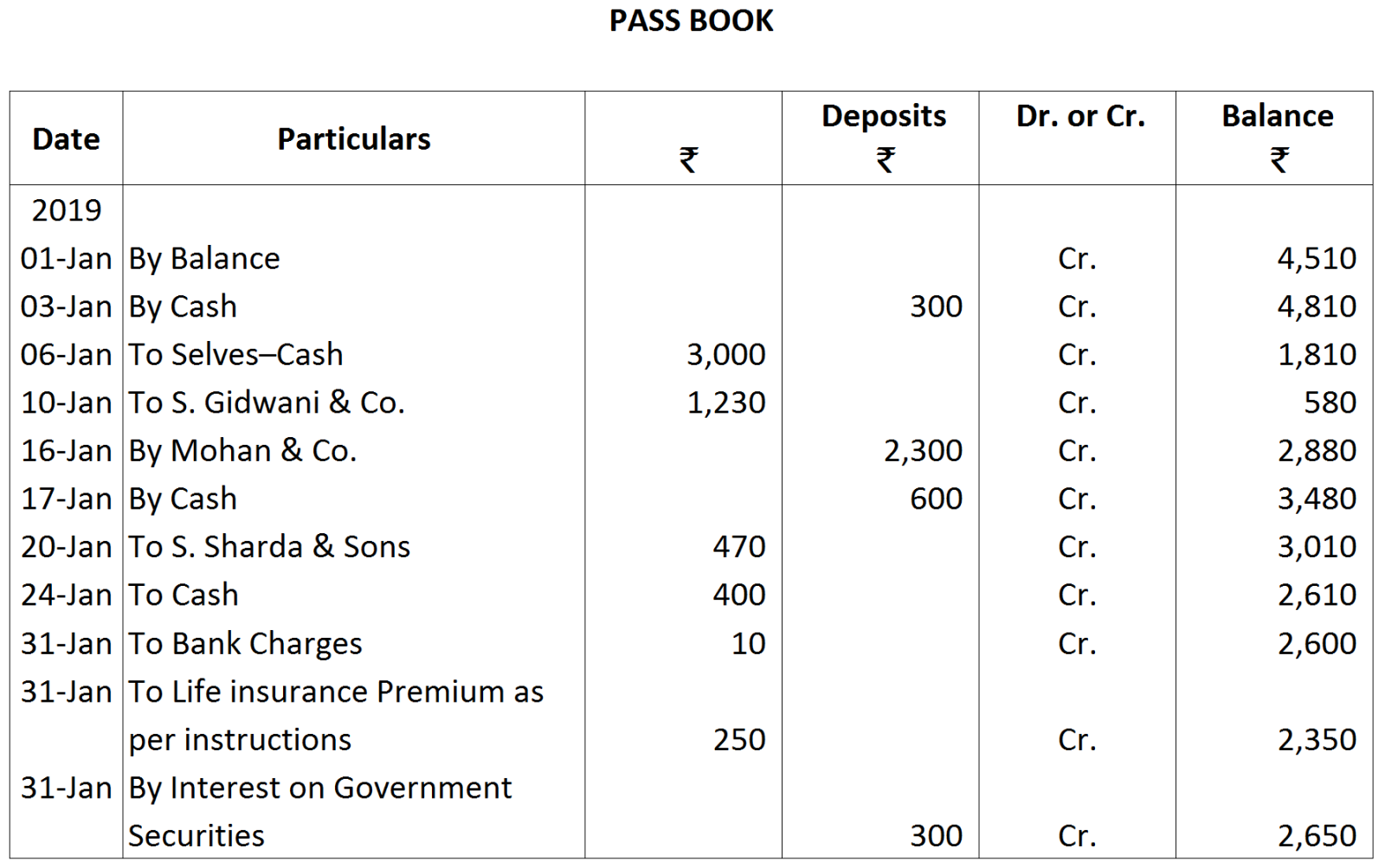
From the following extracts from the Cash Book and the Pass Book for the month of January, 2019, prepare Bank Reconciliation Statement:
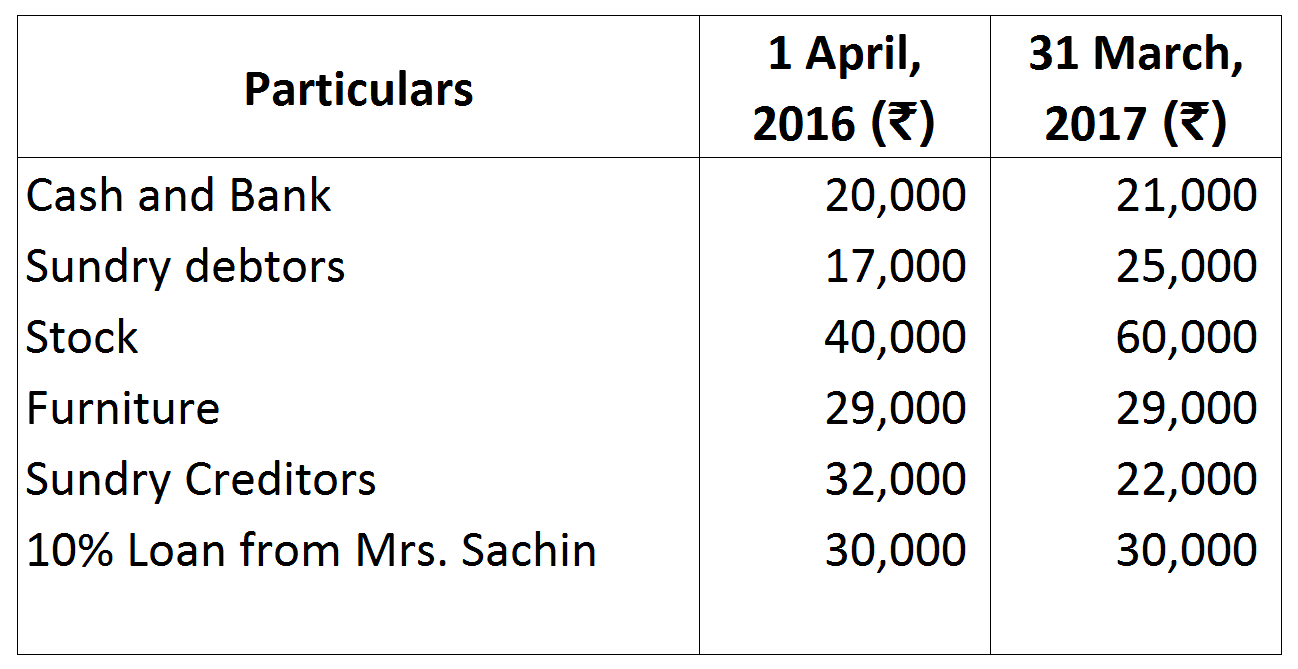
The following information is available from Sachin, who maintains books of accounts on single entry system:
Sachin withdrew $₹\ 5,000$ from the business every month for meeting his household expenses. During the year, he sold investments held by him privately for $₹\ 35,000$ and invested the amount in his business. At the end of the year $2016-17$, it was found that full year's interest on loan from Mrs. Sachin had not been paid. Depreciation $@ 10\%$ per annum was to be provided on furniture for the full year. Shop assistant was to be given a share of $5\%$ on the profits ascertained before charging such share. Calculate profit earned during the year ended $31^{st}$ March, $2017$ by Sachin.