Question
What is differentiation and redifferentiation?

Answer

  1. It is the maturation of cells derived from the apical meristem of the root and shoot. A permanent change in the structure and function of cells leading to maturation is called differentiation.
  2. During cell differentiation, the cell undergoes few to major anatomical and physiological changes. For example, Parenchyma in hydrophytes develops large schizogenous interspaces for mechanical support, buoyancy, and aeration.
  3. The maturation is at the cost of the capacity to divide and redivide.

The cells produced by dedifferentiation once again lose the capacity to divide and mature to perform specific functions. This is called redifferentiation. For example, secondary xylem and secondary phloem are formed from dedifferentiated cambium present in the vascular bundle.

Need a full question paper?

Generate a complete, print-ready paper with questions like this in minutes — across 16+ boards, with answer keys.

Start Generating Free

Similar questions

What are ‘true breeding lines’ that are used to study inheritance pattern of traits in plants?
Give the term for each of the following:
  1. The condition in which both male and female reproductive organs are found on the same plant.
  2. The condition in which both male and female parts are present on the different plants.
  3. Animals that remain reproductively active throughout their reproductive phase.
  4. Animals that remain reproductively active only during the favourable seasons in their reproductive phase.

Genetic Disorders
[Turner’s syndrome, Sickle-cell anaemia, Thalassemia, Edward’s syndrome, Klinefelter’s syndrome, Down’s syndrome]

Column AColumn B
(A) Autosomal disorder—————–
(B) Sex chromosomal disorder—————–
(C) Mendelian disorder—————-

Classify the given plant hormones as their specific effect observed in plants in Column A and complete Column B.
(ABA, GA, Ethylene, Kinetin)

Column AColumn B
(1) Bolting of rosette plants————-
(2) Epinasty————
(3) Closure of stomata————-
(4) Proliferation of callus————-
The development of embryo sac is described as monosporic.
How do microbes reduce the environmental degradation caused by chemicals?
What are the different techniques by which foreign DNA can be transferred to host cell without using a vector?
Identify the type of the given ecological pyramid and give one example each of pyramid of number and pyramid of biomass in such cases.
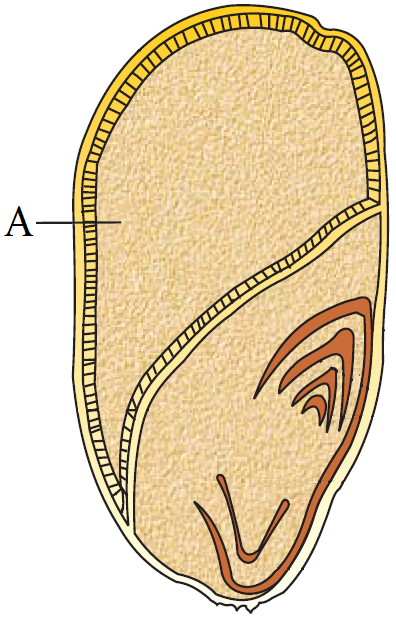
Given below is a section of a maize grain. Identify ‘A’ and state its function.
With the help of a neat and labelled diagram explain VAM (vesicular arbuscular mycorrhizae).