Question
What is diffraction of light? How does it differ from interference? What are Fraunhoffer and Fresnel diffractions?

Answer

1. Phenomenon of diffraction of light: When light passes by the edge of an obstacle or through a small opening or a narrow slit and falls on a screen, the principle of rectilinear propagation of light from geometrical optics predicts a sharp shadow. However, it is found that some of the light deviates from its rectilinear path and penetrates into the region of the geometrical shadow. This is a general characteristic of wave phenomena, which occurs whenever a portion of the wavefront is obstructed in some way. This bending of light waves at an edge into the region of geometrical shadow is called diffraction of light.

2. Differences between interference and diffraction :

  1. The term interference is used to characterise the superposition of a few coherent waves (say, two). But when the superposition at a point involves a large number of waves coming from different parts of the same wavefront, the effect is referred to as diffraction.
  2. Double-slit interference fringes are all of equal width. In single-slit diffraction pattern, only the non-central maxima are of equal width which is half of that of the central maximum.
  3. In double-slit interference, the bright and dark fringes are equally spaced. In diffraction, only the non-central maxima lie approximately halfway between the minima.
  4. In double-slit interference, bright fringes are of equal intensity. In diffraction, successive non-central maxima decrease rapidly in intensity.

[Note : Interference and diffraction both have their origin in the principle of superposition of waves. There is no physical difference between them. It is just a question of usage. When there are only a few sources, say two, the phenomenon is usually called interference. But, if there is a large number of sources the word diffraction is used.]

3. Diffraction can be classified into two types depending on the distances involved in the experimental setup :

(A) Fraunhofer diffraction : In this class of diffraction, both the source and the screen are at infinite distances from the aperture. This is achieved by placing the source at the focus of a convex lens and the screen at the focal plane of another convex lens.
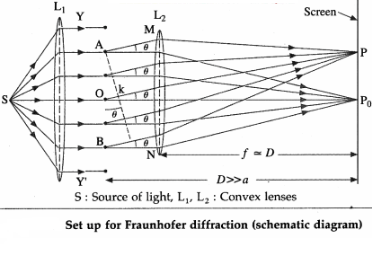
Image
(B) Fresnel diffraction : In this class of diffraction, either the source of light or the screen or both are at finite distances from the diffracting aperture. The incident wavefront is either cylindrical or spherical depending on the source. A lens is not needed to observe the diffraction pattern on the screen.

Need a full question paper?

Generate a complete, print-ready paper with questions like this in minutes — across 16+ boards, with answer keys.

Start Generating Free

Similar questions

A rectangular wire frame of size $2 cm \times 2 cm$, is dipped in a soap solution and taken out. A soap film is formed, if the size of the film is changed to $3 cm \times 3 cm$, calculate the work done in the process. The surface tension of soap film is $3 \times 10^{-2} N / m$.
On the basis of the kinetic theory of gases, derive an expression for the pressure exerted by the gas.
Explain analytically how stationary waves are formed. What are nodes and antinodes? Show that distance between two adjacent nodes or antinode is \(\frac{\lambda}{4}\).
The speed of water is $2 m / s$ through a pipe of internal diameter $10 cm$. What should be the internal diameter of nozzle of the pipe if the speed of water at nozzle is $4 m / s$ ?
 
Obtain an expression for energy of an electron in Bohr orbit. Hence obtain the expression for its binding energy.
Derive an expression for the effective or equivalent capacitance (capacity) of a combination of a number of capacitors connected in series.
OR
Derive an expression for the effective capacitance of three capacitors connected in series.
What is vertical circular motion? Comment on its two types.
Calculate the wavelength associated with an electron, its momentum and speed
(a) when it is accelerated through a potential of $54\ V$
Calculate the value of capacitance in picofarad, which will make 101.4 micro henry inductance to oscillate with frequency of one megahertz.
A pipe open at both ends has the fundamental frequency $n$. If the pipe is immersed vertically in water up to half its length, what would be the fundamental frequency of the resulting air column?