Question
What is doping ? - Explain.

Answer

"The deliberate addition of a desired impurity is called doping. And the impurity atoms are called dopants. Such a material is also called a doped semiconductor (or extrinsic semiconductors or impurity semiconductors.)".
The dopant atom (impurity atom) has to be such that it does not distort the original pure semiconductor lattice.
It occupies only a very few of the original semiconductor sites in the crystal. A necessary condition to attain this is that the sizes of the dopant and the semiconductor atoms should be nearly same.
Generally a small amount, say, a few parts per million (ppm), of a suitable impurity is added to the pure semi-conductor. Due to the added impurity atoms, the conductivity of the semiconductor is increased manifold.
There are two types of dopants used in doping the tetravalent $S i$ or Ge:
(i) Pentavalent (Valency 5) : like Arsenic (As), Antimony (S $b$ ), Phosphorous ( P ), etc.
(ii) Trivalent (Valency 3) : like Indium (I $n$ ) Boron (B), Aluminium $( A l$ ) etc.

Need a full question paper?

Generate a complete, print-ready paper with questions like this in minutes — across 16+ boards, with answer keys.
Start Generating Free

Similar questions

An iron needle is attracted to the ends of a bar magnet but not to the middle region of the magnet. Is the material making up the ends of a bar magnet different from that of the middle region?
Suppose the amplitude of a simple pendulum having a bob of mass m is $\theta_0.$ Find the tension in the string when the bob is at its extreme position.
Using Bohr’s atomic model, derive the expression for the radius of $n^{th}$ orbit of the revolving electron in a hydrogen atom.
Three charges $-q, Q$ and $-q$ are situated at equal distances in a straight line. If the total potential energy of the system of all three charges is zero, then what will be the value of ratio $Q : q$ ?
Describe/Explain single slit diffraction using a simple day to day life example.
###
Describe a simple experiment (/activity) to see single slit diffraction.
Calculate the potential energy of a system of two charges in an external field.
A sphere of radius 5 cm has a charge of 31.41 µC. Calculate the surface density of charge.
Calculate the orbital period of the electron in the first excited state of hydrogen atom.
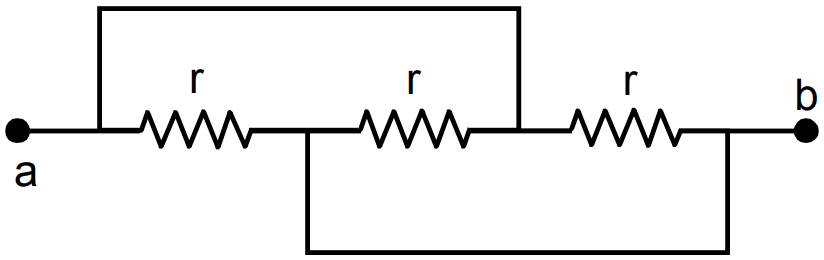
Find the equivalent resistance of the network shown in figure. between the points a and b.
In the Rutherford's nuclear model of the atom, the nucleus (radius about $10^{-15} m$ ) is analogous to the sun about which the electron move in orbit (radius $\approx 10^{-10} m$ ) like the earth orbits around the sun. If the dimensions of the solar system had the same proportions as those of the atom, would the earth be closer to or farther away from the sun than actually it is? The radius of earth's orbit is about $1.5 \times 10^{11} m$. The radius of sun is taken as $7 \times 10^8 m$.