Question
What is Double-Entry System? Explain its principles and advantages.

Answer

Meaning of Double Entry System: According to this system every business transaction affects at least two accounts in opposite directions. For example, if the furniture is purchased in the business, furniture is increased whereas the cash is decreased. There can be no transaction in the business which affects only one account or which has only one aspect. As such, both the aspects of every transaction are recorded under this system. It may, however, be noted that the double entry does not mean that a transaction is recorded twice. But it means that at least two accounts are affected by a transaction - one account receiving a benefit and the other account yielding a benefit. The person or the account receiving a benefit is debited and the person or the account who gives something to the business is credited. The amount of every transaction is written twice, once as a debit and again as a credit. For example, we received ₹ 25,000 from Mohan. This transaction affects two accounts - Cash Account and the Mohan's Account. Cash account is receiving a benefit (as cash is coming in) and hence Cash account will be debited, whereas Mohan is yielding a benefit and hence his account will be credited.
Principles or Characteristics of Double Entry System: Double Entry System is based upon the principle that “Every debit has a credit and every credit has a debit”. Following are the important features or essentials of the double entry system.
  1. Every bussiness transaction affects two accounts: Every business transaction has a two-fold effect, i.e., it affects two accounts simultaneously. One of them is debited and the other is credited. Certain transactions may affect more than two accounts but the amount of the accounts to be debited and credited will always be equal.
  2. Recording of both personal and impersonal aspects: Both personal and impersonal aspects of a transaction are recorded in Double Entry. It is possible that both the aspects of a transaction may be personal or both may be impersonal or one may be personal and the other may be impersonal.
The advantages of Double Entry System are:
  1. Scientific System: Double Entry System is a scientific system of recording business transactions as compared to other systems of Book Keeping. It helps attain the objectives of accounting.
  2. Complete Record of Transactions: Under the system, both sides of a transaction are recorded. It is a complete record as it results in showing correct income or loss, assets and liabilities.
  3. Arithmetical Accuracy of Accounts is Ensured: By the use of this system, arithmetical accuracy of the accounting work can be established throagh the Trial Balance.
  4. Determining Profit or Loss: Profit earned or loss incurred during a period can be determined by preparing Profit and Loss Account.

Need a full question paper?

Generate a complete, print-ready paper with questions like this in minutes — across 16+ boards, with answer keys.

Start Generating Free

Similar questions

Journalise the following transactions in the Journal of M/s. Gupta Brothers (Prop. Shri R. K. Gupta), Delhi and post them to the Ledger:
2019
 
March 1
Started business with cash
2,00,000
March 2
Opened bank account with SBI
80,000
March 4
Goods purchased from Raj, Jaipur (Rajasthan)
22,000
March 5
Goods purchased for cash
30,000
March 8
Goods sold to Naman, Delhi
12,000
March 10
Cash paid to Raj
22,000
March 15
Cash received from Naman
11,700
Discount allowed
300
March 16
Paid wages
200
March 18
Furniture purchased for office use
5,000
March 20
Withdrawn from bank for personal use
4,000
March 22
Issued cheque for rent
3,000
March 23
Goods taken for household purpose. These goods were purchased from Raj
2,000
March 24
Drawn cash from bank for office use
6,000
March 26
Commission received
1,000
March 27
Bank charges
300
March 28
Cheque issued for life insurance premium of Proprietor
3,000
March 29
Paid salary
10,000
March 30
Cash sales
20,000
Record the following transactions in the books of Sahdev & Sons assuming all transactions have been entered within the state of Bihar, Charging CGST and SGST @ 9% each.
1.
Bought goods from Nanak Bros. for ₹ 4,00,000 at 10% trade discount and 3% cash discount on purchase price. 25% of the amount paid at the time of purchase.
2.
Sold goods to Kumar & Sons. for ₹ 2,00,000 at 20% trade discount and 5% cash discount on sale price. 60% of the amount received by Cheque.
3.
Received from Gopi Chand ₹ 38,000 by Cheque after deducting 5% cash discount.
4.
Paid ₹ 20,000 for rent by Cheque.
5.
Paid ₹ 50,000 for salaries by Cheque.
6.
Goods worth ₹ 10,000 distributed as free samples.
7.
₹ 5,000 due from Chanderkant are bad-debts.
8.
Sold household furniture for ₹ 15,000 and the proceeds were invested into business.
Trial Balance of Madan did not agree and he put the difference to Suspense Account. He discovered the following errors:
  1. Sales Returns book overcast by ₹ 800.
  2. Purchases returns to Sahu ₹ 2,000 were not posted to his account.
  3. Goods purchased on credit from Narula ₹ 4,000 though taken into stock, but no entry was passed in the books.
  4. Installation charges on new machinery purchased ₹ 500 were debited to sundry expenses account as ₹ 50.
  5. Rent paid for residential accommodation of Madan (the proprietor) ₹ 1,400 was debited to Rent A/c as ₹ 1,000.
Rectify the errors and prepare Suspense Account to ascertain the difference in Trial Balance.
Mention the subsidiary books in which following transactions are recorded along with reason thereof:
  1. Purchase of furniture on credit for use in shop.
  2. Sale of goods on credit.
  3. Goods returned by Debtors.
  4. Purchase of stock on credit.
  5. Providing for interest on capital to proprietor.
  6. Goods returned to creditors.
  7. Sale of goods for cash.
Pass entries in the books of all parties in the following cases assuming CGST @ 6% and SGST @ 6%:
2018
 
March 1
Mahesh Chandra of Bihar purchased goods for ₹ 1,00,000 from Sunil Soren of Jharkhand and sold the same to Deepak Patnaik of Odisha for ₹ 1,50,000.
March 5
Deepak Patnaik sold goods to Suresh Yadav of Odisha for ₹ 1,80,000.
March 10
Suresh Yadav sold goods to Ravi Chakravarti of West Bengal for ₹ 2,50,000.
March 14
Ravi Chakravarti sold goods costing ₹ 2,50,000 to Sanjay Diwedi of West Bengal at a profit of 40% on cost.
Rajesh Kumar was unable to reconcile his Trial Balance as on 31st March 2014 and has opened a suspense account from the difference. Later on the following errors were discovered:-
  1. There were three compensating errors:-
  1. The total of Sales Return Book was overcast by ₹ 100.
  2. The total of one page of the Purchase Book was carried forward as ₹ 1,286 instead of ₹ 1,826.
  3. Goods purchased from C for ₹ 400 was debited to his account as ₹ 40.
  1. ₹ 425 paid for wages to workmen for making office table were debited to wages account.
  2. Rent paid ₹ 1,500 were posted to the credit of Rent account as ₹ 150.
  3. Cash received from Ghanshyam ₹ 500 were correctly recorded in cash book but were posted to his account as ₹ 50.
  4. ₹ 720 paid to Kamal has been debited to Kamlesh A/c as ₹ 520.
  5. The total of Purchase Return Book ₹ 2,500 was left unposted.
Pass rectifying entries and prepare Suspense A/c.
Prepare an Accounting Equation from the following:
  1. Started business with cash ₹ 50,000 and goods ₹ 30,000.
  2. Purchased goods for cash ₹ 30,000 and on credit from Karan ₹ 20,000.
  3. Goods costing ₹ 40,000 were sold for ₹ 55,000.
  4. Withdrew cash for personal use ₹ 10,000.
  5. Rent outstanding ₹ 2,000.
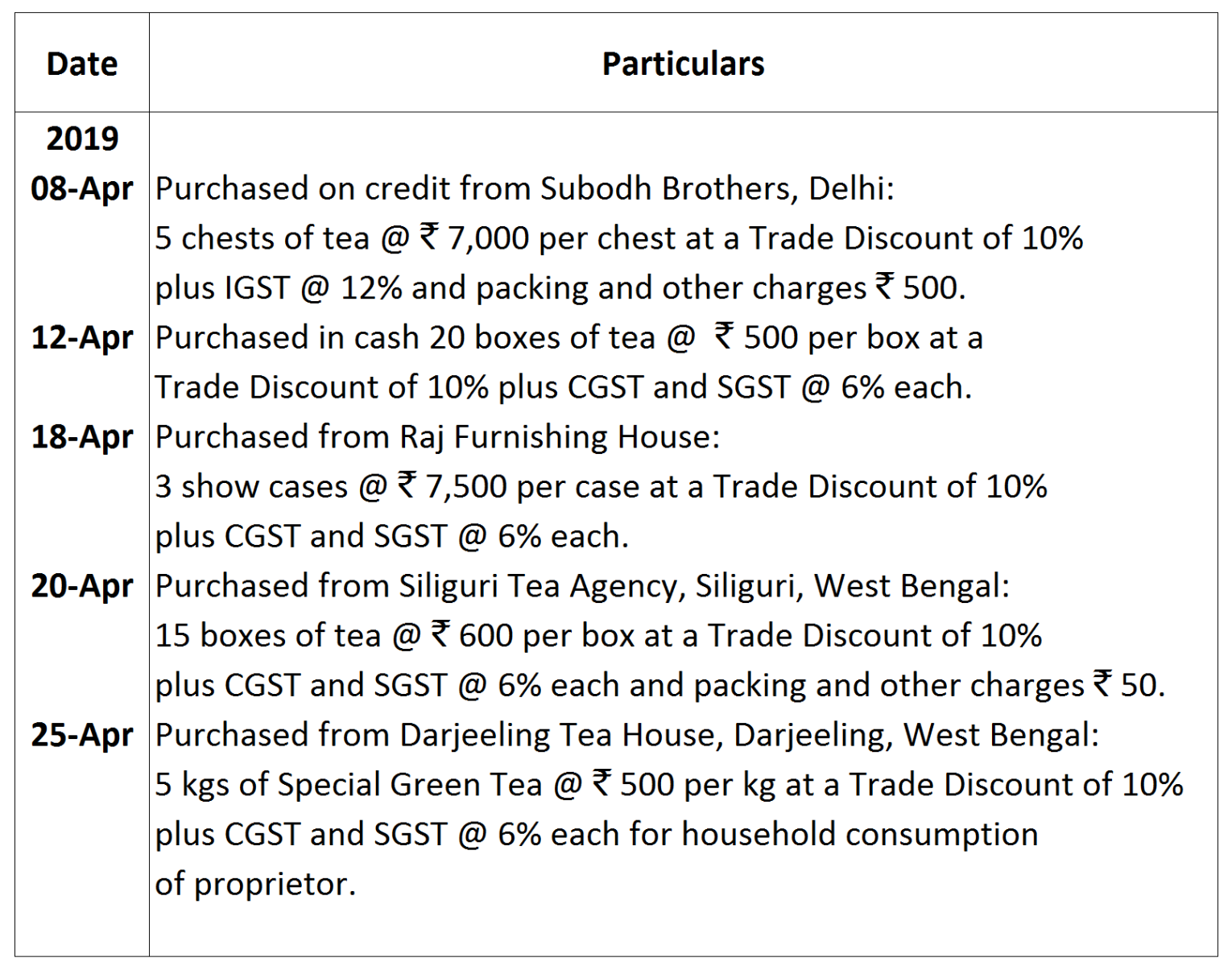
The following purchases were made by Karam, Kolkata, during the month of April, 2019. Prepare Purchases Book and post into Ledger Accounts:
Following was the position of Harish & Co. as on 1st April, 2017:
Cash in Hand ₹ 10,000; Cash at Bank ₹ 16,800; Furniture ₹ 8,000; Stock ₹ 50,000; Debtors−Ram ₹ 8,000; Shyam ₹ 12,000; Creditors−Anil ₹ 4,000; Sunil ₹ 5,000.
Following transactions took place during April, 2017:
2017
 
April 2
Received a cheque from Ram in full settlement of his account after deducting 5% cash discount.
April 4
Deposited the above cheque into Bank.
April 5
Goods purchased for ₹ 20,000 at 10% trade discount and 5% cash discount. Payment made by cheque.
April 6
Discount allowed to him ₹ 140. Cheque deposited into the bank on the same day.
April 10
Cash paid to Anil after deducting 2% cash discount.
April 15
Old furniture sold for ₹ 800.
April 16
Sold goods to Shiv Parshad of the list price of ₹ 10,000 at a trade discount of 15%.
April 18
Shiv Parshad returned goods of the list price of ₹ 1,000.
April 20
Paid for furniture repairs to Bahadur Singh ₹ 100.
April 25
Received a cheque from Shiv Parshad after deducting 4% cash discount. Cheque was deposited into bank.
April 28
Bank charged ₹ 50 for 'Bank Charges'.
April 30
Received Commission ₹ 200.
Pass Journal entries for the above transactions.
Prove that accounting equation is satisfied in all the following cases:
  1. Commenced business with cash ₹ 50,000.
  2. Paid rent ₹ 4,000 including ₹ 1,000 as advance.
  3. Bought goods for cash ₹ 30,000 and on credit ₹ 20,000.
  4. Sold the goods bought on credit for ₹ 25,000.
  5. Purchased furniture worth ₹ 10,000 for office use and for ₹ 5,000 for domestic use.