Question
What is electrode potential?

Answer

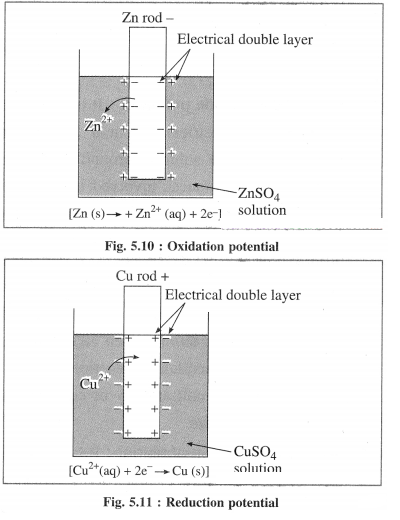
(1) Electrode potential : It is defined as the difference of electrical potential established due to electrode half reaction between metal electrode and the solution around it at equilibrium at constant temperature.

(2) Explanation : When a metal is immersed into a solution containing its ions there arises oxidation (or reduction) reaction involving a release of electrons (or gain of electrons). This gives rise to the formation of an electrical double layer, consisting of a charged metal surface and an ionic layer. The potential across this double layer i.e., between metal and the solution is an electrode potential.

Image

Need a full question paper?

Generate a complete, print-ready paper with questions like this in minutes — across 16+ boards, with answer keys.
Start Generating Free

Similar questions

Calculate the amount of work done in the
(a) oxidation of $1$ mole $HCl_{(g)}$ at $200 ^\circ\ C$ according to reaction.
$4HCl_{(g)} + O_2_{(g)} \rightarrow 2 Cl_2_{(g)} + 2 H_2O_{(g)}$​​​​​​​
(b) decomposition of one mole of NO at 300 °C for the reaction
$2 NO_{(g)} \rightarrow N_2_{(g)} + O_2$​​​​​​​
Which of the following species are reducing agents? Arrange them in order of increasing strength under standard state conditions. The standard potentials are given in parenthesis.
$K (-2.93V), Br_2(1.09V), Mg(-2.36V), Co^{3+}(1.61V), Ti^{2+}(-0.37V), Ag^+(0.8V), Ni (-0.23V)$.
Write the electronic configuration of $Mn^{6+}, Mn^{4+}, Fe^{4+}, Co^{5+}, Ni^{2+}.$
Derive the relationship between degree of dissociation and dissociation constant in weak electrolytes.
The vapour pressure of water at 20 °C is 17 mm Hg. What is the vapour pressure of solution containing 2.8 g urea in 50 g of water? (16.17 mm Hg)
Predict all the alkenes that would be formed by dehydrohalogenation of the following alkyl halide.
  1. 2-chloro-2-methylbutane
  2. 3-bromo-2,2,3-trimethylpentane
Using Nernst equation, calculate the potentials for the following half reactions :
(a) $I _{2( s )}+2 e ^{-} \longrightarrow 2 I ^{-},\left[ I ^{-}\right]=0.03 M$,
$E_{ I ^{-} / I _2}^0= 0 . 5 3 5 V .$
(b) $Fe _{\text {(aq) }}^{3+}+ e ^{-} \longrightarrow Fe _{(\text {aq }}^{2+},\left[ Fe ^{2+}\right]=0.1 M$, $\left[ Fe ^{3+}\right]=0.01 M \quad E ^0 Fe ^{3+}, Fe ^{2+}=0.771 V$.
Why is Nickel-cadmium cell referred to as a secondary cell?
Isothermal process and Adiabatic process.
What is the action of 2,4-Dinitrophenylhydrazine on
(1) Acetaldehyde
(2) Acetone
(3) Butanone
(4) Benzaldehyde ?###Complete and rewrite the balanced chemical equation : Butanone + 2, 4-Dinitrophenylhydrazine.