Question
What is f-block element?

Answer

→ The element in which last electron fill in f-orbital is known as f-block element.
→ f-block element is known as inner transition element.
→ The elements constituting the f-block are those in which the 4f and 5f orbitals progressively filled.
→ The two series of the inner transition metals, (4f and 5f) are known as lanthanoids and actinoids respectively.

Need a full question paper?

Generate a complete, print-ready paper with questions like this in minutes — across 16+ boards, with answer keys.
Start Generating Free

Similar questions

A galvanic cell has electrical potential of 1.1V. If an opposing potential of 1.1V is applied to this cell, what will happen to the cell reaction and current flowing through the cell?
Give structures of the products you would expect when each of the following alcohol reacts with $\ce{SOCl_2}$
$(i)$ Butan$-1-ol$
$(ii) \ 2-$Methylbutan$-2-ol$
Write the chemical equations involved in the following reactions:
  1. Hoffmann-bromamide degradation reaction.
  2. Carbylamine reaction.
 
Which of the following compounds $(a)$ and $(b)$ will not react with a mixture of $\ce{NaBr}$ and $\ce{H_2SO_4}$. Explain why?
  1. $\text{CH}_3\text{CH}_2\text{CH}_2\text{OH}$
Cyanide ion acts as an ambident nucleophile. From which end it acts as a stronger nucleophile in aqueous medium? Give reason for your answer.
Which alkyl halide from the following pairs would you expect to react more rapidly by an $\ce{S_N2}$ mechanism? Explain your answer.
$\ \ \ \ \ \ \ \ \ \ \ \ \ \ \ \ \ \ \ \ \ \ \ \ \ \ \ \ \ \ \ \ \ \ \ \ \ \ \ \ \ \ \ \ \ \ \text{CH}_3\\\ \ \ \ \ \ \ \ \ \ \ \ \ \ \ \ \ \ \ \ \ \ \ \ \ \ \ \ \ \ \ \ \ \ \ \ \ \ \ \ \ \ \ \ \ \ \ \mid\\\text{CH}_3\text{CH}_2\text{CH}\text{CH}_3\ \text{or}\ \text{H}_3\text{C}-\text{C}-\text{Br}\\\ \ \ \ \ \ \ \ \ \ \ \ \ \ \ \ \mid\ \ \ \ \ \ \ \ \ \ \ \ \ \ \ \ \ \ \ \ \ \ \ \ \ \ \ \mid\\\ \ \ \ \ \ \ \ \ \ \ \ \ \ \ \text{Br}\ \ \ \ \ \ \ \ \ \ \ \ \ \ \ \ \ \ \ \ \ \ \ \ \ \ \text{CH}_3$
Write following conversions:
  1. Nitrobenzene → acetanilide.
  2. Acetanilide → p-nitroaniline.
Define the following terms:
  1. Abnormal molar mass.
  2. van’t Hoff factor (i).
Elimination reactions $($especially $\beta-$elimination$)$ are as common as the nucleophilic substitution reaction in case of alkyl halides. Specify the reagents used in both cases.
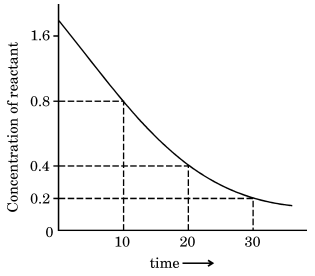
Analyse the given graph, drawn between concentration of reactant vs. time.
Image
(a) Predict the order of reaction.
(b) Theoretically, can the concentration of the reactant reduce to zero after infinite time? Explain.