MCQ
What is formed when a ketone is reduced?
  • A
    Primary alcohol
  • Secondary alcohol
  • C
    Tertiary alcohol
  • D
    Phenol

Answer

Correct option: B.
Secondary alcohol
b

Need a full question paper?

Generate a complete, print-ready paper with questions like this in minutes — across 16+ boards, with answer keys.

Start Generating Free

Similar questions

Match List $I$ with List $II$

List $I$ Oxide List $II$ Type of Bond
$A$ $N _2 O _4$ $I$.  $1 N = O$ bond
$B$ $NO _2$ $II$. $1 N - O - N$ bond
$C$ $N _2 O _5$ $III$. $1 N - N$ bond
$D$ $N _2 O$ $IV$.  $1 N = N / N \equiv N$ bond

Choose the correct answer from the options given below:
A mixture has $18\,g$  water and $414\,g$  ethanol. The mole fraction of water in mixture is (assume ideal behaviour of the mixture)
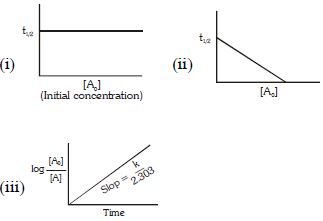
In the following graphs, which graph $(s)$ belong to first order
The charcoal maintained at ${100^o}\,C$ absorbs
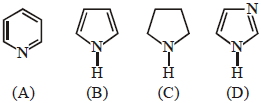
The increasing order of basicity of the following compounds is
At $363\,K ,$ the vapour pressure of $A$ is $21 \,kPa$ and that of $B$ is $18\, kPa$. One mole of $A$ and $2$ moles of $B$ are mixed. Assuming that this solution is ideal, the vapour pressure of the mixture is ....... $kPa$. (Round of to the Nearest Integer).
Element Electronegative value
$W$ $2.7$
$X$ $2.1$
$Y$ $0.8$
$Z$ $3.4$

The incorrect statement regarding given information is

Assertion : The molecular weight of acetic acid determined by depression in freezing point method in benzene and water was found to be different.

Reason : Water is polar and benzene is nonpolar.

A solution containing $10 \mathrm{~g}$ of an electrolyte $\mathrm{AB}_2$ in $100 \mathrm{~g}$ of water boils at $100.52^{\circ} \mathrm{C}$. The degree of ionization of the electrolyte $(\alpha)$ is............ $\times 10^{-1}$.

(nearest integer)

[Given : Molar mass of $\mathrm{AB}_2=200 \mathrm{~g} \mathrm{~mol}^{-1} \cdot \mathrm{K}_{\mathrm{b}}$

(molal boiling point elevation const. of water)

$=0.52 \mathrm{~K} \mathrm{~kg} \mathrm{~mol}^{-1}$, boiling point of water $=100^{\circ} \mathrm{C}$;

$\mathrm{AB}_2$ ionises as $\left.\mathrm{AB}_2 \rightarrow \mathrm{A}^{2+}+2 \mathrm{~B}^{-}\right]$

For $Zn - Cu$ cell, $E ^{\circ}=1.10 V$. If the reduction potential $\left[ Cu ^{2+}{ }_{( aq )} / Cu _{( s )}\right]$ pair is 0.34 V , then the reduction potential of $\left[ Zn ^{2+}{ }_{(a q)} / Zn _{( s )}\right]$ pair will be :