MCQ
What is formed when Iodine is absorbed by hypo solutoin ?
  • A
    $NaI_3$
  • B
    $Na_4S_4O_6$
  • C
    $Na_2S_4O_6$
  • $Na_3S_4O_6$

Answer

Correct option: D.
$Na_3S_4O_6$
d
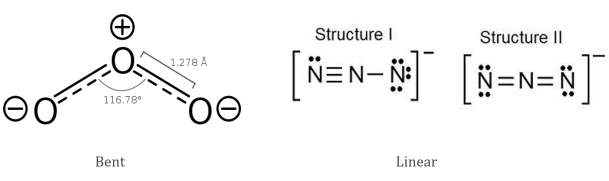
The structures of $\mathrm{O}_{3}$ and $\mathrm{N}_{3}^{-}$ are shown in figure. They have bent and linear structures respectively.

Need a full question paper?

Generate a complete, print-ready paper with questions like this in minutes — across 16+ boards, with answer keys.

Start Generating Free

Similar questions

Anisole $\frac{excess\, HI \,(conc.)}{reflux}$ Product
In a molecule of phosphorus $(V)$ oxide, there are
In which of the following, addition of $HBr$ does not take place against Markownikoff's rule or Anti-Markownikoff addition of $HBr$ is not observed for
Which of the following is most acidic
Addition of $HCl$ to vinyl chloride gives $1, 1-$dichloroethane because of
By how much would the oxidising power of the $(MnO_4^- / Mn^{2+})$ couple change if  the $H^+$ ion concentration is increased upto $100 \,times$ at $25\,^oC$ ?
The total number of isomers for a square planar complex $[M(F)(Cl)(SCN (NO_2)]$ is
Answer the following by appropriately matching the lists based on the information given in the paragraph Consider the Bohr's model of a one$-$electron atom where the electron moves around the nucleus. In the following List$-I$ contains some quantities for the $n^{t /}$ orbit of the atom and List$-II$ contains options showing how they depend on $n$. Which of the following options has the correct combination considering List$-I$ and List$-II$?
List$-I$ List$-II$
$(I)$ Radius of the $n^{\text {th }}$ orbit $(P)$ $\propto n ^{-2}$
$(II)$ Angular momentum of the electron in the $n^{\text {th }}$ orbit $(Q)$ $\propto n ^{-1}$
$(III)$ Kinetic energy of the electron in the $n^{\text {th }}$ orbit $(R)$ $\propto n ^0$
$(IV)$ Potential energy of the electron in the $n^{\text {th }}$ orbit $(S)$ $\propto n ^1$
  $(T)$ $\propto n ^2$
  $(U)$ $\propto n ^{1 / 2}$
$(1)$ Which of the following options has the correct combination considering List$-I$ and List$-II$?
$(1) (II), (R) (2) (I), (P) (3) (I), (T) (4) (II), (Q)$
$(2)$ Which of the following options has the correct combination considering List$-I$ and List$-II$?
$(1) (III), (S) (2) (IV), (Q) (3) (IV),(U) (4) (III), (P)$
Give the answer or quetion $(1)$ and $(2)$
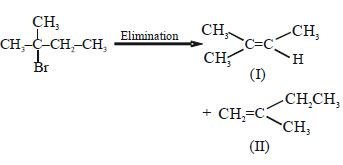
Consider the following reaction Which of the following base will give the best yield of the alkene $II$ as the major product
The first, second and third Ionisation energies $(E_1 , E_2$ and $E_3)$ for an element  are $7\, eV, 12.5\,eV$ nnd $42.5\, eV$ respectively. The most stable oxidation state of the  element will be