Question
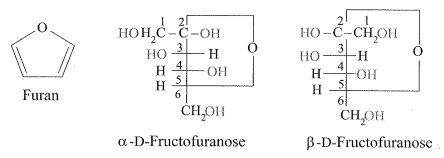
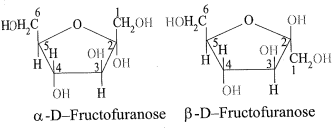
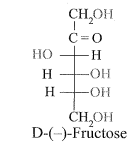
What is fructose? Explain the structure of fructose.

Need a full question paper?

Generate a complete, print-ready paper with questions like this in minutes — across 16+ boards, with answer keys.

Start Generating Free

Similar questions

Read the passage given below and answer the following questions:

At the freezing point of a solvent, the solid and the liquid are in equilibrium. Therefore, a solution will freeze when its vapour pressure becomes equal to the vapour pressure of the pure solid solvent. It has been observed that when a non-volatile solute is added to a solvent, the freezing point of the solution is always lower than that of the pure solvent. Depression in freezing point can be given as, $\Delta\text{T}_\text{f}=\text{K}_\text{f}\text{m}$ Where, Kf = Molal freezing point depression constant or we can write, $\Delta\text{T}_\text{f}=\frac{\text{K}_\text{f}\times\text{W}_\text{B}\times1000}{\text{W}_A\times\text{M}_\text{B}}$

a statement of assertion followed by a statement of reason is given. Choose the correct answer out of the following choices.

  1. Assertion and reason both are correct statements and reason is correct explanation for assertion.
  2. Assertion and reason both are correct statements but reason is not correct explanation for assertion.
  3. Assertion is correct statement but reason is wrong statement.
  4. Assertion is wrong statement but reason is correct statement.
  1. Assertion: 0.1M solution of glucose has same depression in the freezing point as 0.1M solution of urea.

Reason: Kf for both has same value.

  1. Assertion: Increasing pressure on pure water decreases its freezing point.

Reason: Density of water is maximum at 273K.

  1. Assertion: Larger the value of cryoscopic constant of the solvent, lesser will be the freezing point of the solution.

Reason: Extent of depression in the freezing point depends on the nature of the solvent.

  1. Assertion: The water pouch of instant cold pack for treating athletic injuries breaks when squeezed and NH4N03 dissolves thus lowering the temperature.

Reason: Addition of non-volatile solute into solvent results into depression of freezing point of solvent.

  1. Assertion: If a non-volatile solute is mixed in a solution then elevation in boiling point and depression in freezing point both wiII be same.

Reason: Elevation in boiling point and depression in freezing point both depend on number of particles of solute.

Read the passage given below and answer the following questions:

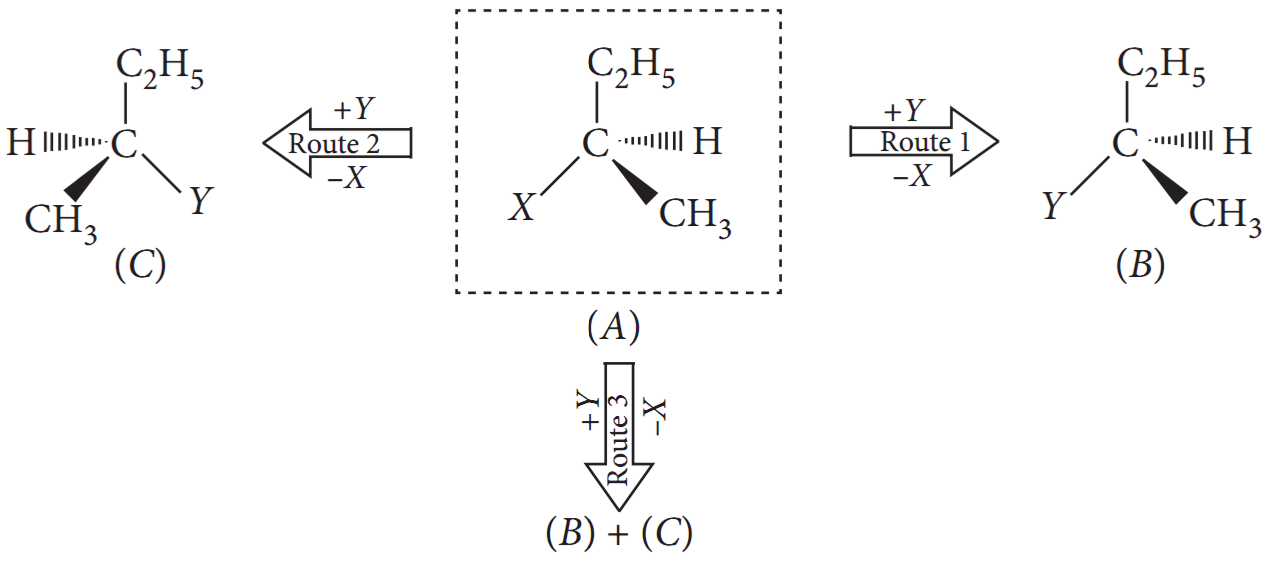
When a chemical reaction involves bond cleavage or bond formation at an asymmetric carbon atom, three different products may be formed. For example, during the substitution of a group X by Y in the following reaction, the three possible products may be shown below:

  1. If Bis the only product, the process is called retention of configuration because B has the same configuration as the starting reactant (A).
  2. If C is the only product, the process is called inversion of configuration because C has the configuration opposite to the starting reactant (A).
  3. If an equimolar mixture of Band C (r.e., a 50 : 50 mixture) is fanned, then the process is called racemisation and the product is optically inactive because one isomer will rotate the light in the direction opposite to another.

In these questions (Q. No. i-iv), a statement of assertion followed by a statement of reason is given. Choose the correct answer out of the following choices.

  1. Assertion and reason both are correct statements and reason is correct explanation for assertion.
  2. Assertion and reason both are correct statements but reason is not correct explanation for assertion.
  3. Assertion is correct statement but reason is wrong statement.
  4. Assertion is wrong statement but reason is correct statement.
  1. Assertion: A reaction is said to be stereospecific if a particular stereoisomer of the reactant produces a specific stereoisomer of the product.

Reason: Bromination of cis-2-butene gives meso-2, 3-dibromobutane which is stereospecific.

  1. Assertion: Addition of Br2 to cis-but-2-ene is stereoselective.

Reason: SN2 reactions are stereospecific as well as stereoselective.

  1. Assertion: Optically active 2-iodobutane on treatment with Nal in acetone undergoes recemization.

Reason: Repeated Walden inversions on the reactant and its product eventually gives a racemic mixture.

  1. Assertion: SN2 reaction of an optically active alkyl halide with an aqueous solution of KOH always gives an alcohol with opposite sign of rotation.

Reason: SN2 reactions always proceed with inversion of configuration.

  1. Assertion: Nudeophilic substitution reaction of an optically active alkyl halide gives a mixture of en an ti om ers.

Reason: The reaction occurs by SN2 mechanism.


What change in the concentration of H₂ will triple the rate of reaction?
(c). Suppose a reaction between A and B, was experimentally found to be first order with respect to both A and B. So the rate equation is:
Rate = k[A][B]
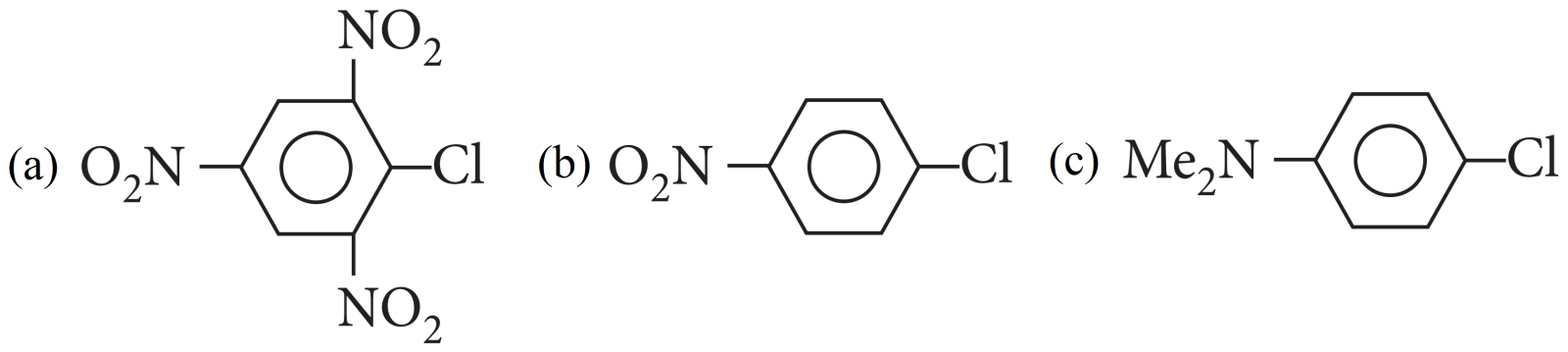
Which of these two mechanisms is consistent with this experimental finding? Why?
Mechanism 1
A → C + D (slow)
B+C → E (fast)
Mechanism 2
A+B →C + D (slow)
C → E (fast)
Read the passage given below and answer the following questions:

Williamson's synthesis is used for the preparation of symmetrical as well as unsymmerical ether. It is SN2 reaction mechanism. In Williamson's synthesis, 1º alkyl halide are used for preparation of ethers because 2º and 3º alkyl halide give alkene. Ethers are cleaved by hydrogen halides to alcohol and alkyl halide where alkyl halide is corresponding to that alkyl which has less number of carbon atom (it is because of less steric hindrance). In polar media unsymmetrical ether like tertiary butyl ethyl ether gives ethyl alcohol and tertiary butyl halide as reaction proceeds via carbocation.

In these questions (Q. No. i-iv), a statement of assertion followed by a statement of reason is given. Choose the correct answer out of the following choices.

  1. Assertion and reason both are correct statements and reason is correct explanation for assertion.
  2. Assertion and reason both are correct statements but reason is not correct explanation for assertion.
  3. Assertion is correct statement but reason is wrong statement.
  4. Assertion is wrong statement but reason is correct statement.
  1. Assertion: Rate of reaction of alkyl halide in Williamson's synthesis reaction is 1ºRX > 2ºRX > 3ºRX.

Reason: It is a type of bimolecular substitution reaction (SN2).

  1. Assertion: T-Butyl methyl ether is not prepared by the reaction of t-butyl bromide with sodium methoxide.

Reason: Sodium methoxide is a weak nucleophile.

  1. Assertion: Williamson's synthesis method cannot be used for preparing diphenyl ether.

Reason: Aryl halides do not undergo nucleophilic substitution easily.

  1. Assertion: When isopropyl bromide is treated with sodium isopropoxide, di-isopropyl ether is obtained as a major product.

Reason: With secondary alkyl halides, both substitution and elimination occur.

  1. Assertion: Both symmetrical and unsymmetrical ethers can be prepared by Williamson's synthesis.

Reason: Williamson's synthesis is an example of nucleophilic substitution reaction.
For a reaction, A + B → Products, the rate law is – Rate = k[A][B]3/2 Can the reaction be an elementary reaction? Explain.
A reaction is said to be of the first order if the rate of the reaction depends upon one concentration term only. For a first order reaction of the type A → Products, the rate of the reaction is given as: rate = k[A]. The differential rate law is given as: $\frac{\text{dA}}{\text{dt}}=-\text{k}[\text{A}].$ The integrated rate law is: In $\frac{[\text{A}]}{[\text{A}]_0}=-\text{kt},$ [A] is the concentration of reactant left at time t and [A]0 is the initial concentration of the reactant, k is the rate constant.
The following questions are multiple choice questions. Choose the most appropriate answer:
  1. The unit of rate constant for a first order reaction is:
  1. S-1
  2. mol L-1 s-1
  3. L mol-1 s-1
  4. L2 mol-2 s-1
  1. Half-life period of a first order reaction is 10min. Starting with initial concentration 12M, the rate after 20min is:
  1. 0.693 × 3M min-1
  2. 0.0693 × 4M min-1
  3. 0.0693 × M min-1
  4. 0.0693 × 3M min-1
  1. 50% of a first order reaction is complete in 23 minutes. Calculate the ti me required to complete 90% of the reaction.
  1. 70.4 minutes.
  2. 76.4 minutes.
  3. 38.7 minutes.
  4. 35.2 minutes.
  1. For a first order reaction, (A) → products, the concentration of A changes from 0.1M to 0.025M in 40 minutes. The rate of reaction when the concentration of A is 0.01M, is:
  1. 3.47 × 10⁻⁴ M/ min
  2. 3.47 × 10⁻⁵ M/ min
  3. 1.73 × 10⁻⁴ M/ min
  4. 1.73 × 10⁻⁵ M/ min
  1. The half-life period ofa 1st order reaction is 60 minutes. What percentage will be left over after 240 minutes?
  1. 6.25%
  2. 4.25%
  3. 5%
  4. 6%

Read the passage given below and answer the following questions:

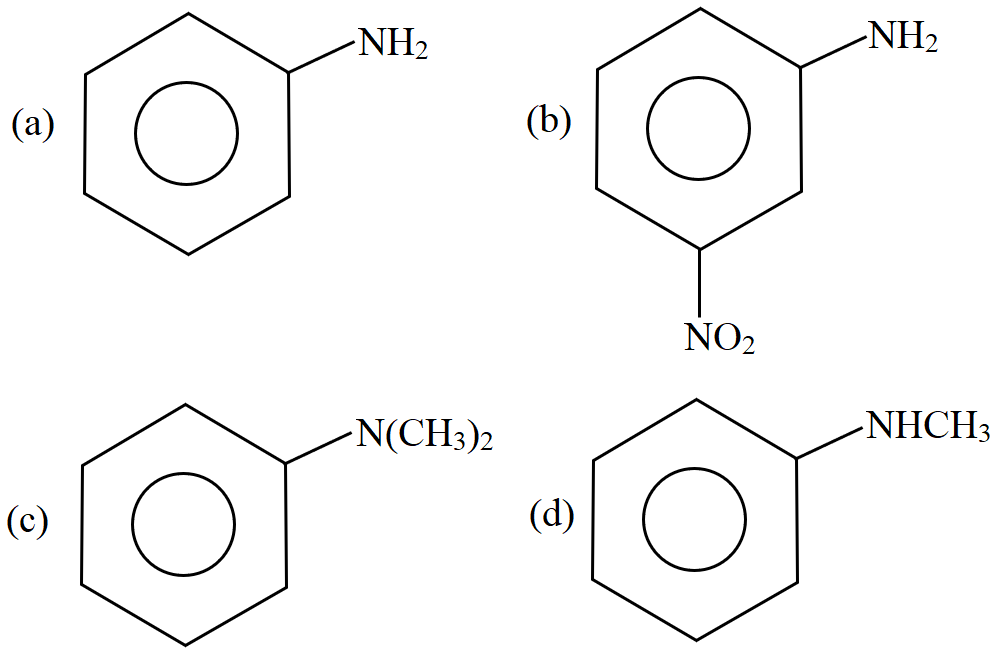
Amines are basic in nature. The basic strength of amines can be expressed by their dissociation constant, Kb or pKb.

$\text{RNH}_2+\text{H}_2\text{O}\rightleftharpoons\text{RNH}^+_3+\text{OH}^-$

$\text{k}_\text{b}=\frac{[\text{RNH}^+_3][\text{OH}^-]}{[\text{RNH}_2]}\text{and}\text{ pk}_\text{b}=-\log\text{k}_\text{b}$

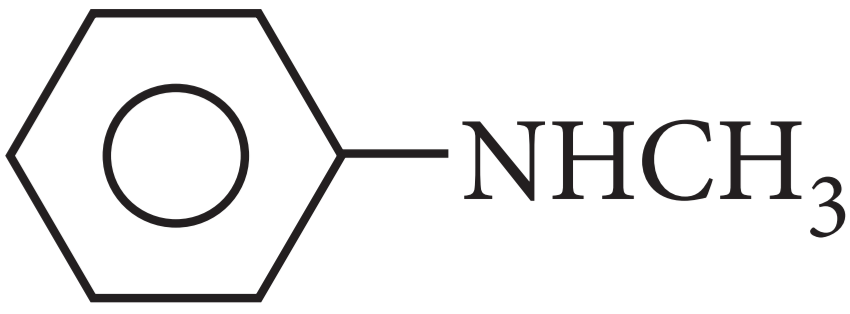
Greater the Kb value or smaller the pKb value, more is the basic strength of a mine. Aryl amines such as aniline are less basic than aliphatic amines due to the involvement of lone pair of electrons on N-atom with the resonance in benzene. In derivatives of aniline, the electron releasing groups increase the basic strength while electron withdrawing groups decrease the basic strength. The base weakening effect of electron withdrawing group and base strengthening effect of electron releasing group is more marked at p-position than at m-position. a-Substituted aniline is less basic than aniline due to ortho effect and is probable due to combination of electronic and steric effect.

The following questions are multiple choice questions. Choose the most appropriate answer:

  1. Which of the following has lowest pKb value?

  1. The strongest base among the following is:
  1. C6H5NH2

  2. p-NO2 - C6H4NH2

  3. m-NO2 - C6H4NH2

  4. C6H5CH2NH2

  1. Maximum pKb value of:
  1.  

  1.  

  1. (CH3CH2)2NH

  2. (CH3)2NH

  1.  The order of basic strength among the following amines in benzene solution is:
  1. Methylamine is more basic than NH3.
  2. Amines form hydrogen bonds.
  3. Ethylamine has higher boiling point than propane.
  4. Dimethylamine is less basic than methylamine.
  1. CH3CH2NH2 contains a basic -NH2 group, but CH3CONH2 does not because:
  1. Acetamide is amphoteric in character.
  2. In ethylamine the electron pair on N-atom is delocalised by resonance.
  3. In ethylamine there is no resonance while in acetamide the lone pair of electrons on N-atom is delocalised and is less available for protonation.
  4. None of these.