Question
What is fuel cell.

Answer

→ We know that a galvanic cell directly converts chemical energy into electricity and is highly efficient.
→ It is now possible to make such cells in which reactants are fed continuoulsy to the electrodes and products are removed continuously from the electrolyte compartment.
→ "Galvanic cells that are designed to convert the energy of combustion of fuels like hydrogen. methane, methanol. etc. directly into electrical energy are called fuel cells."
→ Fuel cells are pollution free. Fuel cells produce electricity with an efficiency of about 70% compared to thermal plants whose efficiency is about 40%.

Need a full question paper?

Generate a complete, print-ready paper with questions like this in minutes — across 16+ boards, with answer keys.
Start Generating Free

Similar questions

Given that the standard electrode potentials (Eo) of metals are:
K+/K = –2.93 V, Ag+/Ag = 0.80 V, Cu2+/Cu = 0.34 V,
Mg2+/Mg = -2.37 V, Cr3+/Cr = – 0.74 V, Fe2+/Fe = – 0.44 V.
Arrange these metals in an increasing order of their reducing power. 
Compare the chemistry of the actinoid with that of lanthanoids with reference to:
Chemical reactivity.
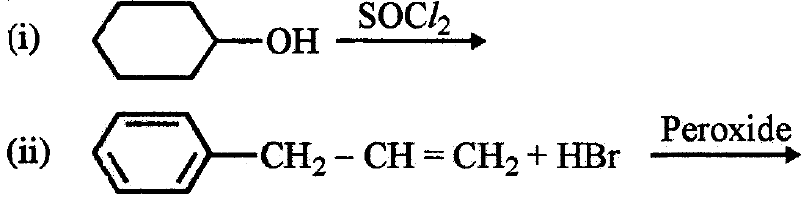
Draw the structure of major monohalo product in each of the following reactions:

Sucrose decomposes in acid solution into glucose and fructose according to the first order rate law, with t1/2 = 3.00 hours. What fraction of sample of sucrose remains after 8 hours?
Using the standard electrode potentials given in Table 3.1, predict if the reaction between the following is feasible:
Br2 (aq) and Fe2+ (aq).
Define the following terms:
  1. Abnormal molar mass.
  2. van’t Hoff factor (i).
Write complete reaction for the bromination of phenol in aqueous and non aqueous medium.
Henry’s law constant for the molality of methane in benzene at 298 K is 4.27 × 105 mm Hg. Calculate the solubility of methane in benzene at 298 K under 760 mm Hg.
Determine the values of equilibrium constant (KC) and $\Delta$Go for the following reaction:
$\text{Ni (s)}+\text{2Ag}^{+}\text{(aq)}\rightarrow\text{Ni}^{2+}+\text{2Ag(s)},\text{E}^{o}=1.05\text{V}\ \ \ (\text{IF} = 96500 \text{C mol}^{–1}).$
Write the name of the cell which is generally used in transistors. Write the reactions taking place at the anode and the cathode of this cell.