Question
What is Genetic variations? Explain the different factors responsible for genetic variations.

Answer

Genetic variations : The change in gene and gene frequencies is known as genetic variation. Genetic variations are caused by following factors:
(i) Mutations : Sudden permanent heritable change is called mutation. Mutation can occur in the gene, in the chromosome structure and in chromosome number. Mutation that occurs within the single gene is called point mutation or gene mutation. This leads to the change in the phenotype of the organism, causing variations.

(ii) Genetic recombination : In sexually reproducing organisms, during gamete formation, exchange of genetic material occurs between non-sister chromatids of homologous chromosomes. This is called crossing over. It produces new genetic combinations which result in variation. Fertilization between opposite mating gametes leads to various recombinations resulting into the phenotypic variations. These result in change in the frequencies of alleles.

(iii) Gene flow : Gene flow is movement of genes into or out of a population. Gene movement may be in the form of migration of organism, or gametes (dispersal of pollens) or segments of DNA (transformation). Gene flow also alters gene frequency causing evolutionary changes.

(iv) Genetic drift : Any random fluctuation (alteration) in allele frequency, occurring in the natural population by pure chance, is called genetic drift. For example, when the size of a population is severely reduced due to natural disasters like earthquakes, floods, fires, etc. elimination of particular alleles from a population becomes possible. Smaller populations have greater chances for genetic drift. It results in the change in the gene frequency. Genetic drift is also an important factor for evolutionary change.

(v) Chromosomal aberrations : The structural, morphological change in chromosome due to rearrangement of genes is called chromosomal aberrations. Due to changes in the gene arrangement or gene sequence variations are caused.

Need a full question paper?

Generate a complete, print-ready paper with questions like this in minutes — across 16+ boards, with answer keys.
Start Generating Free

Similar questions

In your view, what motivates the youngsters to take to alcohol or drugs and how can this be avoided?
Draw a neat diagram of the female reproductive system and label the parts associated with the following.
  1. Production of gamete.
  2. Site of fertilisation.
  3. Site of implantation.
  4. Birth canal.
Samya visited a zoo with her mother, on watching the cheetah, she wondered how he uses his forelimbs for running. While the same forelimbs in bats are used for flying. She wanted to know more about it and so asked her mother (a biology teacher) about it. Her mother explained her how forelimbs are modified in different animal groups for different functions.
  1. What are such organs called?
  2. Give an example of such organs from the plant world.
  3. What led to the origin of such organs?
  4. What are the values shown by Samya?
How were simple organic molecules formed on the earth?
Applications of tissue culture.
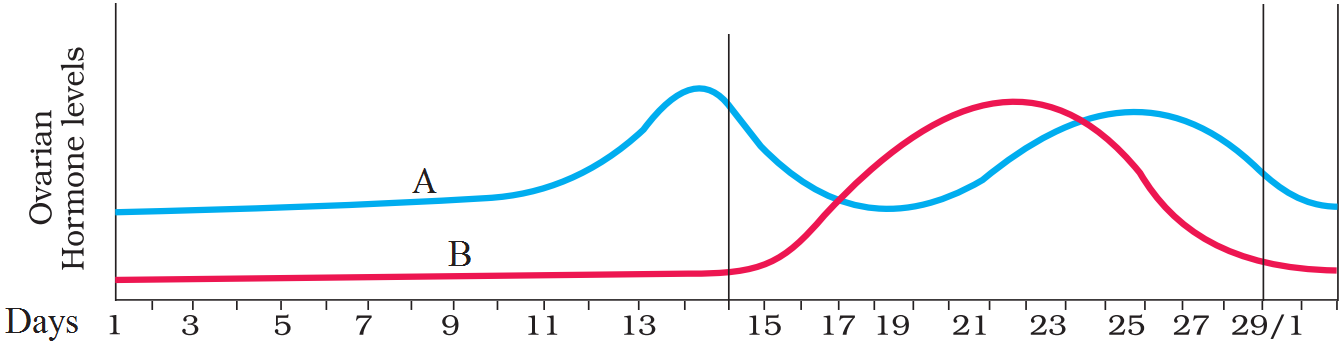
The graph given below shows the variation in the levels of ovarian hormones during various phases of menstrual cycle:
Compare the role of A and B.
Give reasons:
(a) Oxytocin is 'birth hormone'.
(b) People living in hilly region are advised to use iodised salt.
(c) Old age persons show weakened immune response.
(d) Pancreas is a dual gland.
You are given a red flower–bearing pea plant and a red flower–bearing snapdragon plant. How would you find the genotypes of these two plants with respect to the colour of the flower? Explain with the help of crosses. Comment upon the pattern of inheritance seen in these two plants.
  1. Compare giving reasons, the J-shaped and S-shaped models of population growth of a species.
  2. Explain 'fitness of a species', as mentioned by Darwin.
List the various abiotic environmental factors.