Question
What is Global Positioning System? Explain its working principle in brief.

Answer

Global Positioning System is method of identifying location or position of any point or a person on earth using a system of 24 satellites, which are continuously orbiting, observing, monitoring and mapping the earth.
Working Principle:
  1. The unique location of GPS user is determined by measuring its distance from at least three GPS satellites.
  2. Using these values of distances, obtained from three satellites, a microprocessor, fitted in GPS device, determines the exact location.

Need a full question paper?

Generate a complete, print-ready paper with questions like this in minutes — across 16+ boards, with answer keys.

Start Generating Free

Similar questions

A monkey of mass 15kg is climbing on a rope with one end fixed to the ceiling. If it wishes to go up with an acceleration of 1m/s2, how much force should it apply to the rope? If the rope is 5m long and the monkey starts from rest, how much time will it take to reach the ceiling?
Mention the important considerations required while fabricating a p-n junction diode to be used as a Light Emitting Diode (LED). What should be the order of band gap of an LED if it is required to emit light in the visible range?
Prove that the instantaneous rate of change of the activity of a radioactive substance is inversely proportional to the square of its half-life.
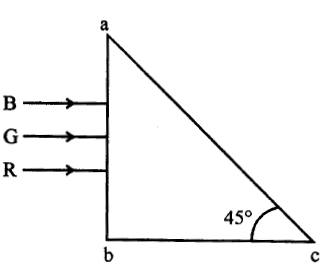
Three light rays red (R), green (G) and blue (B) are incident on a right-angled prism ‘abc’ at face ‘ab’. The refractive indices of the material of the prism for red, green and blue wavelengths are 1.39, 1.44 and 1.47 respectively. Out of the three which colour ray will emerge out of face ‘ac’? Justify your answer. Trace the path of these rays after passing through face ‘ab’.

Find the electric field intensity due to a uniformly charged spherical shell at a point (i) outside the shell and (ii) inside the shell. Plot the graph of electric field with distance from the centre of the shell.
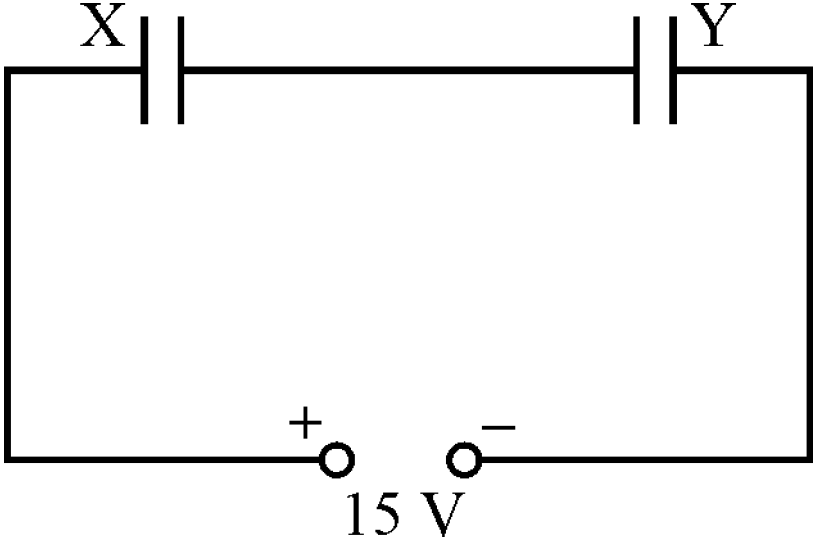
Two parallel plate capacitors X and Y have the same area of plates and same separation between them. X has air between the plates while Y contains a dielectric medium of $\varepsilon_{\text{r}} = 4.$

  1. Calculate capacitance of each capacitor if equivalent capacitance of the combination is $4\mu\text{f}.$
  2. Calculate the potential difference between the plates of X and Y.
  3. Estimate the ratio of electrostatic energy stored in X and Y.
A steel rod is rigidly clamped at its two ends. The rod is under zero tension at 20°C. If the temperature rises to 100°C, what force will the rod exert on one of the clampa? Area of Cross section of the rod = 2.00mm2. Coefficient of linear expansion of steel  12.0 × 10⁻⁶ °C-1 and Young's modulus of steel = 2.00 × 10¹¹N m-2.
Answer the following questions:
  1. In a double slit experiment using light of wavelength 600 nm, the angular width of the fringe formed on a distant screen is 0.1o. Find the spacing between the two slits.
  2. Light of wavelength 5000 Å. Propagating in air gets partly reflected from the surface of water. How will the wavelengths and frequencies of the reflected and refracted light be affected?
Find the energy liberated in the reaction:
223Ra → 209Pb + 14C.
The atomic masses needed are as follows.
223Ra 209Pb 14C
22.018u 208.981u 14.003u
State Kirchhoff's laws and explain them by giving examples.###Explain that first law of Kirchhoff is equivalent to law of conservation of charge and the second law is a descriptive form of Ohm's law.###For a current carrying conductor, write Kirchhoff's laws of charge and energy conservation.