Question
What is Huckel's rule of aromaticity?
Answer

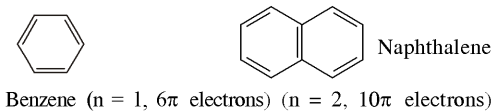
According to Huckel if in any ring $(4 n+2) \pi$ electrons are present, compound possess aromatic property. Here n is integer whose value is $0,1,2,3 \ldots$. etc. Hence in ring $2 \pi, 6 \pi, 10 \pi$ and $14 \pi$ electrons can be present.
Example :
Image

Need a full question paper?

Generate a complete, print-ready paper with questions like this in minutes — across 16+ boards, with answer keys.

Start Generating Free

Similar questions

What are reactive intermediates? How are they generated by bond fission?
18.0g of water completely vapourises at 100°C and 1 bar pressure and the enthalpy change in the process is 40.79kJ mol–1. What will be the enthalpy change for vapourising two moles of water under the same cond tions? What is the standard enthalphy of vapourisation for water? 
Identify the redox reactions out of the following reactions and identify the oxidising and reducing agents in them.
$\text{HgCl}_2\text{(aq)}+2\text{KI(aq)}\xrightarrow{ \ \ \ \ \ \ \ }\text{HgI}_2\text{(s)}+2\text{KCl(aq)}$
Give the method to detect sulphur in organic compound and how it is detected when nitrogen and sulphur both are present in compound.
Calculate the energy per photon associated with the following radiations:
  1. Radiation of frequency = 3 × 10¹⁵ s-1
  2. Radiation of wavelength = 40nm.
(h = 6.62 × 140-34Js; c = 3 × 108ms-1)
Give IUPAC name of the following:

  1.  

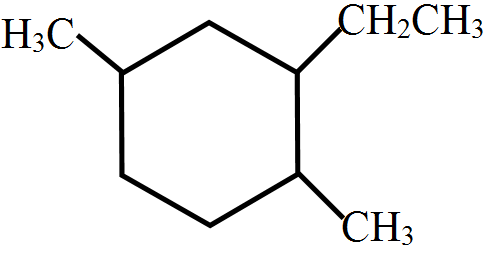
$\ \ \ \ \ \ \ \ \ \ \ \ \stackrel{8\ \ \ \ }{\text{CH}_2}-\stackrel{9\ \ \ \ }{\text{CH}_3}\ \ \ \ \ \ \ \ \ \ \ \ \ \text{CH}_3\ \ \ \text{CH}_2-\text{CH}_3\\\ \ \ \ \ \ \ \ \ \ \ \ \ \ |\ \ \ \ \ \ \ \ \ \ \ \ \ \ \ \ \ \ \ \ \ \ \ \ \ \ \ \ \ \ \ \ \ \ |\ \ \ \ \ \ \ \ \ | \\\text{CH}_3-\text{CH}-\text{CH}_2-\text{CH}_2-\text{CH}-\text{CH}-\text{CH}_2-\text{CH}_3\\\ \ \ \ \ \ \ \ \ \ \ \ \ \ ^{7\ \ \ \ \ \ \ \ \ \ \ \ \ 6\ \ \ \ \ \ \ \ \ \ \ \ \ \ \ 5\ \ \ \ \ \ \ \ \ \ \ \ \ \ \ 4\ \ \ \ \ \ \ \ \ \ \ \ \ \ \ 3\ \ \ \ \ \ \ \ \ \ \ \ \ \ \ 2\ \ \ \ \ \ \ \ \ \ \ \ \ \ 1}$
  1.  

Write the structural formula of following compounds :
(i) Neopentyl isocyanide
(ii) Isopentyl alcohol
(iii) Ethylisopropyl ketone
(iv) Isopropyl methyl acetylene
Br2 + 2Cl- → Cl2 + 2Br-, will this reaction take place or not?
$\text{E}^0_\frac{\text{Br}_2}{\text{Br}^-}=+1.09\text{V}$
$\text{E}^0_\frac{\text{Cl}_2}{\text{Cl}^-}=+1.36\text{V}$
Consider the elements:
Cs, Ne, I and F
Identify the element which exhibits neither the negative nor does the positive oxidation state.
  1. Name the most metallic element in second period and most non-metallic element.
  2. Name the element with (a) largest atomic radius, (b) smallest atomic radius in third period.
  3. Name the element having general electronic configuration ns2 np4 in fourth period.