Question
What is interference of light? Find an expression for fringe width in 'Young's double slit experiment.
Answer

When two waves of light having same frequency and same ampliitude propagate in a medium simultaneously in the same direction then due to their superposition the resultant intensity in the region of superposition is, in general, different from the sum of intensities due to each wave separately. This modification in the distribution of intensity of light in region of superposition is called interference. In the region of superposition there are certain points at which waves superimpose in such a way that resultant intensity is greater than the sum of intensities due to separate waves. Interference at such points is called constructive interference. At other points in the region of superposition the resultant intensity is less than the sum of intensities due to separate waves and interference at these points is called as destructive interference.
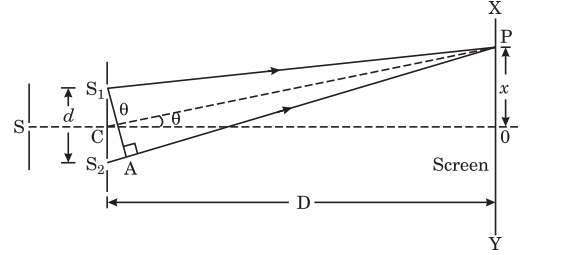
Expression for Fringe Width : In Fig. S is a narrow slit illuminated by monochromatic light. S1 and S2 are two parallel narrow slits placed very close to each other. Each of S₁ and S₂ is at equal distance from S. The light waves from S reach at S1 and S2 in the same phase.
Image
According to Huygen's principle, S1 and S2 act as new light-sources from which secondary wavelets originate. These wavelets form interference fringes on a screen XY placed at a distance D from double slit arrangement. S1S2, i.e., CO = D. Suppose the distance between the two slits is d i.e., S1S2 = d.
Let the right bisector CO of distance S1S2 meet the screen XY at a point. D and let P be a point on the screen at a distance x from O, where both waves starting from S1 and S2 reach simultaneously, traversing different distances S1P and S2P. Hence the path difference between them is $\left( S _2 P - S _1 P \right)$. Let a perpendicular S1A be drawn from S1 on S2P. Then S2A will be equal to the path difference between two waves. Therefore,
$\left( S _2 P - S _1 P \right)= S _2 A$.
The right angled triangles $\triangle S _1 AS _2$ and $\triangle POC$ are similar. Therefore
$\frac{ S _2 A}{ S _1 S_2}=\frac{ OP }{ CP }$
The distance CO is large in comparison to S1S2 and so CP may be taken equal to CO.
$\therefore \quad \frac{ S _2 A}{ S _1 S_2}=\frac{ OP }{ CO } \Rightarrow \frac{ S _2 A}{d}=\frac{ x }{ D }$
$\therefore \quad S _2 A=\frac{ x d }{ D }$
i.e. Path difference $=\frac{x d}{D}$
Now, according to the value of path difference bright or dark fringes will be obtained at P.
Locations of Bright Fringes : Bright fringes will be obtained at those points on the screen where the path difference between two interfering light waves will be 0, $\lambda, 2 \lambda, \ldots$ ... Hence for constructive interference i.e. bright fringe, we have
Path difference $\frac{x d}{ D }=m \lambda$
(where $m=0,1,2,3, \ldots$ )
$\Rightarrow \quad x = m \left(\frac{ D \lambda}{ d }\right)$ ...(1)
Thus equation (1) gives the location of mth bright fringe.
Hence the location of various bright fringes will be as follows :
For $m=0$; $x_0=0$
which is the position of central bright fringe which is called zero order bright fringe also.
For m = 1 ; $x_1= D \lambda / d$
which gives the location of first bright fringe.
For m = 2 ; $x_2=2 D \lambda / d$
which gives the location of second bright fringe and so on.
Location of Dark Fringes : Dark fringes will be obtained at those points on the screen where the path difference between two interfering light waves will be $\lambda /$ $2,3 \lambda / 2,5 \lambda / 2, \ldots$ ... Hence for destructive interference i.e., dark fringe, we have
Path difference : $\frac{x d}{ D }=(2 m-1) \frac{\lambda}{2}$
(where $m=1,2,3, \ldots$.)
$\Rightarrow \quad x=\frac{(2 m-1) D \lambda}{2 d}$ ...(2)
Thus, equation (2) gives the location of mth dark fringe.
Hence the locations of various dark fringes will be as follows :
For $m=1$ ; $x_1=\frac{ D \lambda}{2 d}$,
which gives the location of first dark fringe.
For $m=2$; $x_2=\frac{3 D \lambda}{2 d}$.
which gives the location of second dark fringe.
For $m=3$; $x_3=\frac{5 D \lambda}{2 d} ;$
which gives the location of third dark fringe and so on.
From the above discussion about the location of bright and dark fringes it is obvious that the bright and dark fringes are located alternately in interference pattern.
Fringe Width : Since it is equal to the distance between two consecutive bright or dark fringes, hence if $x_n$ and $x_{n+1}$ be the distances of the $n$th and $(n+1)$ th fringes respectively then fringe width :
$W =x_{n+1}-x_n$
For mth bright fringe :
$x_m=\frac{m D \lambda}{d}$
$\Rightarrow \quad x_n=\frac{n D \lambda}{d}$ and $x_{n+1}=\frac{(n+1) D \lambda}{d}$
$\therefore \quad W =x_{n+1}-x_n$
$\Rightarrow \quad W =\frac{(n+1) D \lambda}{d}-\frac{n D \lambda}{d}$
$\Rightarrow \quad W =\frac{ D \lambda}{ d }$ ...(3)
For mth dark fringe :
$x_m=\frac{(2 m-1) D \lambda}{d}$
$\Rightarrow \quad x_n=\frac{(2 n-1) D \lambda}{d}$
and $x_{n+1}=\frac{\{2(n+1)-1\} D \lambda}{2 d}$
$\Rightarrow \quad x_{n+1}=\frac{(2 n+1) D \lambda}{2 d}$
$\therefore \quad W =x_{n+1}-x_n$
$\Rightarrow \quad W =\left[\frac{(2 n+1) D \lambda}{2 d}\right]-\left[\frac{(2 n-1) D \lambda}{2 d}\right]$
$\Rightarrow \quad W =\frac{ D \lambda}{ d }$ ...(4)
From equations (3) and (4) it is obvious that the bright and dark fringes are of equal fringe width.
In this way in interference pattern obtained on the screen bright and dark fringes are equally spaced in alternate order.

Need a full question paper?

Generate a complete, print-ready paper with questions like this in minutes — across 16+ boards, with answer keys.

Start Generating Free

Similar questions

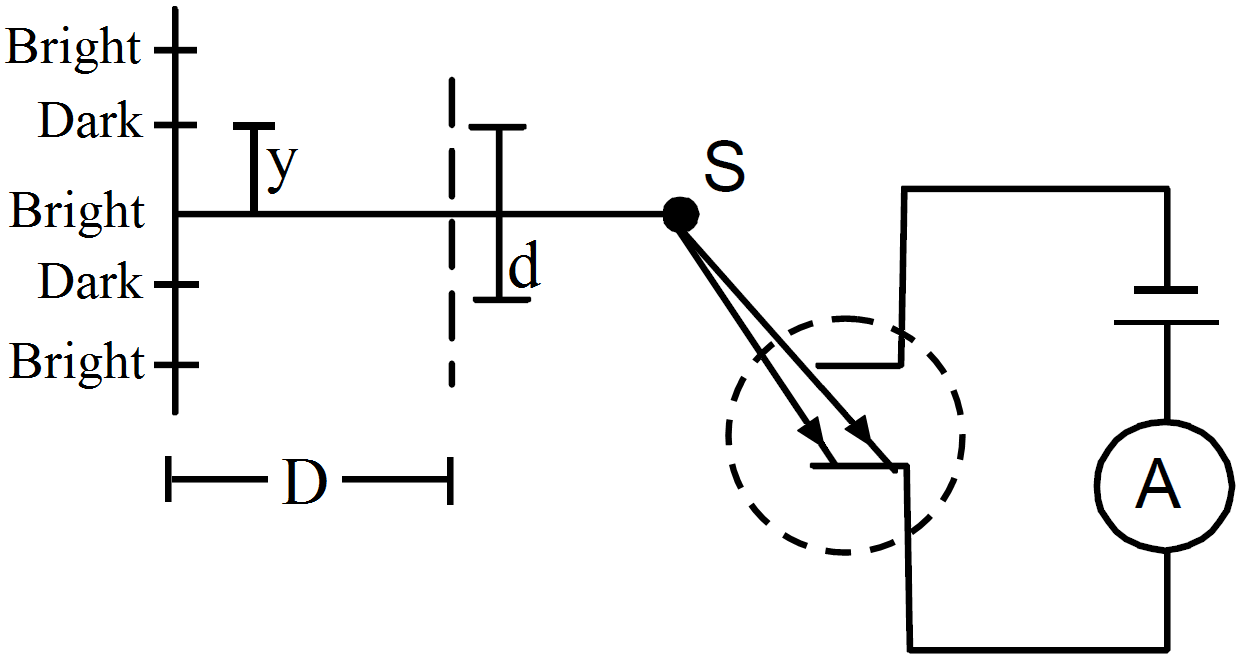
In the arrangement shown in figure y = 1.0mm. d = 0.24mm end D = 1.2m. The work function of the materiel of the emitter is 2.2eV. Find the stopping potential V needed to stop the photocurrent.

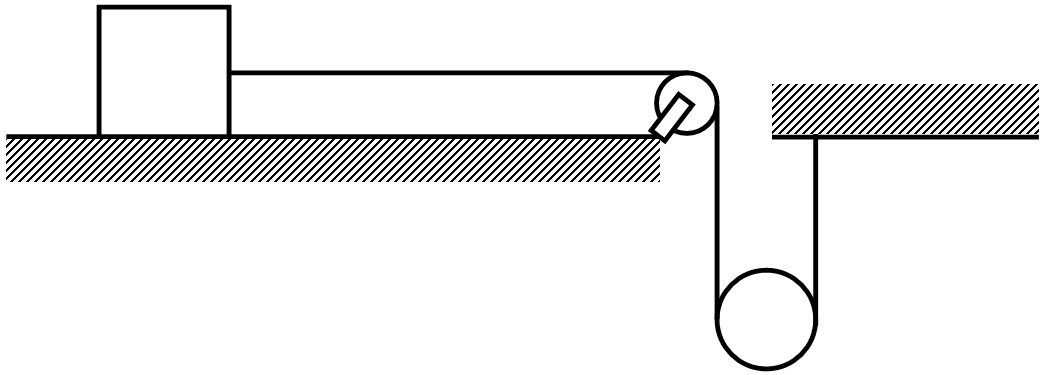
The descending pulley shown in figure has a radius 20cm and moment of inertia 0.20kg-m2. The fixed pulley is light and the horizontal plane frictionless. Find the acceleration of the block if its mass is 1.0kg.

Two cells of voltage 10V and 2V and internal resistances 10Ω and 5Ω respectively, are connected in parallel with the positive end of 10V battery connected to negative pole of 2V battery (Fig). Find the effective voltage and effective resistance of the combination.

Take $\text{C}_1=4.0\mu\text{F}$ and $\text{C}_2=6.0\mu\text{F}$ in figure. Calculate the equivalent capacitance of the combination between the points indicated.


a. Draw the diagram of a device which is used to decrease high ac voltage into a low ac voltage and state its working principle. Write four sources of energy loss in this device.
b. A small town with a demand of 1200 kW of electric power at 220 V is situated 20 km away from an electric plant generating power at 440 V . The resistance of the two wire line carrying power is $0.5 \Omega per km$. The town gets the power from the line through a $4000-220 V$ step-down transformer at a sub-station in the town. Estimate the line power loss in the form of heat
Calculate the smallest wavelength of radiation that may be emitted by (a) hydrogen, (b) He+ and (c) Li++
A beam of monochromatic light of wavelength $\lambda$ ejects photoelectrons from a cesium surface $\big(\Phi=1.9\text{eV}\big).$ These photoelectrons are made to collide with hydrogen atoms in ground state. Find the maximum value of $\lambda$ for which (a) hydrogen atoms may be ionized, (b) hydrogen atoms may get excited from the ground state to the first excited state and (c) the excited hydrogen atoms may emit visible light.
A uniform disc of radius r is to be suspended through a small hole made in the disc. Find the minimum possible time period of the disc for small oscillations. What should be the distance of the hole from the centre for it to have minimum time period?
The electric field in a region is given by $\overrightarrow{\text{E}}=\frac{\text{E}_0\text{x}}{\text{l}}\vec{\text{i}}.$ Find the charge contained inside a cubical volume bounded by the surfaces x = 0, x = a, y = 0, y = a, z = 0 and z = a. Take E0 = 5 × 10³Nc-1, l = 2cm and a = 1cm.
The short-wavelength limit shifts by 26pm when the operating voltage in an X-ray tube is increased to 1.5 times the original value. What was the original value of the operating voltage?