Question
What is interference of light? Write two essential conditions for sustained interference pattern to be produced on the screen.
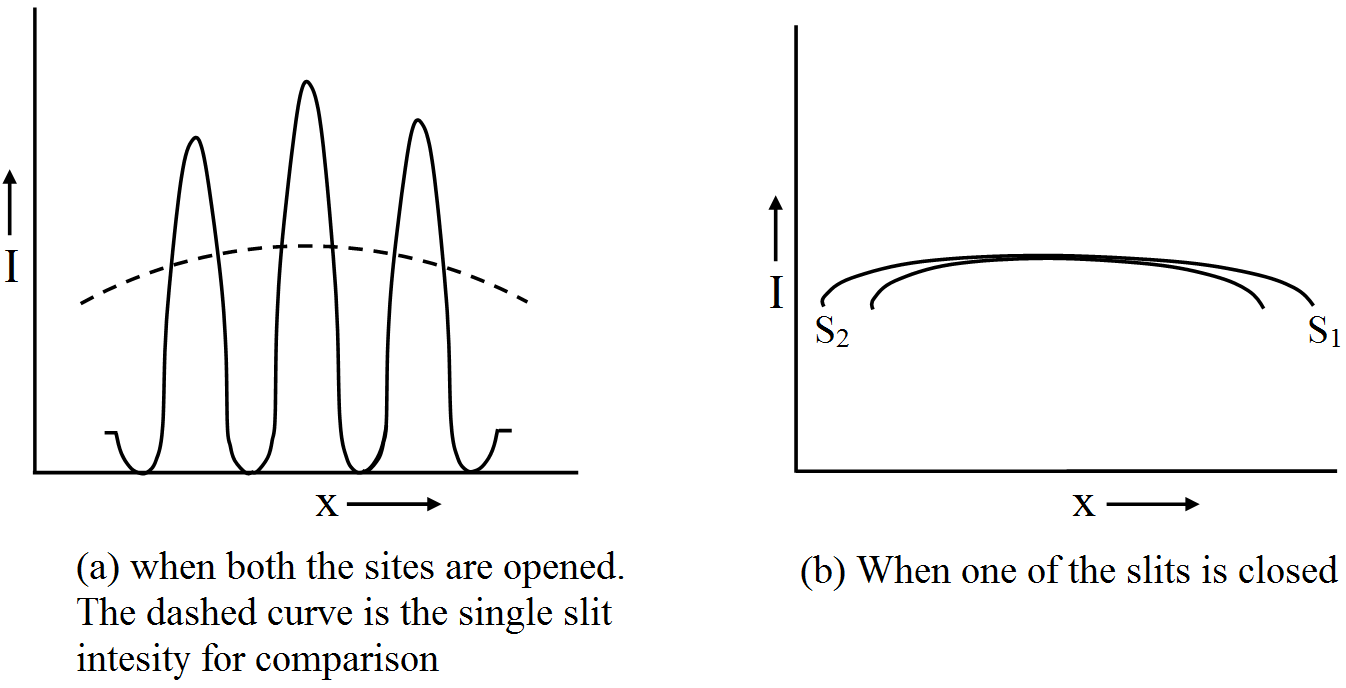
Draw a graph showing the variation of intensity versus the position on the screen in Young’s experiment when (a) both the slits are opened and (b) one of the slits is closed.
What is the effect on the interference pattern in Young’s double slit experiment when:
  1. Screen is moved closer to the plane of slits?
  2. Separation between two slits is increased?
Explain your answer in each case.

Answer

Interference of light: When two waves of same frequency and constant initial phase difference travel in the same direction along a straight line simultaneously, they superpose in such a way that the intensity of the resultant wave is maximum at certain points and minimum at certain other points. This phenomenon of redistribution of energy due to superposition of two waves of same frequency and constant initial phase difference is called interference
Conditions for Sustained Interference of Light Waves:

To obtain sustained (well-defined and observable) interference pattern, the intensity must be maximum and zero at points corresponding to constructive and destructive interference. For the purpose following conditions must be fulfilled:

  1. The two interfering sources must be coherent and of same frequency, i.e., the sources should emit light of the same wavelength or frequency and their initial phase should remain constant. If this condition is not satisfied the phase difference between the interfering waves will vary continuously. As a result the resultant intensity at any point will vary with time being alternately maximum and minimum, just like the phenomenon of beats in sound.
  2. The interfering waves must have equal amplitudes. Otherwise the minimum intensity will not be zero and there will be general illumination.

The variation of intensity I versus the position x on the screen in Young’s experiment. Fringe width, $\beta=\frac{\text{D}\lambda}{\text{d}}.$

  1. $\text{B}\alpha\text{D},$ therefore with the decrease of separation between the plane of slits and screen, the fringe width decreases.
  2. On increasing the separation between two slits (d), the fringe separation decreases as β is inversely proportional to d $(\text{i.e.,}\beta\alpha\frac{1}{\text{d}}.)$

Need a full question paper?

Generate a complete, print-ready paper with questions like this in minutes — across 16+ boards, with answer keys.

Start Generating Free

Similar questions

The optical properties of a medium are governed by the relative permitivity $(\in_\text{r})$ and relative permeability $(\mu_\text{r})$. The refractive index is defined as $\sqrt{\mu_\text{r}\in_\text{r}}=\text{n}$.For ordinary material $\in_\text{r}=0\text{ and }\mu_\text{r}<0$ and the positive sign is taken for the square root. In 1964, a Russian scientist V. Veselago postulated the existence of material with $\in_\text{r}=0\text{ and }\mu_\text{r}<0$. Since then such 'metamaterials' have been produced in the laboratories and their optical properties studied. For such materials $\text{n}=-\sqrt{\mu_1\in_1}$. As light enters a medium of such refractive index the phases travel away from the direction of propagation.
  1. According to the description above show that if rays of light enter such a medium from air (refractive index = 1) at an angle ? In 2nd quadrant, them the refracted beam is in the 3rd quadrant.
  2. Prove that Snell's law holds for such a medium.
A particle slides on the surface of a fixed smooth sphere starting from the topmost point. Find the angle rotated by the radius through the particle, when it leaves contact with the sphere.
Explain the concept of energy bands with a figure.
A compound microscope has a magnifying power of 100 when the image is formed at infinity. The objective has a focal length of 0.5cm and the tube length is 6.5cm. Find the focal length of the eyepiece.
Two identical pith balls, each carrying a charge q, are suspended from a common point by two strings of equal length l. Find the mass of each ball if the angle between the strings is $2\theta$ in equilibrium.
One day Chetan’s mother developed a severe stomach ache all of a sudden. She was rushed to the doctor who suggested for an immediate endoscopy test and gave an estimate of expenditure for the same. Chetan immediately contacted his class teacher and shared the information with her. The class teacher arranged for the money and rushed to the hospital. On realising that Chetan belonged to a below average income group family, even the doctor offered concession for the test fee. The test was conducted successfully.
Answer the following questions based on the above information:
  1. Which principle in optics is made use of in endoscopy?
  2. Briefly explain the values reflected in the action taken by the teacher.
  3. In what way do you appreciate the response of the doctor on the given situation?
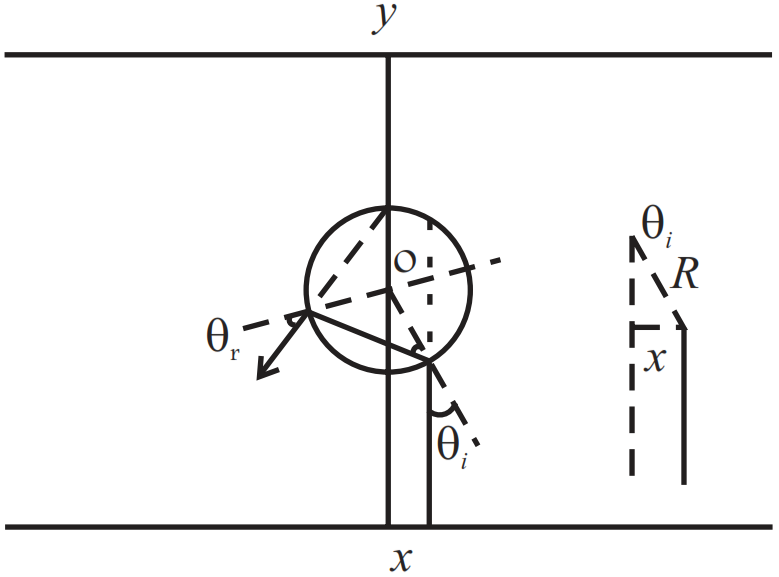
An infinitely long cylinder of radius R is made of an unusual exotic material with refractive index -1 (Fig). The cylinder is placed between two planes whose normals are along the y direction. The center of the cylinder O lies along the y-axis. A narrow laser beam is directed along the y direction from the lower plate. The laser source is at a horizontal distance x from the diameter in the y direction. Find the range of x such that light emitted from the lower plane does not reach the upper plane.

Light is incident from glass $(\mu=1.50)$ to water $(\mu=1.33).$ Find the range of the angle of deviation for which there are two angles of incidence.
An aluminium plate fixed in a horizontal position has a hole of diameter 2.000cm. A steel sphere of diameter 2.005cm rests on this hole. All the lengths refer to a temperature of 10°C. The temperature of the entire system is slowly increased. At what temperature willl the ball fall down? Coefficient of linear expansion of aluminium is 23 × 10-6 °C-1 and that of steel is 11 × 10-6 °C-1.
A particle of mass m is kept on the top of a smooth sphere of radius R. It is given a sharp impulse which imparts it a horizontal speed v.
  1. Find the normal force between the sphere and the particle just after the impulse.
  2. What should be the minimum value of v for which the particle does not slip on the sphere?
  3. Assuming the velocity v to be half the minimum calculated in part.
  4. Find the angle made by the radius through the particle with the vertical when it leaves the sphere.