Question
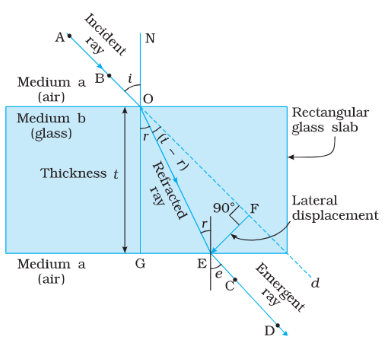
What is lateral displacement? Show that a ray incident obliquely on a rectangular glass slab, emerges parallel to the incident ray
Answer

$\rightarrow$ Place a glass slab on a plane sheet of paper fixed on a drawing board.
$\rightarrow$ Draw its boundary.
$\rightarrow$ Fix two pins A and B on one side of the slab.
$\rightarrow$ Look through the opposite side of the slab and fix two pins C and D in such a way that all the four pins A, B, C and D appear to be in a straight line.
$\rightarrow$ CD is the emergent ray. Let it subtend an angle e with the normal.
$\rightarrow$ In the first refraction from medium a (air) to medium b (glass), i is the angle of incidence and r is the angle of refraction.
$n_{ ba }=\frac{\sin t}{\sin r}\ldots\ldots (1)$
Image
In the second refraction at E, the angle of incidence in medium bis r and the angle of refraction in medium a is e.
$ n_{ab}=\frac{\sin r}{\sin e} \ldots\ldots (2)$
From (1) and (2), we have
$ n_{ba} \times n_{ab}=\frac{\sin i}{\sin r} \times \frac{\sin r}{\sin e} $
But $n_{ ba } \times n_{ ab }=1$, according to the principle of reversibility.
$\begin{array}{l}\text { Hence, } \quad 1=\frac{\sin t}{\sin e} \\ \therefore \sin i=\sin e \\ \therefore i=e\end{array}$
Thus, the angle of emergence is equal to the angle of incidence. Therefore, incident ray produced (or extended), i.e., AOd is parallel to emergent ray CD.
Thus, the emergent ray is parallel to the incident ray, but displaced sideways as shown in the figure. This sideways displacement FE is known as lateral displacement.

Need a full question paper?

Generate a complete, print-ready paper with questions like this in minutes — across 16+ boards, with answer keys.

Start Generating Free

Similar questions

Samples of four metals $A, B, C$ and $D$ were taken and added to the following solution one by one. The results obtained have been tabulated as follows:
Metal Iron $(II)$ sulphate Copper $(II)$ sulphate Zinc sulphate Silver nitrate
$A$ No reaction Displacement    
$B$ Displacement   No reaction  
$C$ No reaction No reaction No reaction Displacement
$D$ No reaction No reaction No reaction No reaction
Use the table above to answer the following questions about metals $A, B, C$ and $D$: $(1)$ Which is the most reactive metal? $(2)$ What would you observe if $B$ is added to a solution of copper $(II)$ sulphate? $(3)$ Arrange the metals $A, B, C$ and $D$ in the order of decreasing reactivity.
Write a short note: Alloy
State the types of movement in plants with examples.
Explain the reactions of metals such as potassium $(K)$, sodium $(Na)$, magnesium $(Mg)$, aluminium $(Al)$, zinc $(Zn)$, lead $(Pb)$, iron $(Fe)$, copper $(Cu)$, silver $(Ag)$ and gold $(Au)$ with oxygen.
Everyone should have knowledge about his/her blood group as well as the blood group of family members. There are four blood group A, B, AB and O.
You consult your family doctor and get more knowledge about blood group.
(1) How is the knowledge of blood grouping essential?
(2) Whether the blood group of an individual is a hereditary character or an acquired character?
(3) Whether the son inherits blood group from his father and the daughter inherits blood group from her mother?
(4) Whether the blood group of the offspring is under the influence of both the parents (father and mother)?
(5) Whether the genes of blood groups have their dominant and recessive expression?
(1) Write the electron-dot structures for sodium, oxygen and magnesium.
(2) Show the formation of Na2O and MgO by the transfer of electrons.
(3) What are the ions present in these compounds?
Write a short note on the force acting on a current-carrying conductor placed in an external magnetic field.
Explain the extraction of metals low in the reactivity series.
Write short note on ‘Electric fuse’.
Explain Binary fission in amoeba and multiple fission in Plasmodium.